
It is one of the first things you grab when you step aboard, and yet it is rarely chosen deliberately. The helm transmits your intentions to the rudder, the submerged blade that turns the boat. Two main families share the cockpits: the tiller, a simple lever fitted to the head of the rudder stock, and the wheel, a helm linked to the rudder by a transmission system. Each has its own logic, its enthusiasts and its trade-offs. Whether you are choosing a boat, thinking of switching systems or simply want to understand your own better, this guide reviews everything that sets them apart.
1. How it works
It all starts with the rudder, pivoting around a vertical axis called the stock. Turning that stock angles the rudder, which deflects the flow of water and turns the boat. The difference between the two systems lies only in how the stock is turned.
The tiller is a lever fixed directly to the head of the stock. Push it to the right and the boat heads left: the link is mechanical, immediate, with no go-between. The wheel inserts a transmission between the helm and the stock — most often steering cables that wind onto a drum and pull on a quadrant, sometimes a rod or hydraulic system on larger boats. This transmission multiplies your effort, but adds intermediate parts.
2. The tiller: its strengths
Its strong suit comes down to one word: feel. Because nothing stands between your hand and the rudder, you sense the water pressure, the smallest gust, the balance of the boat. This direct information allows fine trimming and instinctive steering, greatly valued under sail and in racing.
- Simplicity and reliability: few parts, so few failures. A tiller almost never "lets go".
- Weight and price: light and economical, both to buy and to repair.
- Repairable at sea: a broken lever can be replaced or lashed up with a piece of wood and some line.
- Simple autopilot: a tiller autopilot ram is cheap and easy to unclip.
In return, the tiller sweeps across the cockpit from side to side, which hampers movement and the fitting of a table. On a heavy boat or in a seaway, the effort required can become tiring over long hours — hence the frequent use of a tiller extension to steer upwind, standing and out to the rail.
On a tiller, trim your sails first to balance the boat: a well-trimmed yacht barely pulls on the helm. If you have to fight it constantly, the tiller is not to blame — you are carrying too much sail or your mainsail / genoa balance is off.
3. The wheel: its strengths
The wheel brings above all comfort and mechanical advantage. Thanks to the gearing ratio, a few turns are enough to swing a rudder of several square metres without superhuman effort. That is what makes it essential on heavy cruising yachts and large boats.
- Clear cockpit: the pedestal is easy to walk around, you move freely and can fit a fixed table.
- High steering position: standing behind the wheel you see the sails, the bow and the water better.
- Reduced effort: ideal for holding the helm for long stretches on a powerful boat.
- Integrated instruments: the pedestal houses the compass, repeaters and autopilot control.
The downside is complexity. Cables, sheaves, quadrant and bearings wear and need regular checking. The feel is filtered: you lose the fine information of the tiller. Finally the whole assembly is heavier, more expensive, and a transmission failure means switching to the emergency tiller.
4. The full comparison
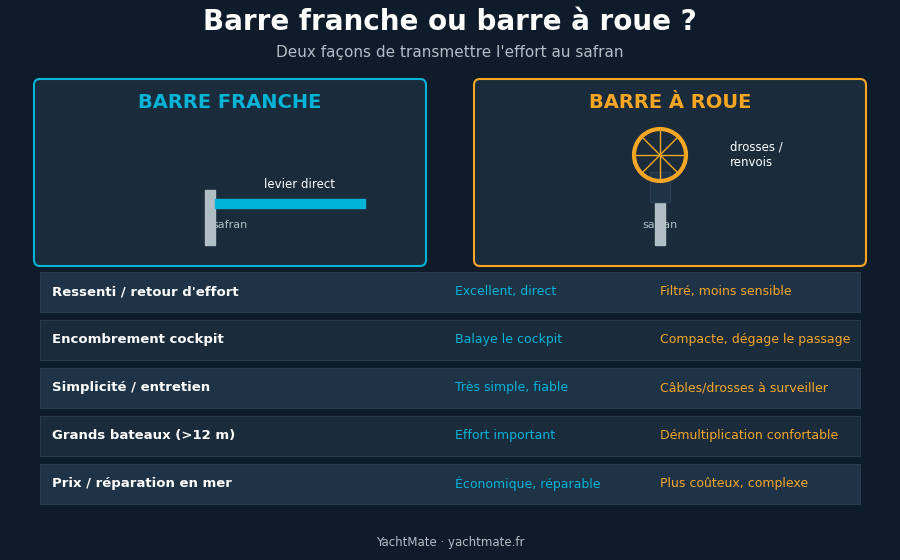
Neither system is better in absolute terms: it all depends on the boat and how you sail. Here are the main decision criteria.
Feel and pleasure at the helm
Clear advantage to the tiller, whose direct link transmits every nuance of the sea. Fans of sporty sailing and racers stay loyal to it for that reason.
Comfort and long passages
Advantage to the wheel on heavy boats: reduced effort, a comfortable standing position and better visibility for the watches that drag on.
Harbour manoeuvres
A draw, with different logics. The tiller gives an instant response and an immediate read of the rudder angle, precious in tight spaces. The wheel lets you steer standing while watching bow and stern during docking.
Reliability and maintenance
Advantage to the tiller: little or nothing to maintain. The wheel demands periodic checks of the cables and quadrant, just as the running rigging needs its own.
5. How to choose in practice
Boil it down to three concrete factors: the size and weight of the boat, your sailing programme and the pleasure you are after.
- Up to 10-11 metres, cruising or sporty sailing: the tiller is light, reliable, economical and rewarding. It is often the best choice for a first boat, as we discuss in our guide to choosing your first sailboat.
- Heavy cruising, large yacht, family crew: the wheel wins on comfort and reduced effort over long hours.
- Catamaran: almost always a wheel, often offset on a raised helm station for visibility — a point covered in our catamaran versus monohull comparison.
- Mixed programme: some boats offer twin wheels that free the passage to the stern while keeping two helm stations to windward.
The best helm is the one that matches your boat and the way you sail. The same sailor may love a tiller on an 8-metre daysailer and bless the wheel on a 14-metre cruising cutter.
6. Maintenance and safety
Whatever the system, the steering chain is one of the vital organs on board. On a tiller, check the stock-head pin, the tightness of the lever and the absence of play; grease the joint and inspect the stock and its bearings.
On a wheel, regularly check the tension and condition of the cables (broken strands, rust spots), the proper running of the sheaves and the quadrant. Locate and keep accessible the emergency tiller: a square socket on the stock head lets you steer directly if the transmission fails. Knowing how to fit it quickly is part of your breakdown-at-sea reflexes.
Test your emergency tiller at the dock, in calm conditions, at least once a season. The day you actually need it will be too late to work out where it is stowed and how it fits.
Frequently asked questions
Is a tiller only for small boats?
Not necessarily. Tillers are common on sailboats up to 10-11 metres and on many racing boats far larger. Beyond that, the effort at the rudder becomes significant in a seaway, and a wheel — with its mechanical advantage — takes over on heavy cruising boats.
Can you fit an autopilot to a tiller?
Yes. Tiller-pilot rams are simple, affordable and easy to disconnect. On a wheel you use a drive motor on the pedestal or a ram on the quadrant, usually more powerful but more complex to install.
Which system is more reliable if something fails?
A tiller, with its direct mechanical link, has very few parts that can break and is easy to repair at sea. A wheel relies on cables, chains or rods that can fail, which is why it is almost always backed up by an emergency tiller acting directly on the rudder stock.
Hold your course with YachtMate
Heading, route, wind and marine charts in real time: whatever your steering system, plan and follow every trip with confidence.
Discover the app