
Holding the helm for hours on end under scorching sun or in rough conditions is exhausting — and dangerous with a small crew. The autopilot is arguably the single piece of equipment that most transforms comfort and safety on board, regardless of boat size. It holds a precise heading, frees your hands for navigation and manoeuvres, and even enables single-handed offshore passages. Yet many sailors still hesitate to take the plunge, lacking clear guidance on how to choose, install and operate this equipment. This guide covers everything you need to know.
How Does a Marine Autopilot Work?
An autopilot is an electronic system that automatically keeps the boat on a given heading by acting on the helm or rudder. It consists of several key components:
- The control unit (computer): the brain of the system, it receives heading data and sends correction commands.
- The fluxgate or gyroscopic compass: heading sensor that detects deviations from the desired course.
- The drive unit: electric motor or hydraulic ram that physically acts on the helm or rudder.
- The remote control: allows heading adjustments from the cockpit, usually in 1° or 10° increments.
The autopilot continuously reads the boat's magnetic heading, compares it to the set course, and corrects deviations via the drive motor. High-end models also integrate roll sensors, GPS data and NMEA 2000 inputs to anticipate corrections based on sea state and wind conditions.
Heading Mode vs. Wind Mode
Most modern autopilots offer two main modes. Magnetic heading mode maintains a fixed angle relative to magnetic north — ideal for offshore navigation or in the absence of stable wind. Wind mode (requires a connected wind instrument) maintains a constant angle relative to apparent wind direction — perfect under sail, as it adapts to wind shifts without changing the sail trim.
With the YachtMate app, you can connect your navigation instruments via NMEA and view in real time the heading held by the autopilot, your track on the chart, and deviations from your waypoint — all on your smartphone screen.
Types of Marine Autopilots
There are several families of autopilots, suited to very different boat configurations. The choice depends primarily on helm type, boat size and budget.
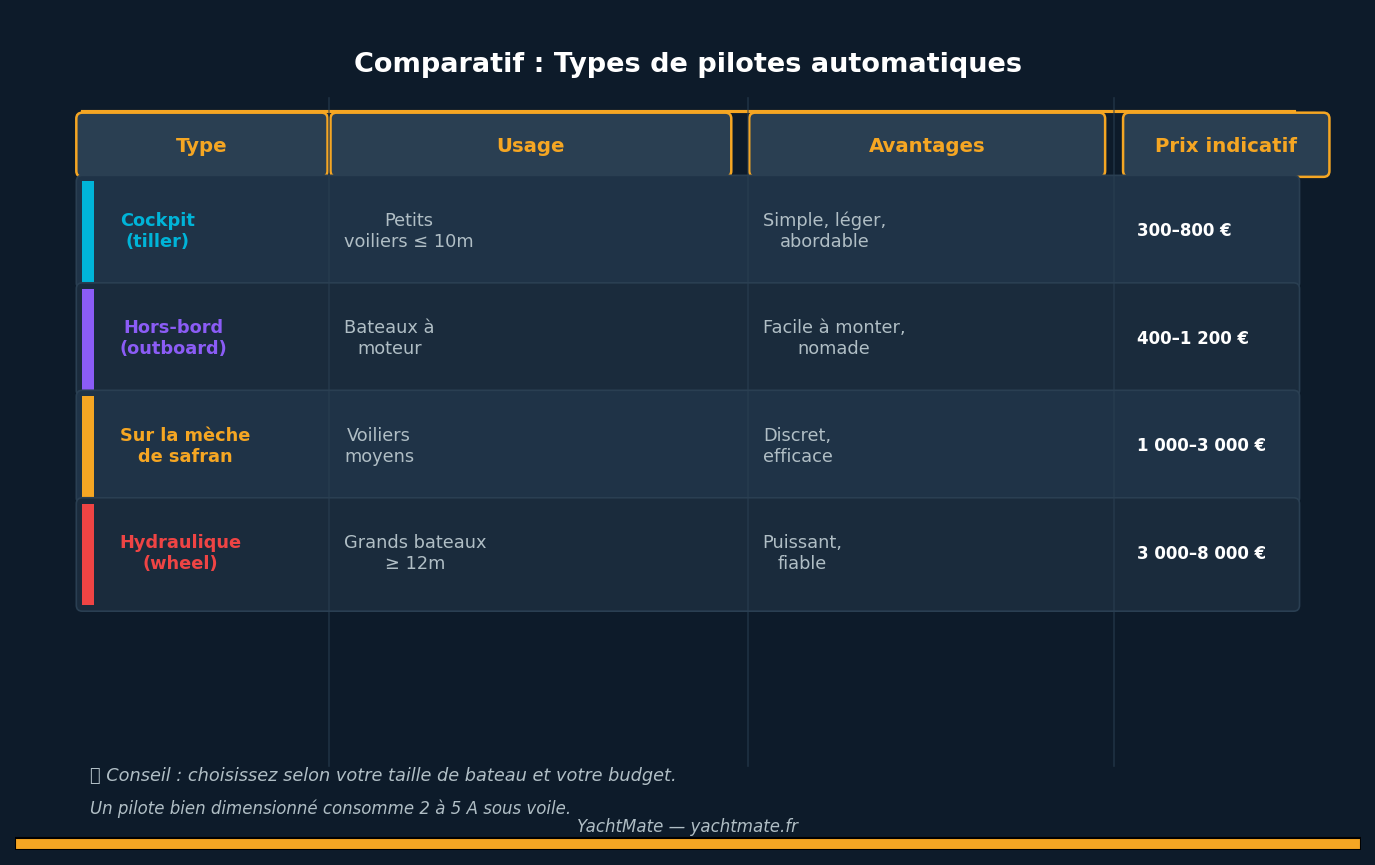
Cockpit Tiller Pilot
The simplest and most affordable option, designed for tiller-steered sailboats under 10 metres. The motor clips directly onto the tiller and acts by push or pull. Lightweight, portable and easy to self-install, it draws little power (under 2 A on average). Its limitation: it lacks power in rough seas and strong winds (Force 5-6 and above), and wears faster than integrated systems. Budget: £250–700 from brands such as Garmin, Simrad or B&G.
Outboard Autopilot
Designed for motorboats with wheel steering, this type acts on the outboard motor or trim. Portable and easy to fit, it suits RIBs and small open boats. Budget: £350–1,000. Good reliability for coastal outings, but performance degrades at high speed or in heavy swell.
Linear Drive (Rudder Stock)
This system mounts inside the boat, directly on the rudder stock via a lever arm. Discreet and more powerful than the tiller pilot, it suits wheel-steered sailboats from 9 to 14 metres. Installation requires access to the aft compartment. Price range: £900–2,500 for the complete system. The ideal choice for sailors who regularly venture beyond coastal waters.
Hydraulic Autopilot
Designed for larger boats of 12 metres and above (especially motorboats and large sailboats), the hydraulic autopilot uses a hydraulic ram acting on the existing steering circuit. Powerful, quiet and reliable, it handles difficult sea conditions without flinching. Installation is more complex and often requires a professional. Price: £2,500–7,000 excluding fitting.
Choosing the Right Autopilot
Before buying, ask yourself these key questions:
- Helm type: tiller or wheel? This directly determines which autopilot family is compatible.
- Boat size and displacement: the heavier the boat, the more powerful the drive must be.
- Sailing area: coastal or offshore? For bluewater sailing, invest in a robust and redundant system.
- Total budget: factor in purchase, installation and 5-year maintenance costs.
- Connectivity: is the autopilot NMEA 2000 compatible to communicate with your GPS, VHF and chartplotter?
When planning a passage with YachtMate, you can create a detailed route with precise waypoints, then transfer that data to your chartplotter. Your autopilot will handle each course change automatically — no manual intervention needed at each tack or gybe.
Installation: What Can You DIY?
The tiller pilot is the only installation most sailors can complete without specialist skills: simply mount the foot bracket on deck and connect the 12 V power supply to the electrical panel. For more complex systems (linear drive, hydraulic), professional help is strongly recommended. Critical points to watch:
- Electrical supply: follow the cable sizing specified by the manufacturer. An undersized cable will overheat and lose performance.
- Fluxgate compass position: keep it well away from magnetic interference sources (engine mass, high-voltage cables, stainless steel rudder stock).
- Drive placement: ensure sufficient travel and avoid binding against the rudder at full lock.
- Emergency disengagement: always establish a clear procedure to disengage the autopilot manually at a moment's notice.
Settings and Calibration
A poorly calibrated autopilot will be ineffective and power-hungry. After installation, the first step is compass calibration: the boat must make full circles in flat water at slow engine speed so the computer can learn local magnetic variations. Then three response parameters need adjustment:
- Sensitivity (deadband / rudder gain): determines the amplitude of helm corrections. Too high = constant hunting and high power consumption; too low = the boat wanders.
- Counter rudder: damps oscillations. Increase it in choppy seas.
- Response speed: adjust to point of sail (slow in light airs, faster when beating hard).
The golden rule: calibrate in calm conditions, then fine-tune gradually in stronger conditions. A well-calibrated autopilot should be almost invisible in operation — making small frequent corrections rather than large, infrequent ones.
Power Consumption: A Key Consideration
An autopilot is one of the biggest power consumers on board during extended passages. On average, a tiller pilot draws 1–3 A, a linear drive 3–6 A, and a hydraulic unit 5–12 A depending on conditions. Over a 24-hour passage, that can mean up to 288 Ah of battery draw. Check your bank capacity and consider supplementary solar or wind generation.
YachtMate lets you monitor your onboard electrical consumption, tracking battery and solar panel performance. Combining this with autopilot use helps you anticipate charging needs before reaching your destination.
Using Your Autopilot Safely
An autopilot is a navigation aid, not a substitute for a watch. Safety rules are non-negotiable:
- Maintain a permanent lookout: the autopilot cannot detect obstacles, other vessels, fishing nets or floating debris. Stay vigilant.
- Set heading with care: verify the entered course does not lead towards a hazard (shoals, reef, shipping lane).
- Disengage manually when in doubt: learn the disengagement reflex, especially at night or in poor visibility.
- Never sleep on autopilot without a watch on deck: even when sailing solo, set regular alarms every 15–20 minutes.
- Regularly check the heading held by comparing the GPS track with the chart.
"The best autopilot is the one you can disengage instantly. Learn that action before you leave the dock."
Maintenance and Common Faults
A well-maintained autopilot can last 10 to 15 years. Routine maintenance includes rinsing with fresh water after every sea passage, lubricating the drive's mechanical linkages, checking electrical connections for corrosion, and updating firmware when available. The most common faults are linked to connector corrosion, drive motor wear (after several thousand hours), and compass derangement following an impact or proximity to magnetic objects.
If the autopilot hunts (oscillates either side of the heading without correcting), start by recalibrating the compass and increasing rudder gain. If corrections are too aggressive, reduce sensitivity. A "drive stall" error message indicates the mechanical travel may be blocked or the 12 V supply is unstable — check both before anything else.
Navigate with confidence using YachtMate
Plan your route, track your heading and manage your instruments from a single app. YachtMate is the navigation app designed for pleasure boaters — available on iOS and Android.
Discover YachtMate →