

Your sailboat's running rigging — the complete set of movable lines — is one of the most heavily loaded systems on board. Halyards, sheets, reefing lines, boom vangs, cunninghams: each element bears considerable loads and degrades gradually under UV, abrasion and mechanical fatigue. A worn line can fail at the worst moment, in a sudden squall or during a tricky maneuver.
This practical guide will help you understand the role of each line, choose the right materials, build an effective maintenance schedule and know when to replace before failure.
Understanding Running Rigging
We distinguish standing rigging (stays, shrouds, spreaders — fixed, in stainless steel) from running rigging, which encompasses all the movable lines. The latter divides into two families:
- Halyards: mainsail, genoa, spinnaker, staysail halyards — they hoist and lower the sails.
- Control lines: mainsail and genoa sheets, reefing lines, boom vang, cunningham, outhaul, lazy bag — they trim and position the sails.
Each line is sized according to the sail area it handles, the type of boat, and the usage profile (racing vs. cruising). In cruising, comfort in hand and durability are prioritized; in racing, lightness and low stretch take precedence.
Materials: Dacron, Dyneema, Nylon…
Polyester (Dacron)
Polyester is the go-to cruising material, offering an excellent price-to-performance ratio. Its low stretch (3–5% elongation under working load), UV resistance and comfortable feel make it the standard for sheets and reefing lines. It degrades gradually in sunlight, but a bimini cover or careful storage can significantly extend its life.
Dyneema (UHMPE)
A high-performance fiber, Dyneema SK75 or SK99 has two to three times the tensile strength of polyester at the same diameter, at half the weight. It is virtually inelastic (<1% elongation), improving sail response. Mainly used for halyards and racing redrives, it costs three to five times more and stiffens in cold weather. It cannot be knotted — splices are required.
Nylon (Polyamide)
Highly elastic (15–25% elongation), nylon is ideal for dock lines and tow warps where shock absorption is essential. Avoid it for halyards and sheets where precise trimming is needed.
For offshore cruising, consider halyards with a Dyneema core and a polyester cover: you get the rigidity of Dyneema (good power transfer) with the polyester cover's protection against abrasion and UV. This is the ideal durability/performance compromise.
Role and Sizing of Each Line
Halyards
The mainsail halyard is the most heavily loaded: on a 10-meter sailboat, it bears 500–1,500 daN depending on sail area and wind strength. It must be sized with a minimum safety factor of 6. For such a boat, a diameter of 10–12 mm in polyester is typical. The genoa halyard is less loaded but suffers more abrasion at the masthead.
Sheets
Mainsail sheets (Ø 12–16 mm) must pass through winches without jamming or slipping. Too thin and they cut into palms and strain the winch; too thick and they are hard to trim. Genoa sheets — often the longest lines on board — experience significant return angles at clutches and genoa cars: they are usually the first to wear at these friction points.
Reefing Lines
A properly sized reefing line (Ø 8–10 mm for a 10-meter boat) allows you to take a reef quickly, even in rough weather. Many sailors keep them too long: a thinned reefing line can break exactly when you need it most — in a gale.
Other Control Lines
The boom vang controls the leech of the mainsail and prevents the boom from rising on a downwind run. It works in both compression and tension and often includes a block-and-tackle purchase system. The cunningham adjusts luff tension on the mainsail to shape it for different wind conditions. These two lines are less UV-exposed than halyards and typically last longer, but must be inspected at friction points.
Running Rigging Maintenance
Season-Start Inspection
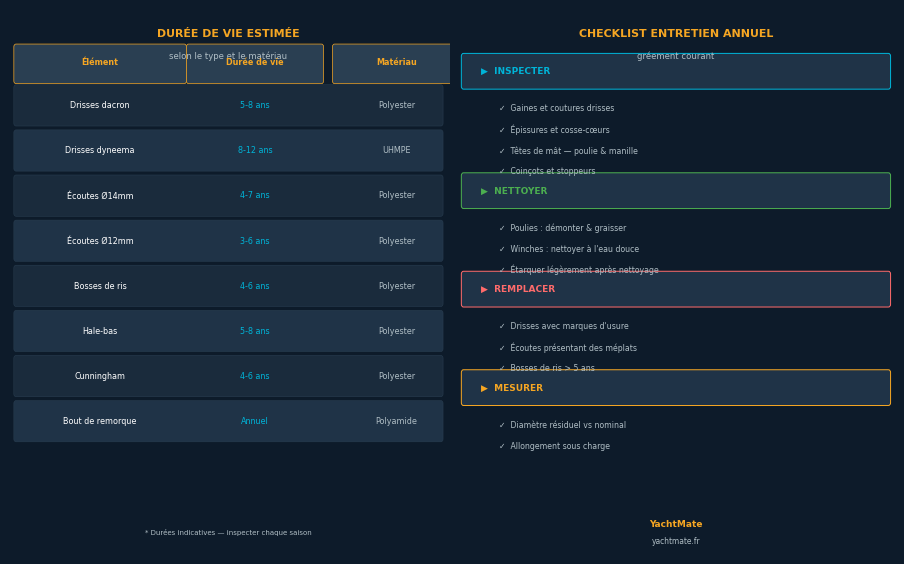
Each spring, before your first sail, run the entire running rigging through your hands, metre by metre. Look for:
- Flat spots: areas where the rope has been crushed (under load in a jammed clutch, for example). The cross-section is no longer round; strength is reduced by 20–40%.
- Local stiffness: rigid cover, slipped core, compression zones.
- Broken cover yarns: visible to the naked eye or by feel — the cover shows small spikes.
- Splices and thimbles: check splice integrity, thimble condition, and shackles.
- Masthead: inspect blocks, sheaves and fairleads — the primary source of halyard abrasion.
End-for-end your halyards mid-season or at the end of the season: the wear zone then moves out of the normal working area. This simple operation — swapping bow and stern ends — can double the life of a mainsail halyard.
Cleaning Blocks and Winches
Blocks must spin freely. A seized sheave creates an abrasion point that quickly eats into the line. Disassemble deck blocks once a season, clean with fresh water, dry and lightly lubricate the axles with PTFE spray (avoid thick greases that attract sand). For winches, a fresh water rinse after each sea passage is enough; a full disassembly (pawl and roller lubrication) is recommended once a year.
When to Replace?
The rule of thumb: when in doubt, replace. The cost of a new set of halyards is less than a sail repair or emergency assistance at sea. In practice, a polyester cruising halyard lasts 5–8 years depending on intensity of use; a polyester genoa sheet, 4–7 years. A bare Dyneema core line can last 10–12 years if protected from UV — but must be carefully inspected every year.
"A worn line that holds at the dock can fail at 30 knots. Running rigging is life insurance — don't skimp on replacement."
Practical Buying Tips
Correct Sizing
Never choose a line based on breaking load alone. Consider the working load (typically 15–20% of break strength), comfort in hand and compatibility with your winches and clutches. A sheet that is too thin will tire your crew; too thick and it overloads the winch and risks jamming in blocks.
Color Coding
Adopt a consistent color code to quickly identify each line, especially at night or in bad weather. A common scheme: red for the mainsail halyard, blue for the genoa halyard, green for reefing lines, white for sheets. Note your codes in the logbook or in the YachtMate app.
Photograph your masthead rigging with the app before unstepping the mast or laying up for winter. You will have an accurate reference for re-splicing, repositioning trim marks and ordering exactly the right replacement lines from your rigger.
Common On-Board Repairs
A few basic skills can save you at sea: the short splice (to join two cut ends), the bowline (to temporarily loop a sheet to a tack point) and whipping (to prevent ends from fraying). Always carry a splicing needle, whipping twine and a length of spare rope sized to your genoa sheets. A rigging repair kit weighing less than 500 g can save you an unplanned port stop.
For temporary repairs at sea, gaffer tape can provisionally bind a fraying line at a friction point, long enough to reach port. Don't rely on it for more than 24 hours.
Running Rigging and Assisted Navigation
The YachtMate app lets you record each line's status in your boat's technical file: installation date, manufacturer, diameter, inspection notes. An alert can be set when the recommended replacement date approaches. During navigation, the integrated logbook lets you note every anomaly detected — a flat spot on the starboard genoa sheet, a suspicious noise in the return block — so nothing is forgotten during the next dockside inspection.
⛵ Manage Your Rigging with YachtMate
Log your lines, schedule your inspections and sail with peace of mind. YachtMate centralizes your sailboat's maintenance.
Discover YachtMate →