
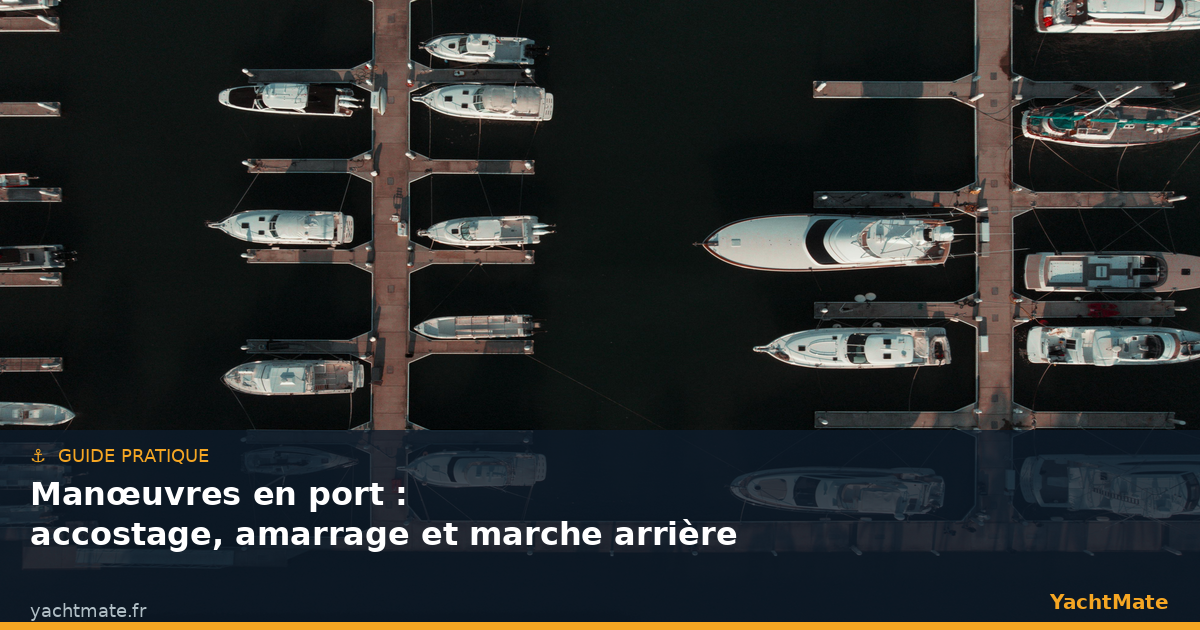
Entering a harbor is one of the most stressful moments for a sailor, whether you are a beginner or a seasoned skipper. Wind funneling between the breakwaters, neighboring boats packed tightly together, onlookers on the dock, and the pressure to get it right on the first try — docking concentrates every challenge of coastal sailing into a single maneuver. Yet with the right techniques and thorough preparation, entering and leaving a port becomes a smooth, even enjoyable operation.
In this guide we cover the three main situations you will encounter in recreational boating: Mediterranean stern-to mooring (with anchor), reverse docking at a pontoon, and picking up a mooring buoy. Each method follows its own logic, and understanding that logic is the key to approaching any harbor with confidence.
Preparing the maneuver before entering the harbor
A good maneuver begins well before you reach the entrance channel. Panic on board is almost always a sign of insufficient preparation. Here is what to organize as soon as the harbor comes into view:
- Observe wind and current from outside the harbor. What is the dominant direction? Is there a current along the quay? These two factors will dictate your approach path.
- Rig the fenders and hang them on the side where you plan to berth. In the Mediterranean, two fenders on each side are often needed.
- Prepare mooring lines by running them outside the lifelines, ready to throw or secure quickly.
- Assign crew roles: who steers, who handles the bow lines, who handles the stern. Clear communication before the maneuver prevents misunderstandings at the critical moment.
- Call the harbor on VHF (channel 9 or 16) to get your assigned berth and any special instructions.
With YachtMate, check depth information and harbor charts directly on your phone before you enter. Partner harbors show real-time berth availability so you know exactly where you're headed.
Mediterranean stern-to mooring (cul-de-poule)
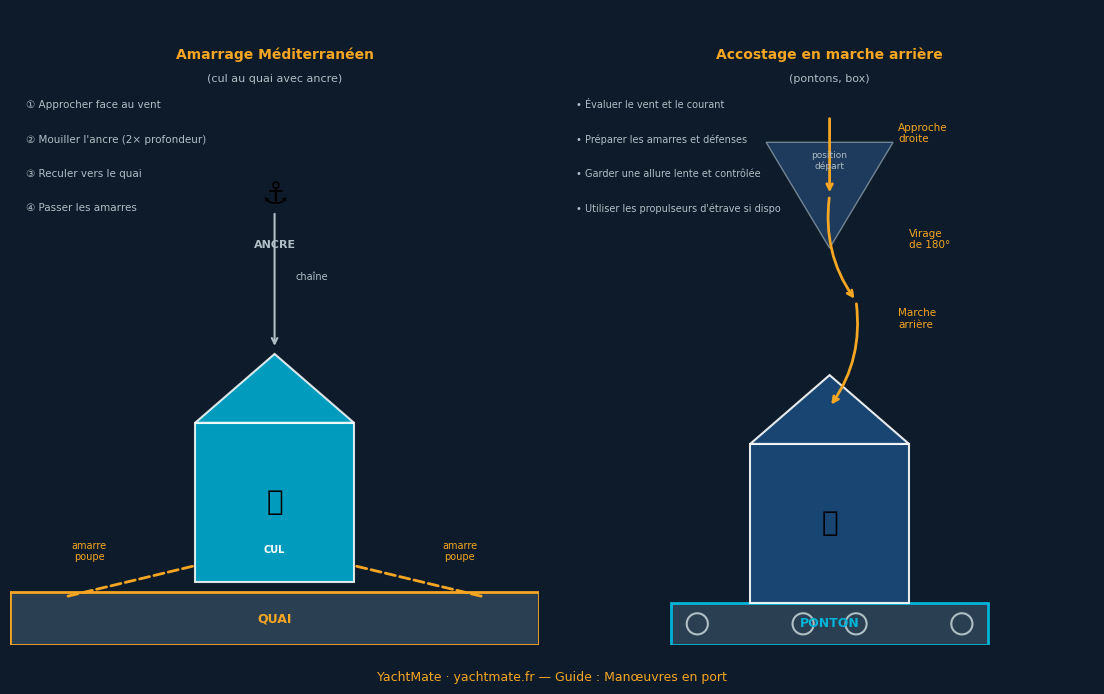
Mediterranean mooring is the dominant berthing method along the French Riviera, Corsica, the Spanish Costa, and throughout the Med. The boat approaches stern-first toward the quay while an anchor dropped from the bow holds the vessel at a safe distance and provides a longitudinal axis of stability.
Step-by-step procedure
- Approach into the wind: approach perpendicular or at a slight angle to the quay with the bow facing the wind or current. Keep speed low — 2–3 knots maximum.
- Drop the anchor: at a distance equal to roughly twice the water depth (minimum 15–20 m from the quay in 4–5 m of water), let the anchor go. Make sure the chain runs freely.
- Reverse toward the quay: engage reverse while paying out chain gradually. Maintain light but steady tension so the anchor sets properly. Correct your track with small bursts of helm.
- Secure the stern lines: when the stern is 50–80 cm from the quay (or the protective tire), a crew member steps ashore with both stern lines and cleats them off.
- Tension and check: take up the chain so the boat sits 30–50 cm from the quay — close enough to step ashore comfortably, far enough not to bump.
"Reversing is a matter of patience: speed is your enemy. A slow-moving boat can always be corrected; a boat coming in too fast damages everything in its path."
Common mistakes to avoid
- Dropping the anchor too close to the quay: the chain has no scope for the anchor to set, so the boat drifts in a crosswind.
- Reversing too fast: you arrive hard and hit the quay or, worse, a neighboring boat.
- Not checking chain direction: if your chain lies over a neighbor's anchor you will have trouble leaving. Watch for bubbles or use an underwater camera.
- Releasing the line before taking a turn on the cleat: always secure before you let go completely.
In a strong beam wind, set up your approach upwind of your berth. The wind will push you sideways into place as you reverse — instead of fighting the elements at the worst moment.
Reverse docking at a pontoon or box berth
In modern marinas with finger pontoons, berths are typically perpendicular to the dock. Docking means coming in stern-first, which requires mastering reverse steering — a skill that takes practice because boats naturally yaw to one side in reverse.
Understanding your boat's behavior in reverse
In reverse, a single-engine motorboat tends to walk to one side based on propeller rotation direction — the so-called paddlewheel effect. A right-hand propeller (conventional) will kick the stern to port (left) when reversing. Test this in open water before your first marina entry.
Box-berth docking procedure
- Observation pass: motor slowly past your berth to assess the width available and the wind direction.
- Positioning: overshoot by about one boat length, then turn to align your axis with the berth.
- Engage reverse: select reverse at low RPM. Counter the natural propeller walk with small helm corrections.
- Use the bow thruster if fitted: it lets you make lateral corrections without changing approach speed.
- Secure lines: when the stern is 50 cm from the pontoon, pass the stern lines, then the spring lines to hold the boat on-axis.
Unsure about berth dimensions? Call the harbourmaster on VHF before committing to the maneuver. YachtMate's partner harbor profiles show berth dimensions so you can plan ahead.
Picking up a mooring buoy
Picking up a mooring buoy means attaching your boat to a ground tackle fixed to the seabed. You will find them in organized anchorages (Corsican creeks, calanques, Villefranche-sur-Mer roads) and some traditional harbors.
Technique
Approach into the wind at very low speed. When you are 5–6 meters from the buoy, stop the engine and let your momentum carry you to it. A crew member at the bow hooks the pendant (floating line or chain) with a boat hook and passes a line through the ring. The maneuver looks simple, but the timing between helm and bow crew is critical — call "light reverse" clearly if you are approaching too fast.
Leaving harbor: rules of good seamanship
Departure is usually less feared than arrival, but it deserves equal care. Before leaving your berth, let your neighbors know if you need their help. Retrieve your anchor slowly, motoring gently forward to avoid loading the chain under tension. Notify the harbourmaster if required, and always check your neighbors' lines before pushing off their boat to disengage.
Leaving downwind is often easier — the boat naturally moves away from the quay. Upwind is trickier: swing the bow or stern to get into the wind first, then accelerate positively.
Key takeaways
- Always prepare before entering: fenders, lines, crew roles, VHF check with the harbor.
- Mediterranean mooring: anchor at 2× depth, reverse slowly, calibrate chain tension.
- Reverse docking: know your prop walk, correct with bow thruster or helm.
- Mooring buoy pickup: approach into wind, boat hook and timing are key.
- Slow speed = maximum control: the golden rule in any harbor.
Navigate with confidence using YachtMate
Marine charts, harbor guides, integrated weather and points of interest — YachtMate accompanies you from harbor entrance to anchorage. Download the app for free and plan your next stopover with peace of mind.
Discover YachtMate →