
As soon as a passage extends beyond a few hours or ventures into the night, the question of watch keeping becomes central. A poorly organised, tired crew without clear rules is a recipe for accidents. Conversely, a well-planned rotation ensures everyone stays alert, rested and responsible for their watch. This guide reviews the main watch systems, their advantages, their limitations, and the golden rules to follow for safe sailing.
Why Are Watches Essential?
On offshore passages or night crossings, it is impossible to stay awake and vigilant for long hours without structure. Fatigue is one of the leading causes of accidents at sea: heading errors, collisions, running aground, or a delayed reaction to worsening weather. The watch system divides navigation time into periods during which one or more people are officially responsible for lookout, while others rest.
Beyond safety, the watch system creates an organisational framework that reduces tension on board. Everyone knows when they need to be on deck, when they can sleep, and what their responsibilities are. This is especially critical on multi-day passages like an Atlantic crossing or a Mediterranean cruise with consecutive nights at sea.
When Should You Introduce Watches?
The rule of thumb is simple: as soon as you are sailing at night or the passage lasts more than 8 hours, a watch system is necessary. Even on a daytime coastal passage that extends, it is wise to plan rotations in advance rather than improvising when fatigue starts to set in.
Announce the watch schedule before departure, while still in port. Everyone should know their schedule so they can adjust their sleep the night before. A crew member who slept badly before departure will be exhausted by their first night watch.
The Main Watch Systems
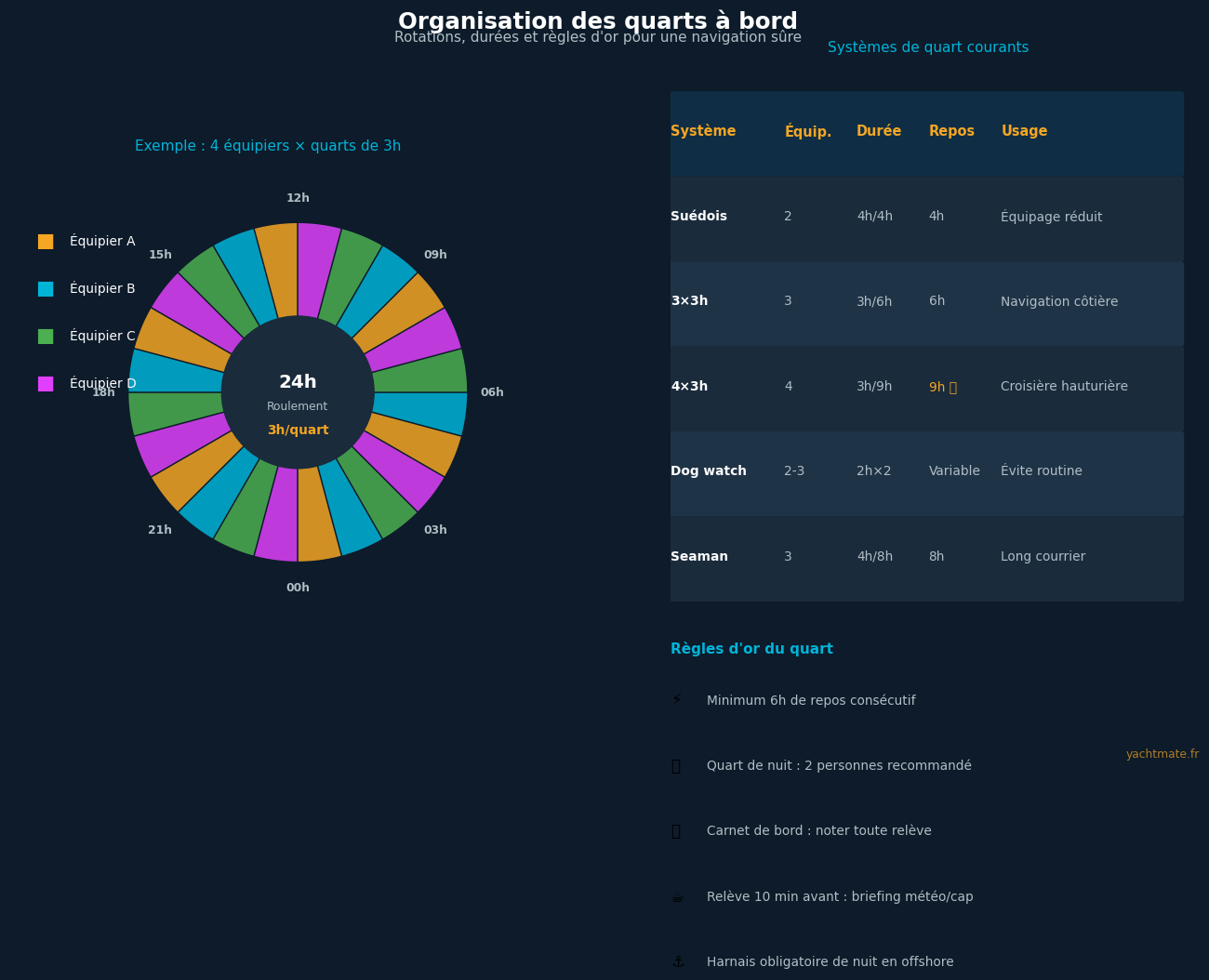
There is no universal system: the best rotation depends on the number of crew, the duration of the passage and the complexity of the navigation. Here are the most widely used schedules among recreational sailors.
The Swedish System (2 people)
With only two crew members, the classic 4h on / 4h off is the most common. Each person takes 4 hours on watch, then 4 hours off. On paper this seems reasonable, but in practice 4 consecutive hours of rest do not allow for genuinely restorative sleep — especially if you need to prepare for the handover or if sea conditions make rest uncomfortable.
The 3×3h System (3 crew)
With three crew members, you can move to 3 hours on / 6 hours off. This is a real qualitative leap: 6 consecutive hours allow a proper sleep cycle, and a 3-hour watch is manageable even in rough weather. This system works perfectly for coastal sailing and Mediterranean cruises.
The 4×3h System (4 crew) — recommended offshore
For an offshore cruise or long passage with four people on board, the 3-hour watch with 9 hours off is the ideal solution. Each crew member enjoys very comfortable rest, allowing for two complete sleep cycles between watches. Fatigue accumulates slowly, and even after several days at sea the crew remains in good shape.
The Dog Watch
The Dog Watch is a legacy of merchant shipping. Two 2-hour watches replace one 4-hour watch in the late afternoon (typically 16:00–18:00 and 18:00–20:00). The goal is to shift the rotation from one day to the next so crew members do not always stand the same hours. It is an elegant solution to avoid monotony on long passages.
What Do You Do During a Watch?
A watch is not simply sitting in the cockpit. The person on watch has specific responsibilities:
- Visual and radar lookout: scan the horizon, identify lights of other vessels, check shipping lanes (AIS on YachtMate).
- Course monitoring: verify that the autopilot or helm is maintaining the planned heading, correct as necessary.
- Weather observation: watch clouds, barometric pressure, wind strength and trim sails accordingly.
- Logbook: record position, heading, speed, wind strength and notable events every hour.
- Routine checks: inspect winches, sails, sheets and halyards, especially at night.
Use the YachtMate app to set position alerts every 30 minutes. If you do not acknowledge them, an alarm sounds — a valuable safety net in case of involuntary drowsiness during a watch.
The Handover: the Most Critical Moment
The watch handover is the most delicate part of the system. A poorly handled handover can lead to errors: forgotten heading, unmentioned weather alert, unreported VHF signal. Always call the relief 10 to 15 minutes before the end of the watch to give them time to wake up, dress, check the instruments and receive a full briefing.
The Handover Briefing: 5 Essential Points
- Heading and next waypoint: what is the planned destination, is there a heading change coming?
- Weather: current conditions, forecast changes, any Navtex or VHF alerts.
- Maritime traffic: vessels identified on AIS, areas to monitor.
- Boat status: sails set, autopilot engaged, any mechanical issues.
- Watch events: everything that happened during the watch — dolphins, floating debris, radio calls, etc.
"A good sailor doesn't just hand over the helm — they hand over the full picture."
Safety Rules During Watches
Personal safety is paramount, especially at night or in rough conditions. Several rules admit no exceptions:
Harness and Safety Line
At night and offshore, wearing a harness with a safety line clipped in is non-negotiable. Falling overboard in darkness is nearly fatal if the remaining crew member did not see the fall and MOB procedures are not perfectly drilled. Clip on your safety line before stepping out of the companionway.
Wake the Skipper When Necessary
Every watch keeper must feel authorised — and indeed obliged — to wake the skipper or an additional crew member if the situation demands it: deteriorating weather, a complex manoeuvre, an approaching vessel, doubt about the position. There is no bad reason to wake someone for safety.
Limit Distractions
No headphones, phone on silent, screens at minimum brightness. At night, your peripheral vision and hearing are your greatest assets. A crew member with headphones on cannot hear a fog horn, an approaching cargo ship's engine, or a sudden squall.
Set instrument brightness to minimum at night to preserve your night vision. It takes the human eye about 20 minutes to fully adapt to darkness — and a single bright light resets the clock completely.
Solo Sailing: Watches Without a Crew
Solo sailing obviously does not allow a classic watch system. Single-handers use heading alarms, AIS alerts, reliable autopilots, and above all 20–30 minute micro-naps interspersed with lookout periods. This is physically and mentally demanding, and offshore races like the Vendée Globe show just how much sleep management is a tactical challenge in its own right.
For occasional solo sailors, the common-sense rules are: sail by day as much as possible, use all available alert systems (AIS on YachtMate, position alarms, radar), and do not hesitate to put into port or anchor up to recover rather than risk an accident through fatigue.
Integrating Watches with YachtMate
The YachtMate app makes watch management easier with several features designed for crewed sailing. Real-time AIS monitoring lets the watch keeper track maritime traffic without leaving the cockpit. Route alerts warn if the boat deviates from its programmed heading, and logbook notes can be entered directly from the app for a smoother handover.
Sail Safer with YachtMate
Real-time AIS, heading alerts, integrated marine weather — everything you need for well-organised, stress-free watches.
Download YachtMate for Free