Catamaran or monohull? This question comes up every time someone thinks about buying a sailboat. Both types have passionate advocates, real advantages, and concrete drawbacks. There is no universal answer: the right choice depends on your sailing style, budget, number of people on board, and your level of experience. This complete guide gives you all the keys to make the best decision.
Understanding the Two Naval Architectures
The Monohull: The "Traditional" Sailboat
The monohull is the classic form of sailboat: a single hull, ballasted by a keel that provides stability from below. Thanks to this ballast (generally 30 to 45% of the total displacement), the monohull naturally rights itself even after a heavy heel. This is what is called ballasted form stability. In rough seas, the boat heels but resists capsizing.
The keel also provides excellent upwind performance: the sailboat points well into the wind and holds its course against the elements. For sailors who enjoy performance and speed sensation, the monohull remains a benchmark. Offshore races — Vendée Globe, Transat Jacques Vabre — use almost exclusively monohulls for reasons of strength and performance.
The Catamaran: Space and Form Stability
The catamaran rests on two parallel hulls connected by a bridge (or "roof"). Its stability comes not from ballast but from the spacing between the two hulls: this is form stability. The result? An almost flat platform while sailing, without the permanent heel of the monohull. For families or non-sailors, it is often a revelation.
In terms of living space, the catamaran generally surpasses the monohull of the same length: the deck is vast, the central saloon offers a panoramic view, and each hull houses one or two independent cabins. Catamarans of 40 to 50 feet can comfortably accommodate 6 to 8 people, while an equivalent monohull houses 4 to 6 more tightly.
Before deciding, rent both types of sailboat for a week. Nothing replaces real sea experience. YachtMate helps you plan your routes and check weather forecasts to fully enjoy every outing.
Detailed Comparison: 8 Essential Criteria
1. Stability and Sea Comfort
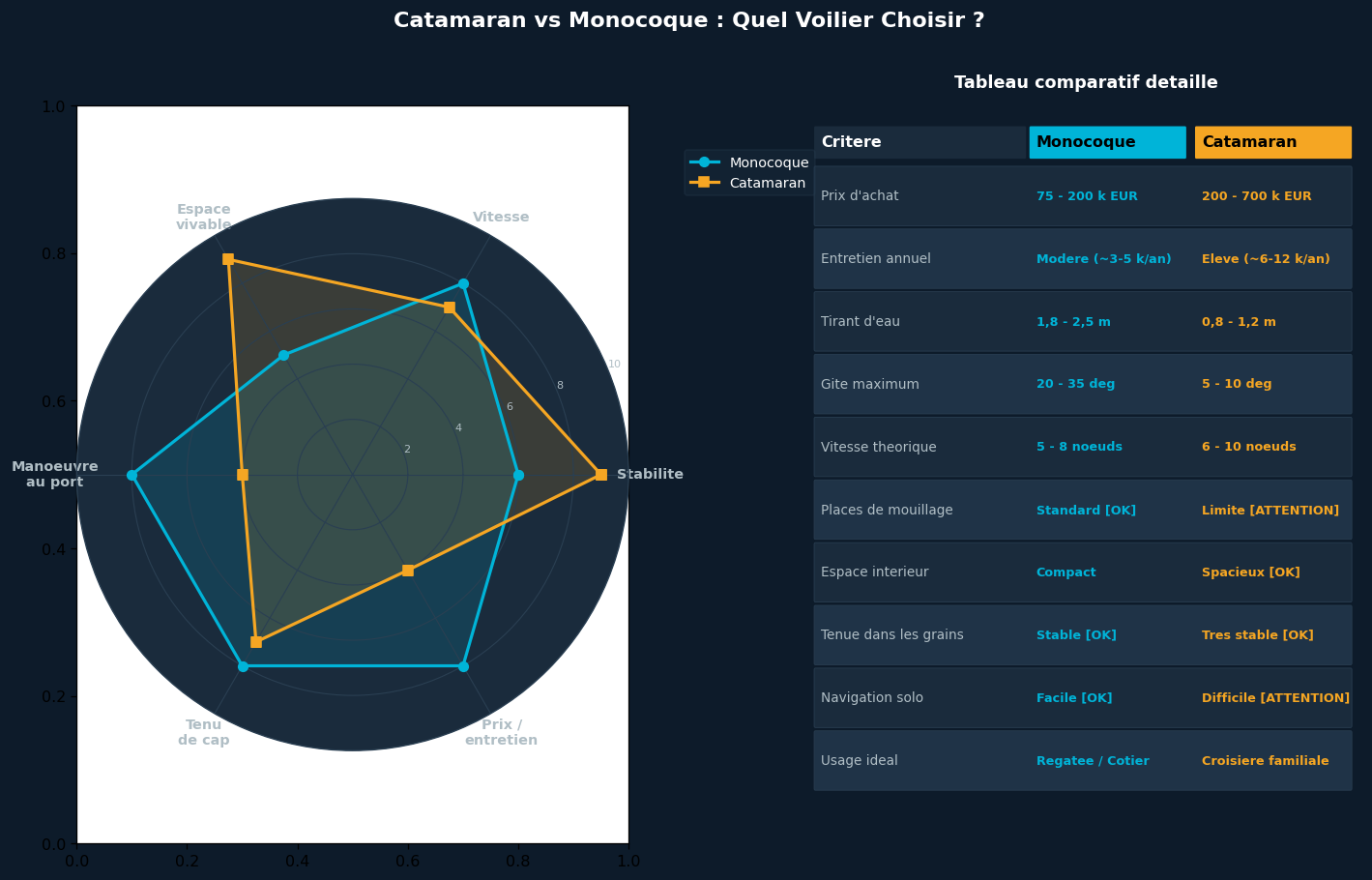
The catamaran barely heels: the table stays flat, cooking is easy, and seasickness diminishes significantly for sensitive passengers. The monohull can heel 15 to 30°, which requires some adaptation. However, in cross seas or violent gusts, the monohull is often more forgiving thanks to the stability reserve offered by the keel. The catamaran can be vulnerable to capsizing if the boom plunges into a wave — a rare but irreversible event (the catamaran does not right itself).
2. Purchase Price and Maintenance
At equal length, a catamaran generally costs two to three times more than a monohull. A used 40-foot monohull in good condition can be found between 80,000 and 180,000 euros. An equivalent catamaran rarely starts below 200,000 euros and often exceeds 400,000 euros for a recent, well-equipped model. Maintenance follows the same logic: two engines, two propellers, two shafts, two rudders — everything is duplicated, making it more expensive to service and replace.
3. Performance and Speed
Under equal wind conditions, a light modern catamaran can be slightly faster than a monohull thanks to its fine hull shapes and the absence of a keel. Some performance or racing catamarans reach impressive speeds. However, upwind in light breezes, the monohull often outperforms: it points better into the wind and responds more finely to heading changes.
4. Handling in Port
This point is often underestimated by prospective buyers. The catamaran is wide — between 7 and 9 meters for a 42-footer — which complicates entering and leaving ports. Special catamaran berths are rare in small Mediterranean marinas, and the berth fee is charged by width. Single-handed or with a small crew, maneuvers can become stressful. The narrower monohull is far easier to maneuver in confined spaces.
Before anchoring or entering port, use the YachtMate chart function to check available depth. The catamaran's draft (often less than 1.2 m) gives access to anchorages denied to deep-keeled monohulls.
5. Draft and Access to Anchorages
This is one of the catamaran's most concrete advantages: with a draft of only 0.8 to 1.2 meters (compared to 1.8 to 2.5 m for a monohull), it can anchor in very shallow water, approach sandy beaches, and access coves off-limits to deep keels. For cruising in the Mediterranean, the Caribbean, or shallow archipelagos, this is a decisive advantage.
6. Living Space and Sociability
The catamaran is king of space. The large central saloon, bathed in light through the glazed roof, is a true living area on board. Each couple or family can have an entire hull for their privacy. The foredeck is generally spacious and can accommodate a swim net. The monohull offers a more compact interior but often well-designed, with numerous storage spaces and a layout optimized for sailing.
7. Ease of Solo or Short-Handed Sailing
The monohull, especially if equipped with a good autopilot and furling systems, can be sailed easily singlehanded or by two. The catamaran, due to its width and two engines to maneuver, generally requires a larger crew for port maneuvers. At sea, however, the catamaran's sails are often relatively smaller, and it can be comfortable to helm in moderate wind.
8. Resale and Used Market
The used catamaran market is solid, with strong demand especially for models like Lagoon, Fountaine Pajot, or Leopard. Depreciation is generally less pronounced than for an equivalent monohull. That said, potential buyers are fewer, which can extend resale times. For a monohull of a recognized brand (Beneteau, Jeanneau, Dufour), market liquidity in Europe is excellent.
Which Sailboat for Which Use?
Choose a Catamaran if...
You sail with family or groups, you prioritize comfort and space, you love anchorages in shallow water, you plan long cruises with non-sailors aboard, you have a substantial budget for purchase and maintenance, or you sail in warm waters (Mediterranean, Caribbean, Pacific).
Choose a Monohull if...
You sail alone or with a small experienced crew, you enjoy racing and performance, you have a limited budget and seek good value for money, small historic marinas and ports are your playground, you want to sail in all weather conditions in rough seas, or you aim for intensive coastal navigation in Brittany, Normandy, or the Atlantic.
Whatever your choice, the YachtMate app accompanies you: route planning, real-time marine weather, anchorage zone spotting, and navigation guides for all French and Mediterranean coasts.
Summary: Quick Decision Table
To decide quickly, ask yourself these key questions. If you mostly answer "yes" to the catamaran column, lean toward a multi-hull; if it's the monohull column, stick with the classic. Also consider your home port: catamaran berths are rare and more expensive, which can represent 3,000 to 8,000 euros extra per year depending on the region.
"The best sailboat is not the most expensive or the fastest, it's the one that makes you want to go sailing every weekend."
Ultimately, catamaran and monohull are two different sailing philosophies, not two levels of quality. Both can be excellent in their domain. The important thing is to clearly define your sailing project before signing: sailing area, duration of outings, number of people, total budget. And don't forget that maintenance, insurance, and berthing costs can represent 10 to 15% of the purchase price per year.
Sail Better with YachtMate
Whether you sail on a catamaran or a monohull, YachtMate accompanies you: offline charts, marine weather, route calculation, anchorage zone spotting and much more.
Discover the app