

Choosing your first sailboat is one of the most important decisions for a prospective sailor. This decision will impact your sailing years ahead: safety at sea, comfort aboard, navigation capabilities, financial investment, and above all, the daily joy of sailing. A good choice leads to years of endless pleasure; a bad choice can turn sailing into a source of frustration and uncontrolled spending.
Unlike buying a car, where criteria are relatively standard, choosing a sailboat depends deeply on your personal nautical project, your physical profile, your actual budget, and your progressive learning of navigation. This sailboat expertise requires systematically exploring different boat categories, decisive technical criteria, common pitfalls, and intelligent buying strategies that will save you thousands of euros.
Defining Your Personal Nautical Project
Before buying, you must honestly answer a simple but fundamental question: what type of sailing will you actually practice? This answer conditions almost all other choices. Navigators who answer this question poorly often end up with a boat unsuited to their real needs.
Coastal Navigation versus Long-Distance Cruising
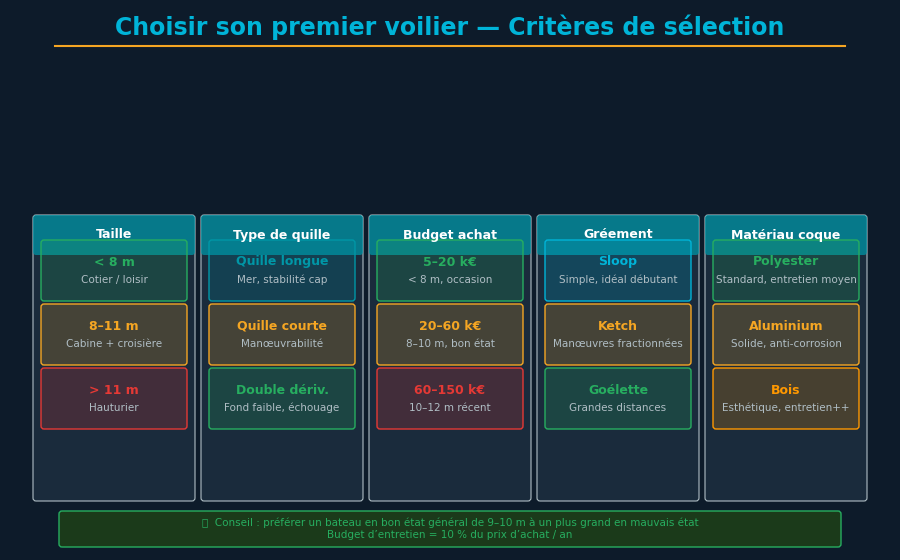
Coastal sailing (days on the coast, nights at nearby anchorages) and long-distance cruising (passages, nights at sea) require very different boats. A small coastal sailboat (8-10m) becomes dangerous offshore; a large bluewater sailboat (15m+) is heavy, expensive, and unnecessarily complex for coastal outings. An effective first sailboat for coastal sailing typically measures 8 to 12 meters.
Racing Sailing versus Comfortable Cruising
Racing navigators seek maximum performance, a trained crew, and accept difficult conditions. Cruisers seek comfort, safety, and ease of operation as a couple or family. These two projects require radically different boats. A racing boat wins races but exhausts; a cruising boat bores racers but enchants cruisers.
- Local Navigation and Weekends — Small boat (5-8m), inexpensive, easy to maintain, based in the same port year-round.
- Semi-Long Cruising (1-3 months) — Boat 8-12m equipped for autonomy (fresh water, diesel, safety equipment), shallow draft.
- Oceanic Voyages — Robust boat 12-18m, dual keel or keel/rudder, redundant systems, great autonomy, ability to face heavy seas.
Use YachtMate's voyage log to document your test sailing and discoveries. This will help you refine your understanding of the ideal boat. After 10-20 outings, patterns emerge clearly: where you really sail, what comforts you miss, what annoys you.
Sailboat Categories: Advantages and Disadvantages
Fine Monocoques (Fine Plans, Low Initial Stability)
These racing sailboats (Dufour, Beneteau Racing) offer excellent performance potential, but require expert crew, offer less interior comfort, and are difficult to handle alone. Ideal for experienced navigators seeking coastal performance.
Dual-Keel Monocoques (Form Stability)
These sailboats (Moody, Hallberg-Rassy) offer stability, ease of navigation, excellent anchoring capacity (shallow draft), and great interior comfort. Ideal for safe family cruising. Drawback: reduced performance in strong wind, high purchase cost, weight and inertia.
Catamarans (Wide Stability, Spacious Interior)
Multihulls offer remarkable width (comfort, stability), great carrying capacity, and ecological efficiency (light for their sail area). Drawbacks: reduced performance compared to monohulls, side-docking difficulty, very high price (30-40% more than equivalent monohull), and few used models.
Centerboard Sailboats (Shallow Draft, Lightweight)
Centerboards or keels (Contessa, Albin Vega) combine tiny draft (75cm), lightweight, and reduced footprint. Excellent for navigating estuaries, lagoons, shallow coasts. Drawback: reduced habitability (often small boat), moderate performance in strong wind.
Before buying, complete at least 3-4 test days sailing on boats from each category, with varied sea conditions. YachtMate helps you record these tests: weather conditions, sailing hours, comfort felt, maneuverability. This empirical data is worth more than 100 theoretical tips.
Essential Technical Criteria
Length Overall and Draft
Length conditions interior comfort and carrying capacity. First rule: the shorter a boat, the more habitability suffers. A 9m boat can be comfortable, a 7m boat will be narrow and tiring on long stays. Draft (boat depth submerged) depends on your waters: 1.2m in coastal Mediterranean, 1.8m+ in Atlantic where tides demand clearance.
Weight and Inertia
A heavy boat (high weight-to-length ratio) maintains speed well, offers comfort in heavy seas, but consumes more, is difficult to haul, and requires more helm work. A light boat accelerates easily, is economical, but loses speed quickly and gets "boxed" by heavy seas. Optimum: 200-280 kg/m length ratio.
- Rigging — Foil (single mast, simple) vs fractioned (mast not reached at top, complex) vs triple spreader. Simpler means less maintenance, cheaper, but less fine tuning.
- Sails — Traditional sails vs battens (lazyjack), automatic booms vs manual. Simplicity wins over time: fewer systems = fewer breakdowns.
- Engine — Outboard (lacks power, noisy), diesel inboard (heavy, maintenance), electric (expensive, limited range). For first cruising: reliable powerful diesel inboard.
Systematic Purchase Inspection
Inspecting a used sailboat requires methodical rigor. Three classic errors: buying emotionally without inspection, superficial inspection, not having an independent expert inspect. Each costs dearly.
External Visual Inspection
Examine the hull gelcoat for bubbles (osmosis), cracks, poorly repaired areas (gelcoat different color). Check hardware (winches, pulleys, genoa rail) for excessive play or corrosion. Manually test every line. Good hull condition inspires confidence; damaged hull suggests neglected maintenance everywhere.
Engine and Electrical System Inspection
Test the engine out of water (check cooling water flows, listen for clicking noises). Examine battery, alternator, solar panels for corrosion. Request engine maintenance history: if absent, assume maintenance was neglected. A poorly maintained diesel engine costs €5,000-€10,000 to repair.
Internal Structural Inspection
Go below in darkness with a lamp, look for moisture traces (mold, black spots), standing water, water damage. Check watertight bulkheads for bulging (prior fire?). Examine hull penetrations for leaks.
An expert inspection costs €500-€800 and is worth every cent: it can reveal defects justifying a price reduction of several thousand euros.
Realistic Budgeting
The purchase price of a sailboat is just the beginning. Real costs hide in annual operating fees: mooring/port (€1,200-€3,600), insurance (€400-€1,200), routine maintenance (planned 5-10% of purchase price annually), diesel fuel (€300-€800 annually depending on use), and unforeseen repairs (mandatory reserve budget).
- Careening Every 2-3 Years — €3,500-€7,500 for 10-12m boat. Budget €1,200-€2,500 annually on average.
- Rigging/Canvas Replacement — Mainsail: €2,000-€4,000 (every 10 years), jib €1,500-€3,000 (every 8 years).
- Electronics — GPS, radar, VHF last 10-15 years but can cost €3,000-€6,000 to replace.
- Surprises — Leaks, rigging failures, engine damage occur regularly. Reserve 10-20% of annual budget for surprises.
Use YachtMate's navigation budget to actually document all your test boat costs: port, fuel, maintenance, repairs. After 12 months of real data, you'll know the true cost of ownership. This transforms theoretical budget into confirmed reality guiding your final purchase.
Intelligent Buying Strategies
Used 10-15 Years Old, Well-Maintained
Boats 10-15 years old offer the best value for money. Popular models (Dufour, Beneteau, Hallberg-Rassy) had reached technical maturity. They're much cheaper than new (50-60% less), but less residual value than very old boats. They allow acceptable loss on resale.
Avoid New Boats (For Your First Purchase)
A new boat loses 20-30% of its value on first resale, and you pay for design defects previous owners already discovered and accepted. Exceptions: if you have a very specific project (family cruising 10 years), buying new might justify avoiding bad surprises.
Local Purchase or Transport?
Buying a boat in a distant port requires transport (expensive, risky). Buying locally avoids these fees and allows frequent visits before purchase. Life rule: all really good boats sell quickly. If you find a good boat at good price, buy quickly after inspection; good opportunities don't last weeks.
Common Mistakes to Avoid
- Buy Too Small — A boat bigger than initially planned? Better mistake. Too small boat frustrates daily and doesn't resell well.
- Buy Emotionally — "I love this boat" doesn't replace technical inspection. Should have consulted expert before getting emotional.
- Ignore Maintenance History — No maintenance file = boat very likely poorly maintained. Refuse these boats.
- Neglect Hidden Costs — Expensive mooring, high insurance, major repairs pending. Request 3-5 years history if possible.
- Buy Beyond Current Competence — A boat you can't handle alone or don't understand becomes stress source, not joy.
Invest in good expert inspection and time testing several boats. These two time and money investments protect you better than any theoretical advice.
Next Steps After Purchase
Once purchased, next priorities: completely certify the boat (engine, sails, rigging), complete technical documentation (plans, manuals), schedule complete careening if more than 2 years since last, and take navigator training if you're a beginner. First three months are crucial to discover boat specifics and feel confident at the helm.
Choose Wisely with YachtMate
YachtMate helps you track boat tests, document maintenance history, and plan your sailing adventures.
Learn More →