

On a downwind course, the sailboat runs before the wind or on a broad reach in a deceptive calm: the sails stop flogging, the bow wave softens, and you feel safe. Yet this is the point of sail that produces one of cruising's most violent accidents: the accidental gybe. Driven by the wind swinging from one side to the other, the boom sweeps across the cockpit at full speed and can knock out a crew member or wreck the rig. The defence comes down to two simple pieces of gear: the boom preventer and the boom brake. This guide explains how they work, how to rig them and when to use them.
1. The accidental gybe: what happens
A gybe is the mainsail crossing from one side to the other as the wind moves behind the boom. Done deliberately, it is a routine manoeuvre. Unplanned, it becomes dangerous: a gust, a wave that yaws the boat, or a moment's inattention at the helm is enough for the wind to catch the sail from behind. The boom, until then eased right out, then whips across to the other side.
Delivery skippers know the consequences well. At the boat's level, the boom can jam in the shrouds, bend a fitting, tear out a mainsheet car or, in extreme cases, bring down the mast. For the crew, a boom flung across at head height is a leading cause of falls overboard and head injuries. It is precisely because the point of sail feels peaceful that vigilance drops and the accident strikes.
Downwind is not a resting point of sail: it is the one that least forgives a free boom. A preventer turns a constant danger into a managed risk.
2. Preventer or brake: two philosophies
Two devices answer the same problem, but differently. The boom preventer mechanically locks the boom forward: a line runs from the end of the boom to a fixed point at the bow, tensioned so the boom can no longer swing back. In an accidental gybe, the sail stays pinned, the wind makes it flog noisily but nothing breaks. Simple, sturdy, almost free.
The boom brake takes the opposite approach: instead of locking, it slows. A line runs through a friction unit fixed under the boom and stretched between the two forward chainplates; you set the friction so the boom can cross, but slowly and without a snatch. The gybe, planned or not, becomes controlled: there is nothing to release before turning stern to wind.
For long family cruising many crews combine both: the boom brake to damp the boom's movement at all times, and a firm preventer rigged in addition whenever they settle in for a long dead-run. Belt and braces.
3. Rigging a boom preventer, step by step
A good preventer has three qualities: it starts from the end of the boom (never the middle, which would bend the section), it leads forward through a block near the bow, and it returns to the cockpit so it can be adjusted or released without leaving the helm. The diagram below shows the run.
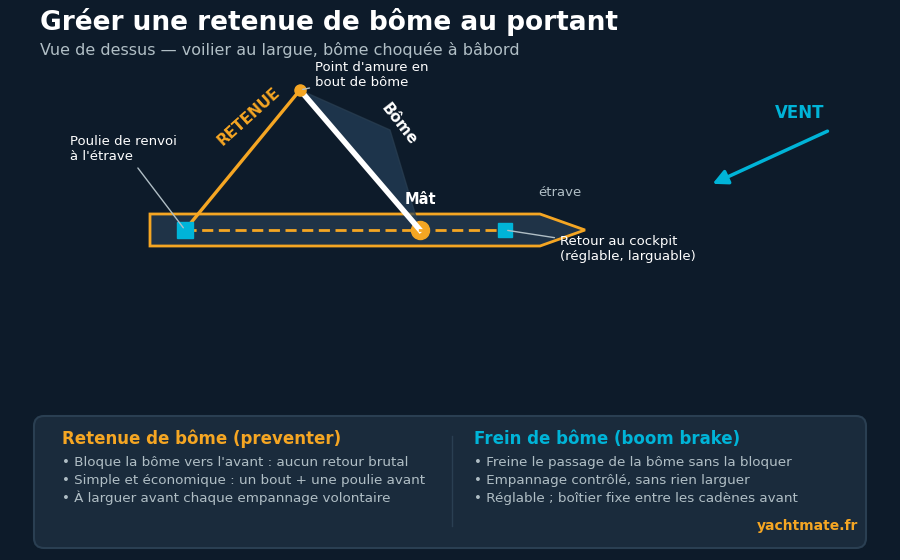
The steps
- Attach a line to the end of the boom. A bridle or a ring at the boom's outer end avoids loading the weaker mid-section.
- Lead it forward. Pass the line through a block or a solid anchor point as far forward as possible (bowsprit, bow cleat, forward rail). The more the angle opens forward, the more effectively the preventer resists the boom swinging back.
- Bring it back to the cockpit. Run the tail along the deck to a cleat or winch reachable from the helm. You must be able to ease it instantly.
- Take up the slack and cleat off. Tension it without overdoing it: the boom should be held, not permanently strained. The sail works against the preventer, not the other way round.
On well-equipped boats a dedicated preventer is made fast on each side and coiled along the boom, ready to be led forward. Otherwise a spinnaker sheet or a good-diameter mooring line will do, provided it is low-stretch.
4. The boom brake: the controlled gybe
The boom brake is a small unit — disc, drum or cam — fixed under the boom, roughly above the mast foot. A continuous line is passed through it and tensioned each side to an anchor point at the forward chainplates or rail. The line's friction inside the unit creates an adjustable resistance to the boom's movement.
Two major advantages: first, it constantly damps the boom's motion in a chop, sparing the rig and the crew's nerves. Second, it allows a deliberate gybe with no prior handling: you bear away, the boom crosses in slow motion, held by the friction, and there is nothing to release. For a shorthanded crew or solo sailing, it is a real comfort in safety terms.
Set the brake's friction to the wind strength: loose enough in light air not to hinder trimming, firmer as it freshens so the boom never breaks away. Test it at anchor, boom by hand, before relying on it at sea.
5. Good downwind practice
The best gear is no substitute for method. A few principles that hold whichever solution you choose:
- Rig the preventer before you need it. Set it while bearing away, as soon as you settle onto a broad reach or run — not in the panic of a gust.
- Never lock the boom's return without being able to free it fast. In a man-overboard situation or when you need to head up, the preventer must release in one second from the cockpit.
- Watch the true wind angle. A good autopilot set to apparent wind, or an attentive helm, sharply cuts the risk of a gybe. The preventer is a safety net, not a licence to switch off.
- Warn the crew before every deliberate gybe. A clear "ready to gybe", release the preventer, cross, re-rig on the other side.
These reflexes match those of any well-run gybing manoeuvre: anticipation, communication, a movement repeated until it becomes automatic.
6. Mistakes to avoid
- Attaching the preventer to the middle of the boom: the leverage can bend the section during a gybe. Always at the end.
- Using a stretchy line (over-stretched nylon): it lets the boom build momentum before checking it, which worsens the shock. Prefer a low-stretch rope.
- Leading the preventer too far aft: an angle almost square to the boom holds it poorly. The lead point must be well forward.
- Forgetting to be able to release from the cockpit: a preventer tied off on deck forces you to crawl forward to free it — unacceptable in a seaway.
- Relying on the sheeted-in mainsheet alone to prevent the gybe: it does not hold the boom forward and can tear out the car.
- Neglecting the brake setting: too loose, it slows nothing; too tight, it prevents a needed gybe or overloads the anchor points.
Preventer or brake, the goal is the same: never let the boom decide on its own to cross the boat. Two metres of line and five minutes of rigging are enough to rule out one of the most serious — and most avoidable — accidents in cruising. Get into the habit of rigging your preventer every time the wind goes aft: the move will soon feel as natural as trimming a sheet.
Sail with peace of mind using YachtMate
YachtMate shows true wind, heading and point of sail in real time — everything you need to anticipate the gybe and stay calm downwind. Free.
Discover YachtMate