
A crew member falls into the water. Within seconds, a joyful day sail can become a life-or-death emergency. Man Overboard — MOB — is one of the most feared situations at sea, and yet one of the least prepared for. Knowing the right reflexes, mastering recovery maneuvers, and having the correct equipment within reach can literally make the difference between life and death.
In this article, we walk you through the three internationally recognized MOB recovery maneuvers, the steps to follow in order, and the essential equipment to carry on board. Practice these procedures regularly: a MOB drill is worth a thousand readings.
A human being in cold water loses their ability to swim in under 10 minutes. Without a life jacket, an unconscious person can sink in 30 seconds. Speed of response is critical.
First reflexes: the 4 critical seconds
The moment someone falls overboard, every second counts. Your crew must have drilled these reflexes during regular exercises:
- Shout "Man Overboard!" to alert all crew immediately.
- Throw a horseshoe buoy or life ring as close as possible to the person — not directly at them. The buoy serves as a visual marker as much as a flotation device.
- Assign a crew member whose sole job is to never lose sight of the person, constantly pointing in their direction.
- Activate the MOB function on the GPS/chartplotter to record the exact position at the time of the fall. Never rely on memory alone.
YachtMate includes a one-touch MOB button accessible from the main screen. It instantly records GPS coordinates, starts a countdown timer, and displays the return bearing to the person. In a high-stress situation, this time saving is invaluable.
Alerting rescue services simultaneously
Throwing a buoy and maneuvering isn't enough — alert the rescue services as soon as possible, even if you think you can recover the person on your own. At sea, complications escalate fast.
On VHF Channel 16
Broadcast a distress call if the situation is critical (unconscious person, advanced hypothermia, rough sea conditions):
"MAYDAY MAYDAY MAYDAY — This is [vessel name] — Position: [latitude/longitude or bearing] — Man overboard — [number of people remaining on board] — Requesting immediate assistance."
Via DSC VHF
On modern VHF radios equipped with DSC (Digital Selective Calling), pressing the red DISTRESS button automatically transmits your MMSI and position to the nearest coast guard coordination centre. It is the fastest and most reliable method available.
The 3 MOB recovery maneuvers
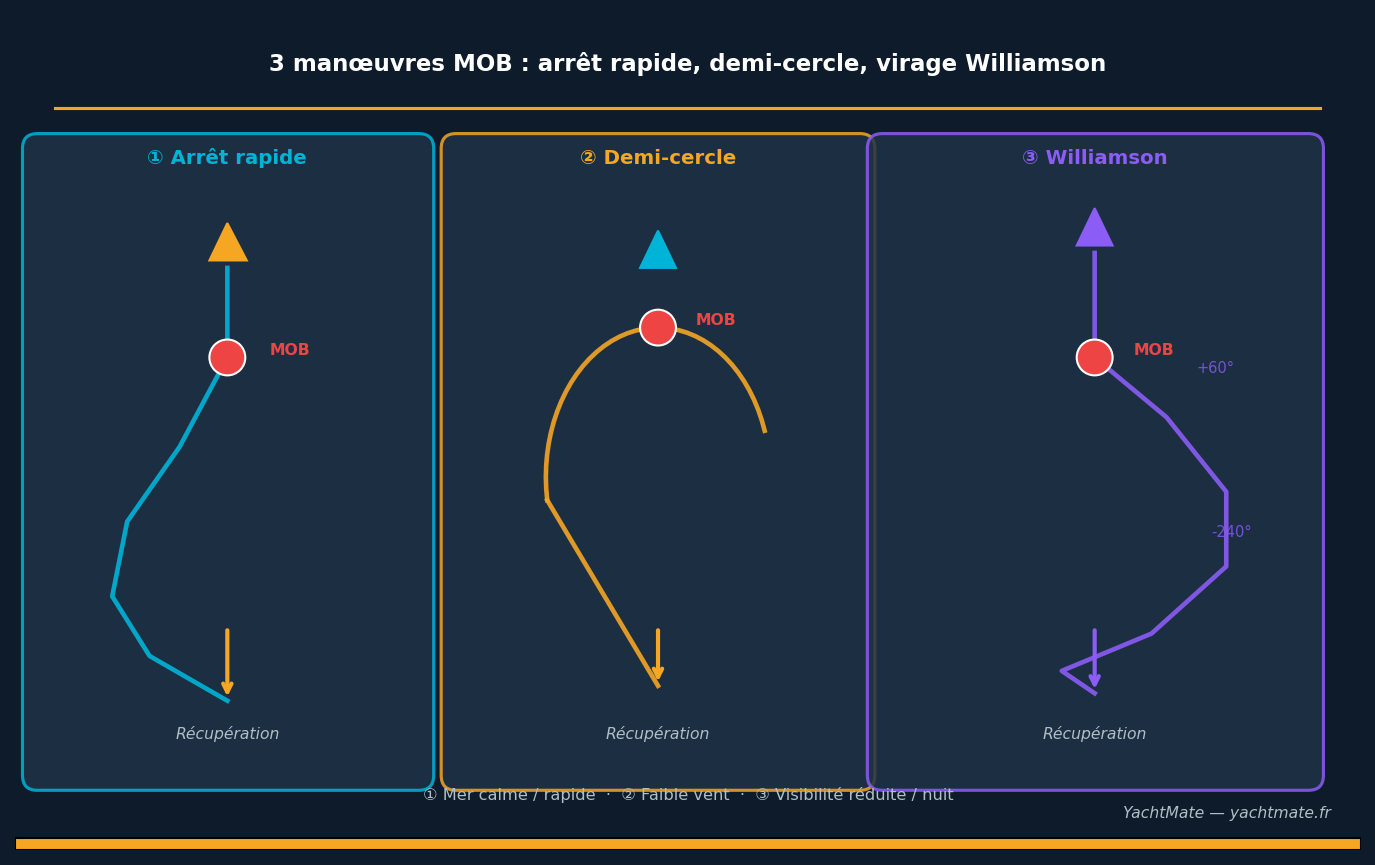
There is no single universal maneuver. The choice depends on sea conditions, crew size, and boat type. Here are the three fundamental techniques, ordered by speed of execution.
① Quick Stop
The fastest maneuver, best suited to modern sailing yachts with a small crew. As soon as someone goes overboard, immediately reduce speed by heading into the wind, then perform a tight circle back to the person. The advantage: you stay close to the MOB throughout the maneuver. The downside: risk of flogging sails if the crew is inexperienced.
② Bear Away (Figure-eight)
Bear away downwind to gain distance briefly, then perform a 180° arc to return upwind toward the person. This approach gives more controlled final positioning and allows you to recover the person from the windward side, making it easier to stop the boat alongside. Best when visibility is good and you have 2–3 crew members available.
③ Williamson Turn
The reference maneuver for offshore navigation or in low visibility (night, fog). Turn 60° toward the side of the fall, then counter-turn 240° in the opposite direction to return on the original track in reverse. The goal is to retrace the vessel's exact wake. It takes more time but guarantees finding the person on the original track, even when they are no longer visible. Ideal for long passages and singlehanding.
In YachtMate, MOB mode displays the real-time bearing and distance back to the recorded position. If the person is drifting due to wind or current, activate position tracking mode to dynamically recalculate the bearing — provided they are equipped with an AIS MOB beacon or PLB.
Approach and recovery: practical techniques
Getting back close to the person is only half the challenge. Physical recovery is often the most difficult phase, especially if the person is exhausted, hypothermic, or unconscious.
Sail or engine approach?
Whenever possible, use the engine for the final approach. This gives you precise control over speed and heading. If sailing, furl or sheet the sails before approaching to avoid running over the person with the propeller. Always approach from the windward side so the boat naturally stops alongside the MOB.
Getting the person back on board
- Swim ladder or recovery net: essential on any cruising yacht. A hypothermic person can weigh twice their normal weight in water-soaked clothing.
- Recovery tackle (or halyard): allows you to hoist an unconscious or incapacitated person. Rig it before departure.
- Harness and jackline: if the person is wearing a harness, attach a line and guide them toward the ladder while keeping their head above water.
- Never jump in to retrieve someone unless you are wearing a life jacket, attached to a line, and a crew member holds the other end on board.
Once back on board
Anyone pulled from the water should be treated for hypothermia even if they appear lucid: remove wet clothing, wrap in a thermal survival blanket, apply skin-to-skin contact if necessary. Keep them horizontal to prevent cardiac shock from blood redistribution. If unconscious and not breathing, start CPR immediately and call Maritime Emergency Services (Channel 16).
Essential MOB equipment on board
Equipment doesn't replace training, but it radically changes the odds of a successful recovery. Here is the minimum kit to have on board:
- Horseshoe buoy with retaining line: fixed at the stern, immediately accessible.
- Life ring with flagpole and automatic light: required under most offshore safety regulations.
- AIS or 406 MHz MOB beacon (McMurdo, Ocean Signal…): clipped to each crew member's life jacket, automatically activating on water contact.
- Safety harness and jacklines: for every crew member during night watches or heavy weather.
- Recovery net or transom ladder: enabling you to bring an incapacitated person on board.
- Waterproof handheld VHF: on each crew member during offshore passages.
- Thermal survival blanket: stored somewhere instantly accessible.
Use YachtMate to log the location of each safety item on board (buoys, net, blankets). In an emergency, a crew member unfamiliar with the boat can instantly find where critical equipment is stored, without losing precious seconds searching.
Practice regularly: the key to success
Knowing MOB maneuvers in theory is not enough. In a real situation, stress, rolling, wind noise, and panic cause even well-learned procedures to disappear from memory. That's why sailing organizations worldwide recommend performing at least one MOB drill per season, ideally using a dummy or buoy as a target.
During drills, time yourself from the "fall" to recovery. The target is under 5 minutes in fair conditions. Repeat at night and in force 4–5 winds to simulate real conditions. It's uncomfortable, but potentially lifesaving.
"The best safety equipment is a trained crew. A maneuver practiced 10 times can be executed under stress. A maneuver read once cannot."
Special case: singlehanding
When sailing solo, falling overboard almost certainly means death unless specific precautions are taken. Essential measures include: always wearing a harness with jackline attached while on deck, fitting an autopilot that can be disengaged quickly, deploying a self-rescue ladder (always rigged at the transom), and activating a PLB beacon with GPS at every watch. Some singlehanders also install a "dead man's switch" that cuts the autopilot and luffs the boat automatically if the skipper is no longer present at the helm.
Navigate safely with YachtMate
YachtMate includes a one-touch MOB button, real-time position tracking, and all the weather and navigation information you need to anticipate risks. Available on iOS and Android, for sailors who take their safety seriously.
Discover YachtMate →