
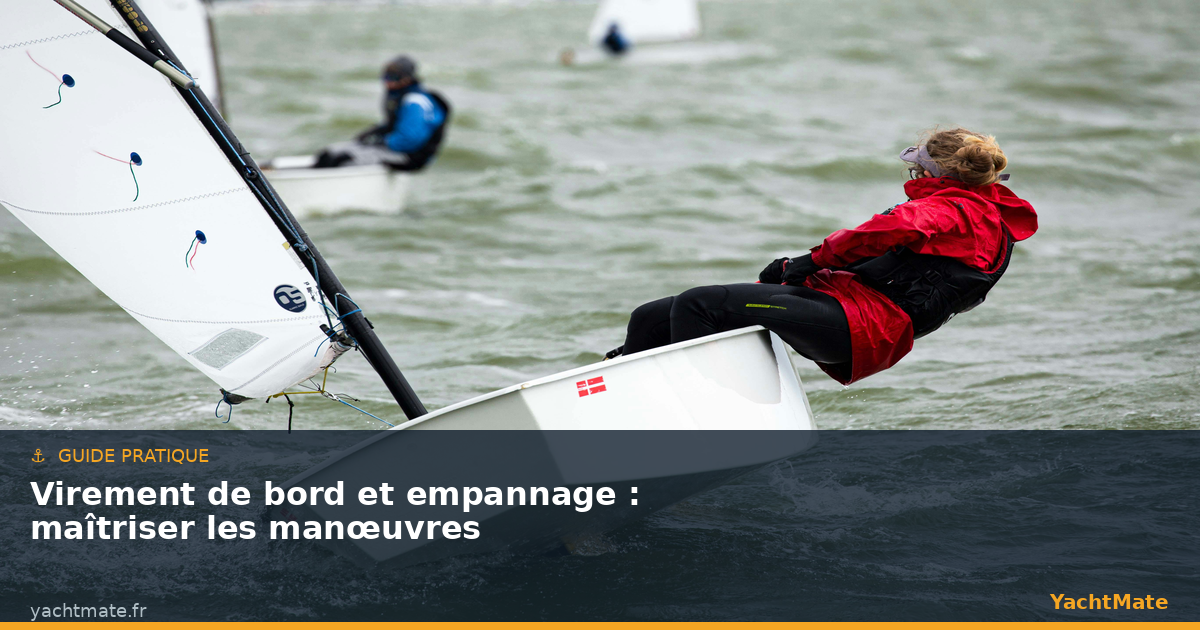
Changing tack is one of the most fundamental sailing maneuvers. Whether you're a beginner or a seasoned sailor, mastering tacking and gybing will help you optimize your course, save time, and above all navigate safely. Both techniques transfer the wind from one side of the boat to the other, but they differ radically in execution and the risks they carry.
In this complete guide, we'll walk through the steps of each maneuver, the classic mistakes to avoid, weather conditions to watch for, and how the YachtMate app can help you plan them intelligently.
Tacking: Bringing the Bow Through the Wind
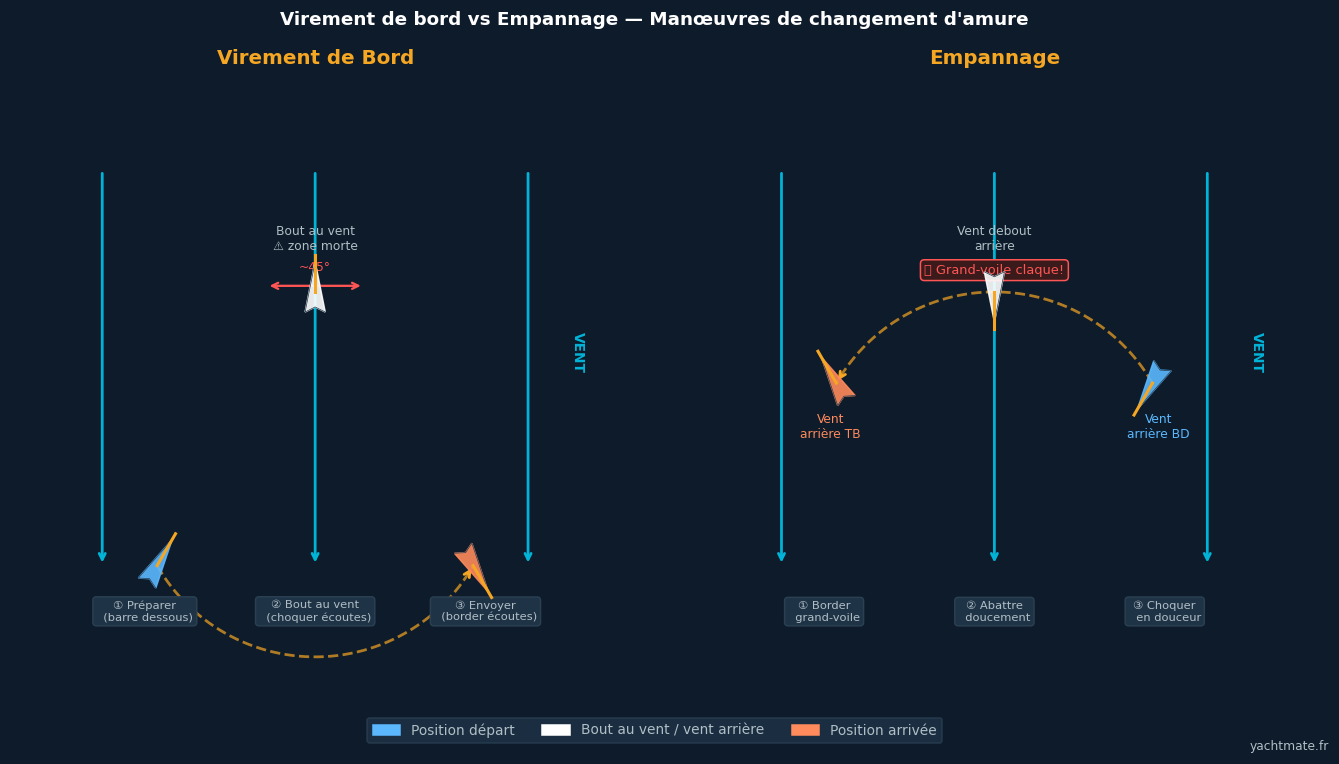
Tacking means rotating the sailboat so that the bow passes through the wind direction. The boat crosses the so-called "head-to-wind" zone — the dead zone of approximately 40–45° on each side of the true wind where the sails flap and provide no drive. This is the maneuver used to beat upwind in a series of zigzags ("beating to windward").
Steps for a clean tack
A well-executed tack unfolds in four precise stages. First, preparation: check the new tack for obstacles, warn the crew ("Ready about?"), and ease the jib sheets slightly. Second, the initiation: luff up gradually by pushing the tiller to leeward (or turning the wheel to windward). The headsail starts to luff — that's your cue. Third, the crossing: once the bow is in the eye of the wind, release the old jib sheet and push the tiller hard across. Finally, trim: sheet in the new jib smartly while the helmsman settles on the new course.
Use YachtMate to display your heel angle in real time during the tack. If heel stays above 25° after the bow passes through the wind, you waited too long to sheet in the jib — adjust the timing of your next tack.
Classic tacking mistakes
The first mistake is tacking too slowly: if the boat lacks sufficient momentum, it risks "getting caught in irons" — stuck head-to-wind, unable to complete the rotation. The solution is to tack with good boat speed — ideally above 3 knots. The second mistake is sheeting in the jib too late, resulting in a flagging sail that slows the boat and increases leeway. Finally, avoid over-trimming the jib after the tack; an overly tight sheet on the new side kills boat speed.
"A good tack is one you barely notice: smooth, quick, with no unnecessary flogging." — Sailing instructor, Marseille Cruising School
Gybing: Bringing the Stern Through the Wind
Gybing is the reverse maneuver: it is the stern (back) of the boat that passes through the wind, allowing a tack change while sailing off the wind (running or broad reach). Unlike tacking, gybing has no dead zone — the transition is nearly instantaneous and can be violent if the mainsail is not controlled. This is why gybing is considered more dangerous, particularly in strong winds.
The controlled gybe: 4 steps
To gybe safely, start by trimming the mainsail all the way in before initiating the maneuver — this reduces the lever arm and therefore the energy stored in the boom when it crosses. Second, warn the crew: "Ready to gybe? — Ready!" Everyone in the cockpit must duck. Third, bear away slowly by pushing the tiller to windward (or turning the wheel to leeward) until the mainsail crosses to the other side. Fourth, as soon as the boom crosses, ease the mainsheet quickly to prevent it from slamming against the shrouds.
YachtMate overlays wind direction and strength on your chart. Before gybing, verify that wind speed is below 18–20 knots if you're short-handed. In stronger winds, consider completing a full tack instead, or dropping the spinnaker before maneuvering.
The accidental gybe: the scenario to avoid
An accidental gybe occurs when the wind shifts across the mainsail without warning. The boom crashes violently to the other side, potentially striking a crew member's head or snapping the boom vang, and the sudden heel can throw someone overboard. To prevent it: sail slightly above dead downwind (150–160° rather than 180°), and use a boom vang or preventer to limit the boom's swing.
Tack vs Gybe: Which One to Choose?
The basic rule: if you're sailing upwind and want to change tack, you tack. If you're sailing downwind, you gybe. In practice, several situations may lead you to prefer one over the other:
- Rough seas or strong wind (>20 knots): prefer tacking even if sailing downwind. A forced gybe in heavy weather is risky.
- Narrow waterway: a gybe takes up less lateral space than a tack.
- Short-handed or solo sailing: tacking is generally safer as it allows more time to handle the sails.
- With spinnaker or gennaker: a gybe is unavoidable. Carefully plan the pole rotation or bowsprit adjustment beforehand.
YachtMate automatically calculates your VMG (Velocity Made Good) to your destination. In tacking mode, the app indicates the optimal course for each tack, signaling when to tack to maximize your upwind progress given real-time conditions.
Training and Progression: Recommended Exercises
Mastery of maneuvers comes from systematic repetition. For tacking, start with calm water exercises in moderate wind (8–12 knots), timing the interval from call to settled course. For gybing, practice first with the mainsail alone (jib furled) to feel the boom movement without the clutter of the headsail. Once comfortable, add the jib, then gradually introduce the spinnaker.
A particularly valuable drill is the "mark rounding": place a buoy and execute 10 consecutive tacks around it, progressively tightening the turning radius. This exercise develops helmsman-crew coordination and clearly reveals each person's weaknesses in the sequence of actions.
Wind and Sea Conditions: Their Influence on Maneuvers
Wind and sea state directly affect the quality of your maneuvers. In light air (below 8 knots), tacking becomes difficult on a heavy boat — carry maximum speed before initiating, or risk getting stuck head-to-wind. Gybing in light wind is easy and low-risk. In strong breeze (above 25 knots), tacking is safer but the boat pivots quickly; gybing demands perfect coordination and an experienced crew.
Sea state also plays a crucial role. A beam swell can stall a tack if a wave hits the bow at the wrong moment. Wait for a trough between waves before initiating, and ensure the boat has enough drive to punch through the next crest.
Sail smarter with YachtMate
YachtMate analyzes wind, currents and your VMG in real time to suggest the best moment to tack or gybe. Available on iOS and Android, for free.
Download YachtMate →