
Solo sailing presents one of the most challenging and rewarding experiences in modern sailing. Whether crossing oceans, running coastal passages, or simply enjoying a weekend on the water alone, single-handed sailing demands thorough preparation, correct equipment, and a deep understanding of safety protocols. The key difference between a pleasant solo voyage and a potentially dangerous situation often comes down to preparation and mindset. This comprehensive guide covers the essential equipment, techniques, and psychological strategies that enable sailors to navigate alone with confidence, drawing on the wisdom of legendary solo sailors and modern marine safety standards.
Self-Steering Systems: Wind Vanes vs. Autopilots
The most critical piece of solo sailing equipment is your steering system. A sailor cannot maintain helm continuously for hours—fatigue leads to poor decision-making and accidents. Two proven technologies exist: wind vanes and electronic autopilots, each with distinct advantages.
Wind vanes like the Aries or Hydrovane require no electrical power and steer the boat relative to wind direction. A typical Aries Mark 3 vane costs 4000-6000 EUR and weighs 15 kg. It maintains course within 3-5 degrees of apparent wind across a 45-140 degree wind range. The advantage is independence from batteries—the system works 24/7 regardless of electrical failure. The disadvantage is limited functionality: it cannot steer compass courses in calm conditions and may struggle in confused seas. However, for passages where wind is expected to remain relatively stable (trade wind routes, Atlantic crossings), wind vanes remain unmatched.
Electronic autopilots from Raymarine, B&G (Simrad), or Garmin offer GPS-steering, waypoint navigation, and adaptive algorithms. A mid-range system (Raymarine EV-100, cost 3000-5000 EUR) draws 2-4 amps at 12V in normal operation. For a 100-hour passage, that's 200-400 Ah total consumption. A properly configured solar/battery system can sustain this indefinitely. Modern autopilots integrate with chart plotters, allowing programmable routes and heading changes without human intervention.
The ideal solution for well-equipped solo sailors is redundancy: a primary wind vane for extended offshore work combined with a backup autopilot for coastal navigation and emergency situations. This costs 10,000-12,000 EUR but provides resilience. Many circumnavigators use wind vane as primary and reserve autopilot for coastal approaches where calm conditions or precise navigation is needed.
Power Budget for Autopilots
Calculating power consumption accurately is essential. A Simrad RF300 autopilot drives hydraulic rudder systems with a pump that draws 15-20A when active. If engaged 50% of the time, daily consumption is 15A × 24h × 0.5 = 180 Ah. A modern lithium system of 400 Ah capacity at 48V (19.2 kWh) costs 20,000-25,000 EUR but solves the problem for multi-month passages. However, this is beyond budget for many cruisers. The alternative: maximize solar generation (6-8 kW system on 40-foot yacht) to achieve net-zero power consumption, supplemented with occasional genset use.
Jacklines and Personal Tethering: Preventing Man Overboard
A man overboard at night or in rough seas is nearly unrecoverable. Modern solo sailors work with redundant safety systems: jacklines running the full length of deck plus personal tethers. The jackline is a continuous line secured at bow and stern, typically Dyneema (1/2 inch diameter, breaking strength 5000 lbf) or tubular Spectra webbing (1 inch, stronger but heavier). The jackline allows crew to clip in continuously while moving forward. A jackline properly installed with through-deck anchorages rated 1.5 times the boat's displacement prevents any possibility of falling overboard while tethered.
Personal tether systems have evolved. Traditional short tethers (1.5-2 meter, cow-hitch style to jackline) allow only short movements. Modern dual-tether systems with long sections (6-8 meter, with shock-absorber and backup carabiner) permit movement along the full deck while maintaining connection. Brands like Wichard and Gottifredi Maffioli offer certified systems. The total cost of a full jackline + dual tether setup is 2000-3000 EUR, but it's insurance against the most common cause of solo sailing accidents.
The tether must be attached to a harness that distributes force across the torso and legs—never to the neck or arms. A properly fitted harness (Spinlock, Mullion, Mystic) costs 400-800 EUR. The critical question: is your harness attached to you before leaving the cabin? Discipline requires putting on harness and clipping in BEFORE opening the companionway, regardless of conditions. This single discipline prevents the majority of MOB incidents.
Testing Tether Attachment Points
Before departure, test every attachment point by pulling horizontally with 500+ lbf force (simulate worst-case impact of wave hitting clipped sailor). Through-deck fittings must be backed with substantial backing plates (minimum 4-inch diameter, 1/4-inch stainless steel). Bolts must be stainless A4 grade, never galvanized. A common failure is relying on the base of a stanchion as anchor point—stanchions are designed to protect railing, not restrain falling bodies. Your anchor point must be engineered for 3-5x the weight of an adult plus dynamic forces.
AIS MOB Beacons: Modern Man-Overboard Technology
The Ocean Signal MOB1 is a personal AIS transponder (cost 1000-1500 EUR) that transmits your GPS position via AIS to any nearby vessel monitoring AIS. If you go overboard, this beacon continuously broadcasts "Man OverBoard" AIS messages with your GPS coordinates to a 20-30 nm radius. Any commercial vessel or equipped yacht receives your distress instantly on their chart plotter—a game-changer for solo sailors on major shipping routes.
The MOB1 must be: 1. Worn on your lifejacket or harness at all times on deck 2. Tested monthly to ensure battery and transponder function (cost ~2 EUR/test) 3. Integrated with your boat's AIS system to provide boat position, making your rescue more efficient Limitations: MOB1 works only if vessels are monitoring AIS and within range. In remote oceans, you need additional equipment (EPIRB, PLB—see below). The MOB1 is essential insurance for coastal and offshore work on busy shipping lanes.
EPIRB vs. PLB: Emergency Beacons Explained
A Personal Locator Beacon (PLB, cost 400-600 EUR) is a handheld device activated manually that transmits on 406 MHz satellite (COSPAS-SARSAT system). Activation alerts rescue authorities worldwide within 3-5 minutes with your exact GPS position. The PLB works globally, but costs 2000+ EUR annually for professional monitoring service. Many cruisers accept this cost because it provides certainty of rescue.
An EPIRB (Emergency Position-Indicating Radio Beacon) is the vessel-based equivalent (cost 2000-5000 EUR). Automatically triggered by water immersion or manually activated, it broadcasts your vessel's position to rescue authorities. For a solo sailor, the best configuration is: (1) MOB1 worn on person, (2) EPIRB hard-mounted and auto-armed, (3) PLB as backup in your grab bag. Total cost: 4000-7500 EUR for full redundancy, but this is the standard on any ocean-going vessel.
Tiller Pilots for Small Boats: Low-Power Steering
Not all boats have hydraulic steering or large wheel systems. Small keelboats, daysailers, and traditional boats use tillers. A tiller pilot is an electric linear actuator (cost 1500-3000 EUR) that grasps the tiller and applies force to steer. The SeaStar Pro Tiller Pilot draws only 1-2 amps in normal operation and can achieve most of what a full autopilot does. It's ideal for the budget-conscious solo sailor or as a backup.
The limitation: tiller pilots struggle in heavy seas because they have limited force (150-200 lbf) and small range of motion. They work excellently for daytrips, coastal navigation, and calm-water passages. For open ocean work, a wind vane paired with tiller pilot is a proven combination.
Sleep Patterns and Watch Discipline: The 20-Minute Cycle
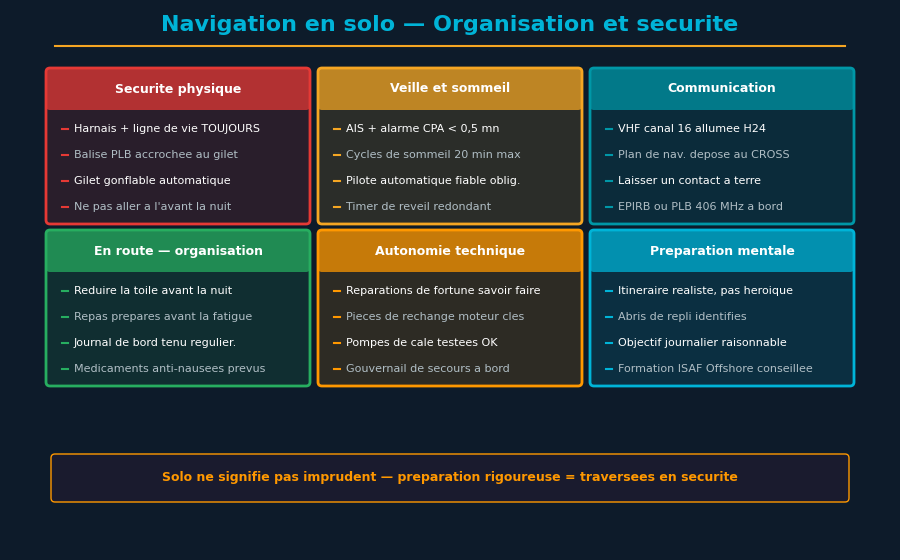
Single-handed sailors cannot maintain continuous watch. The sustainable pattern developed by ocean racers and cruisers is: 20 minutes of active steering + 40 minutes of sleep or rest, repeated continuously. This rhythm allows sufficient sleep to avoid fatigue while maintaining responsiveness. The key is disciplined use of alarms.
Modern systems use AIS alarm and radar guard zones to provide alerts. Configure: - AIS alarm: triggers audible alert if any vessel enters 2 nm zone - Radar guard zones: 1 nm immediate zone (red) and 5 nm outer zone (yellow) alert zones - Autopilot override alarm: sounds if wind vane or autopilot disconnects These alarms allow you to sleep with confidence that you'll be awakened if traffic approaches or steering fails. The 20-minute active steering period is used to visually scan the horizon, check trim, and adjust sails if needed.
This rhythm, maintained over weeks, provides 4-5 hours of sleep per 24-hour period—below ideal but sustainable. Crossing crew report that after the first 3-4 days, the body adapts and these short sleep cycles become effective. The critical rules: never skip the 20-minute watch no matter how tired, and immediately move to safety harness upon waking.
Managing Fatigue: The Ellen MacArthur Model
Ellen MacArthur's record-breaking solo circumnavigation in 71 days revealed the importance of power naps. She slept in 5-10 minute intervals rather than the traditional 20-minute cycle, allowing hyper-efficient alertness. Her system: every 60-80 minutes of active sailing, take a 5-10 minute nap if autopilot handles steering and alarms are armed. This provides ~120 minutes of sleep per 24 hours instead of 240-300 minutes, forcing the brain into polyphasic sleep mode. Not sustainable long-term (3-4 weeks maximum) but proven effective for intense passages.
Reefing Philosophy: The First Instinct
A solo sailor's golden rule: "First thought, reef." The moment you think about reefing, do it immediately. Delaying costs energy and increases risk. A well-practiced reef takes 3-5 minutes with modern in-mast or in-boom systems. The alternative—waiting until conditions deteriorate—forces you to reef in dangerous situations with less control.
Modern sails are designed to easily reef at any point. A roller furling main with batten system allows reduction from full sail to 30% in 90 seconds (motorized furler). Cost: 8000-12,000 EUR for quality installation but eliminates the physical strain of single-handed reefing. For traditional systems, reef points sewn into mainsail at 50%, 35%, and 20% coverage allow flexibility. The principle: always carry more canvas in reserve than you currently use.
In-Mast vs. In-Boom Furling
In-mast furling (main rotates around mast axis): faster to furl, lower cost (3000-5000 EUR), but creates shape distortion at deep reefs. The mainsail becomes triangular and inefficient. Better for motorsailing or light-wind work. Cost advantage: 30-40% cheaper than boom system.
In-boom furling (main rotates around boom axis): maintains better sail shape across all reef positions. Cost 6000-10,000 EUR, heavier boom, but preferred by serious cruisers. Disadvantage: if furling mechanism fails, sail is partially trapped inside boom—difficult to recover.
Jib handling via roller furler: 2000-3500 EUR, allows partial or full furling without touching headsail. This is essential for solo work. A properly sized roller allows you to reduce headsail from 100% to 25% in 30 seconds by pulling a line from the cockpit.
Collision Avoidance Technology: Radar and AIS Integration
Operating alone means you cannot maintain dedicated lookout. Radar and AIS compensate. A solid-state radar (Simrad Halo, cost 3000-5000 EUR) provides 24 nm range in typical maritime conditions. Modern systems integrate with AIS display, showing radar blips overlaid with AIS targets (vessel name, course, speed). If your radar shows a blip 8 nm away and AIS identifies it as a 180m container ship on collision course, you have 20+ minutes to alter course safely.
Configure your radar with collision-avoidance algorithms. Simrad Halo provides "target tracking"—the radar marks relative motion vectors for each target, showing predicted closest point of approach (CPA). If CPA is less than 1 nm and time to CPA is less than 12 minutes, this indicates collision risk requiring immediate action.
AIS MOB guard zones: set your AIS to activate audible alarm if any vessel enters within 2 nm and is on collision course. This catches fishing vessel fleets that might not be monitoring VHF. Small fishing boats may have older AIS transponders that don't have COLREG compliance, so your radar fills the gap.
Emergency Protocols: Flooding, Rigging Failure, and Hull Damage
Solo sailors must be able to handle emergencies without assistance. Pre-plan responses to common scenarios:
- Flooding (through-hull or seacock failure): Location of all seacocks, emergency patches, and manual bilge pump. Drill monthly: find the failed seacock in the dark under pressure. A soft wooden peg exactly sized to fit your largest through-hull will jam into a broken fitting. Keep multiple in labeled locations (cabin sole, emergency kit, forepeak). An electric bilge pump drawing 5A can remove 1000 gallons/hour—usually enough to manage slow leaks while you navigate to port.
- Rigging failure (shroud, stay, or halyard): Carry spare wire of various sizes (3 mm, 4 mm, 5 mm Dyneema). A failed upper shroud can be temporarily secured with tackle purchase of 2:1 (pulling aft) to prevent mast rotation. Know how to raise a storm jib and lower main using emergency halyard (often fitted in the boom). Practice once: in darkness or fog, lower mainsail in 60-knot wind using emergency halyard and staysail. Time yourself.
- Dismasting: Your boat must be capable of motoring to safety or sailing under storm jib alone. Establish a goal distance—can you sail 50 nm to nearest port without a mast? In Mediterranean, most positions are within 50 nm of land. In mid-Atlantic, you're 1000+ nm from safety. Passage planning must account for this.
- Engine failure: Can you sail your boat safely without engine? Many modern cruisers cannot—they're too heavy or poorly balanced under sail. If your boat requires engine for safety, carry spare fuel and perform engine maintenance diligently. A fuel gelling issue in cold water = disabled engine = serious problem.
Emergency Grab Bag Contents
An emergency grab bag must be pre-packed, mounted near the companionway, and accessible in 10 seconds: - PLB or EPIRB (activated immediately upon abandoning ship) - Waterproof flashlight with spare batteries - Knife (2: one folding, one fixed) - First aid kit (maritime-specific: bandages, antiseptic, pain relief) - Thermal protective foul weather gear (preserves body heat in cold water) - Sea anchors or drogues (slows drift, aids rescue coordination) - Signaling mirror and whistle (visible/audible up to 1 nm) - Emergency rations (high-calorie bars, 200+ calories) - Hand flare kit (6+ aerial flares visible 15+ nm) - Seasickness medication if prone
Famous Solo Sailors and Their Wisdom
Bernard Moitessier's 1968 circumnavigation in Joshua (39-foot wooden yacht) established the standard for modern cruising. His philosophy: "The sea, the wind, and the stars. No engines, minimal electronics." He navigated with sextant, felt his boat's motion intuitively, and made passages of 60+ days between stops. His lesson: traditional seamanship (learning to feel the boat, read the sea, anticipate weather) remains invaluable.
Éric Tabarly's numerous records proved that a small, well-designed boat with a capable sailor outperforms larger, less-skilled operations. His technique: obsessive preparation, constant vigilance, and reefing before conditions became critical. He famously sailed 500+ nm at sea in his 40-footer often covering 200+ nm daily. His margin of safety came from never pushing limits.
Ellen MacArthur's solo circumnavigation in 71 days (2004) was aided by modern electronics but also proved that polyphasic sleep patterns and hyper-efficient techniques allow solo sailing of heavy weather. Her record (2005 in Movistar, 72 days) demonstrated that modern catamarans with powerful engines and automation enable faster passages, but at cost of higher fuel consumption and less connection to traditional seamanship.
Deck Layout for Single-Handing: Practical Arrangements
Your boat's deck layout determines whether solo sailing is comfortable or exhausting. Critical features:
- Lines led to cockpit: All sail control lines (sheet, outhaul, downhaul, cunningham) should be accessible from steering position. Jib sheets, halyard, furler control, reefing lines—all should route to cockpit without requiring forward movement. Cost to retrofit older boats: 5000-10,000 EUR for professional installation.
- Clutches and cam cleats: Harken or Spinlock clutches allow one-handed line management. Jam a line in a clutch, adjust tension on the winch, then cleat off. This is faster than traditional knots and more secure. Cost: 200-400 EUR per clutch × 8-12 required = 2000-4000 EUR investment.
- Furlers: Roller headsail furlers (2000-3500 EUR) and in-mast main furlers (3000-5000 EUR) eliminate the need to go forward to manage sails. The speed and safety gain is enormous. Any serious solo cruiser budget must include these.
- Emergency tiller: If steering cable breaks, an emergency tiller (200-500 EUR) is your backup. Mount it accessible near the helm so it can be installed in 30 seconds. Test annually.
- Deck organization: Spinnaker pole, boom tent, fenders, anchor rode, and storm jib should be prepositioned for instant use. Don't store them where they require moving other gear to access. Label everything with permanent ink.
Passage Planning and Weather Windows
Solo sailors have less margin for error, making passage planning critical. A coastal passage of 100 nm in marginal conditions might take 20 hours with crew (who spell each other) but 36 hours solo—moving into darker, colder hours. The rule: plan passages for light winds and stable weather.
Study weather patterns 7-10 days before departure. For Atlantic crossings (30+ days), wait for high-pressure system to move into position, guaranteeing trade winds and stable conditions. For Mediterranean, wait for passing weather front to clear, ensuring 3-5 days of favorable winds. Delaying departure 3-5 days for better conditions is worth the effort—you'll cover 300 nm extra in better conditions and reduced fatigue.
Use specialized routing services: Windy, PredictWind, and Meteo Consult Marine provide 10-day forecasts of pressure systems, wind, and wave state. Plan your departure window to catch the optimal system. Solo sailors who depart in marginal conditions and encounter sustained 6-week gales (instead of expected 3-week trade winds) suffer disproportionately because they have no crew to share watch burden.
Conclusion: The Solo Sailing Mindset
Solo sailing is as much psychological as technical. The successful solo sailor combines rigorous preparation, redundant safety systems, and a calm approach to problem-solving. Every system is over-engineered for failure: if wind vane fails, autopilot engages; if autopilot fails, hand-steering resumes; if hand-steering becomes impossible, sea anchor deploys.
The first solo passage is always the most challenging. After your first 500 nm alone, you develop a sixth sense for the boat's behavior and a confidence in your preparation. The knowledge that you have practiced every emergency, that your boat is properly equipped, and that rescue systems (EPIRB, MOB1) are armed provides peace of mind. Solo sailing, at its best, becomes a meditative exploration of self-reliance and connection to the sea—a profound human experience unmatched in modern life.
Navigate Solo With Confidence
Real-time AIS monitoring, autopilot integration, and emergency alerts keep you safe when sailing alone. Discover YachtMate marine intelligence.
Discover YachtMate →