
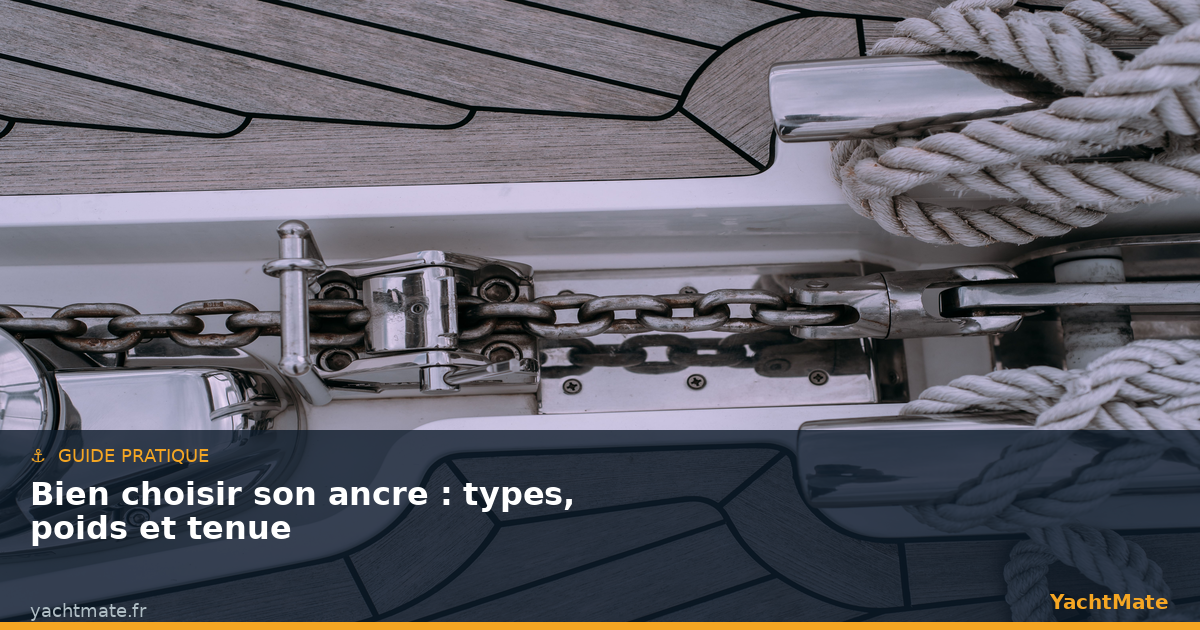
Your anchor is probably the most-used piece of safety gear on your boat. It holds you at anchor during a nap, keeps you off the rocks if the engine stalls near a harbour entrance, and makes all the difference when the wind picks up at night. Yet many boaters cruise with the factory-fitted anchor without ever wondering whether it actually suits them. This guide will help you choose the right model, the right weight and the right rode.
1. Why the anchor choice matters
An anchor does not hold by weight alone: it holds because its shape makes it dig into the seabed and bury itself under load. A well-designed anchor sets quickly, resists a wind shift and re-buries itself if it breaks out. An unsuitable or undersized anchor, on the other hand, can plough across the bottom without ever gripping — the dreaded "dragging anchor".
The right choice depends on three factors: the type of seabed you frequent, the size and weight of your boat, and your cruising program (a one-hour lunch stop or a night at anchor in a settled breeze).
2. The main types of anchors
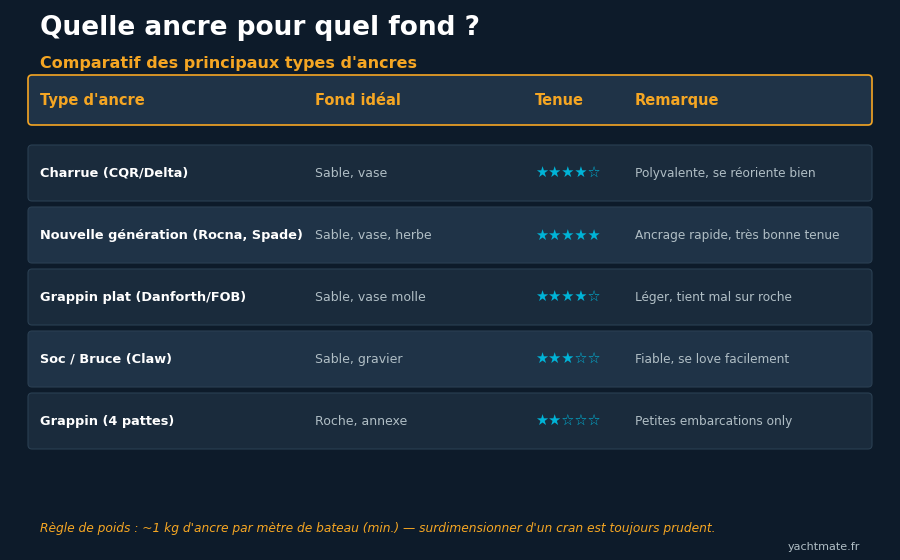
There are dozens of models, but they fall into a few broad families:
The plough anchor (CQR, Delta)
Recognisable by its single ploughshare, it is versatile and has been popular for decades. The Delta (fixed shank) sets faster than the hinged CQR. Excellent in sand and mud, it is a good default choice for most cruising sailboats.
New-generation anchors (Rocna, Spade, Vulcan, Mantus)
Introduced in the 2000s, they combine a concave fluke with a roll-bar (or a tip weight) that makes them set fast and dig deep. They offer the best average holding today, including on difficult bottoms. Their main drawback is the price.
The flat fluke anchor (Danforth, FOB)
Two large hinged triangular flukes offer an enormous gripping surface for a modest weight. Formidable in sand and soft mud, light and easy to stow: it is the ideal secondary anchor (kedge, fair-weather anchor). However, it holds poorly on rock and struggles to reset after a wind shift.
The claw / Bruce anchor
Shaped like a claw, it is reliable and easy to handle, stows well on the bow roller and forgives uneven or stony bottoms. Its holding is decent but lower than recent models of the same surface area.
The grapnel
This small four- or five-prong model is only for dinghies and light craft, or for hooking into rock. Avoid it as the main anchor of a liveaboard boat.
3. Choosing by seabed type
No anchor is perfect everywhere. The seabed you visit most should guide your choice:
- Sand — The best holding ground. Almost every anchor works; flat flukes and new-generation types excel.
- Mud — Good holding but slower to set. Favour a large surface (Danforth) or a new-generation anchor.
- Seagrass (Posidonia) — Difficult, and protected in the Mediterranean: anchor on the sand patches between the grass. High-penetration anchors cope better.
- Rock and shingle — No anchor truly "sets"; it wedges. A Bruce or a grapnel works, but keep a close watch on the boat.
On the YachtMate chart, the seabed type and community reviews help you spot the sandy patches where your anchor will hold best — before you even reach the anchorage.
4. What weight for your boat?
The most widespread rule of thumb is roughly 1 kg of anchor per metre of boat length for a traditional anchor. A 10-metre sailboat would therefore start with an anchor of around 10 to 15 kg. But that is only a starting point:
- Always refer to the manufacturer's sizing table, which factors in displacement and windage.
- Because new-generation anchors hold better for the same weight, some makers allow you to go down one size — stay cautious.
- If you anchor often, in heavy weather or in exposed spots, size up one step. A little extra weight on the bow roller rarely costs you at anchor.
The best anchor is the one you trust enough to sleep soundly. When in doubt, take the size up.
5. Chain, rope and the anchor rode
An anchor is only as good as the rode that links it to the boat. Chain brings three advantages: its weight keeps the pull horizontal along the bottom (the anchor works better flat), it resists chafe on rock, and it absorbs snatching. In the Mediterranean, where anchoring is frequent, an all-chain rode is the norm.
Rope is lighter and elastic, useful for small craft or as an extension. A mixed setup — a few metres of chain near the anchor then rope — lightens the bow while keeping the ballasting effect where it counts.
Whatever your rode, it is the length paid out that determines holding. The AnchorFix feature calculates the recommended chain length based on depth and weather, then watches your position all night.
6. Mistakes to avoid
Keeping the factory anchor without question
Boatyards often fit the bare minimum anchor to keep the price down. Check that it truly matches your program.
Undersizing "to save weight"
A few extra kilos on the bow change nothing in your performance, but can change everything in 30 knots of wind.
Neglecting the secondary anchor
Carrying a second anchor of a different type (for example a stowable Danforth alongside a plough) covers you on bottoms where the primary sets poorly.
Overlooking the shackle and swivel
A high-end anchor linked by a rusty or undersized shackle makes the whole safety chain only as strong as its weakest link. Thread-lock and regular inspection are essential.
Conclusion
Choosing an anchor means balancing the seabed you frequent, the size of your boat and your program. For versatile cruising, a correctly sized plough or new-generation anchor on a mostly-chain rode covers the vast majority of situations. And if you anchor regularly, don't skimp: it is one of the rare items where sizing up is a virtue.
Read also
Anchor with peace of mind using YachtMate
AnchorFix calculates your chain length, monitors your position and alerts you if you drag. Free.
Discover YachtMate