
Anchoring should be a pleasure, not a feat of strength. On a small boat with a light anchor, hauling the rode by hand is fine. But the moment you move up to a fifteen-kilo anchor and several dozen metres of chain, the electric windlass becomes the piece of kit that changes everything: it saves your back, makes the manoeuvre safer, and lets you anchor more often — and therefore better. Provided, of course, that you size it correctly, wire it properly and use it without abuse. Here is the complete guide.
1. What a windlass is for
The windlass is the winch fitted on the foredeck that raises and lowers the ground tackle. Its job is not just to spare your arms: it makes the manoeuvre repeatable and controlled. Anchoring and weighing become a matter of minutes, which encourages you to re-set your anchor when the spot isn't right, rather than putting up with it out of laziness. And a good hold depends as much on how well the anchor bites as on the length of chain you pay out.
There are two main families. The vertical windlass, with the gypsy axis vertical, takes up little deck space, copes better with loads and is the most common on modern yachts. The horizontal windlass, with a horizontal axis, keeps all its mechanism above deck: easier to install where the chain locker is shallow, but more exposed. In both cases the heart of the system is the same: a gypsy whose profile matches the exact calibre of your chain.
2. How it works
An electric windlass brings together a few connected parts. An electric motor, 12 or 24 volts, coupled to a gearbox, drives the gypsy. The gypsy is a profiled wheel that grips each link: it is what turns rotation into chain being hauled in. Most models add a smooth drum (or capstan) on the side, useful for working a rope. Control is from the deck via foot switches or a push-button, sometimes backed up by a wired or wireless remote from the cockpit.
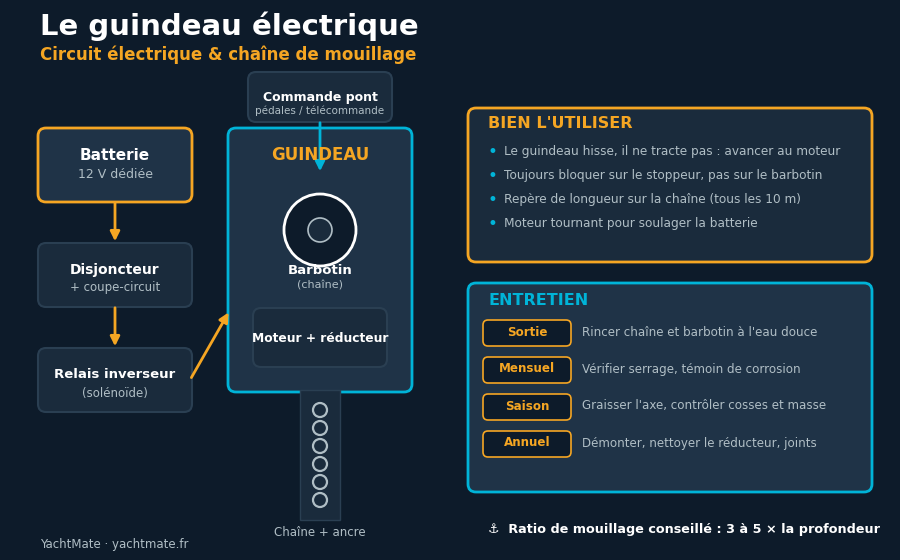
On the electrical side, current leaves a battery, passes through an isolator and a sized circuit breaker, then a reversing relay (the solenoid) that controls the direction of rotation — up or down. It is this relay that takes the high amperages: a weak point worth knowing when fault-finding. Finally, a separate chain stopper must always take the load once the anchor is set: the gypsy is not designed to remain loaded permanently.
3. Sizing it correctly
An undersized windlass struggles, overheats and fails early; oversized, it adds weight and cost for nothing. The reference rule is simple: the windlass must be able to lift at least three times the total weight of the ground tackle — anchor plus fully deployed chain. That margin absorbs the weight of the bow plunging in the swell just as the anchor breaks out.
| Boat size | Typical anchor + chain | Indicative power |
|---|---|---|
| 7 to 9 m | 8–10 kg + 30–40 m Ø8 | 700 to 900 W |
| 10 to 12 m | 15 kg + 50 m Ø10 | 1000 to 1200 W |
| 13 to 15 m | 20–25 kg + 60–80 m Ø10–12 | 1500 W and up |
Two points matter more than raw power. First, the gypsy must match exactly the diameter and pitch of your chain: a mismatched gypsy jumps, slips and damages the links. Insist on agreement between the chain standard (for example ISO Ø10) and the gypsy. Second, check the fall between the deck and the heap of chain in the locker: too little, and the chain piles up, jams and blocks the gypsy.
Weigh your complete rode once and for all: anchor, shackle, length of chain and any rope tail. Noted in your logbook, that figure stops you buying a windlass "by feel" and gives you the basis for the ×3 margin calculation.
4. The electrical circuit
This is where reliability and longevity are decided. A windlass draws very high currents — often more than a hundred amps at peak — but for short bursts. The great enemy is voltage drop in cables that are too long or too thin: the motor weakens, strains, overheats and eventually trips.
The best answer is to fit a dedicated battery forward, near the windlass, rather than running a long cable from the stern bank. Recharge it from the alternator via a combiner, and only call on it during manoeuvres. Failing that, allow a generous cable cross-section, calculated for the distance, and never skimp on it.
- Protection: a dedicated breaker or fuse sized for the motor, plus a manual isolator to cut the windlass off at rest and if something goes wrong.
- Cabling: heavy gauge, crimped and sealed terminals, run protected from the damp of the chain locker.
- Earth: a return as carefully done as the positive; many "windlass faults" are nothing but a corroded earth.
- Recharging: engine running during the manoeuvre, to spare the battery and steady the voltage.
5. Using it well
The most widespread — and most expensive — mistake is to drag the boat up to its anchor on the windlass alone. The windlass hauls the chain; it does not move several tonnes of boat. To weigh anchor, motor gently towards the anchor while a crew member takes up the slack: the windlass then merely recovers the chain as it goes slack, with no excessive effort. When it comes to breaking the anchor out of the bottom, it is the engine's drive, not the winch, that does the work.
To anchor, lower the chain in a controlled way rather than letting it run freely, which would wear the gypsy and risk jamming the locker. Once the anchor has set and the desired scope is out, transfer the load to the chain stopper, then ideally to a snubber that relieves the windlass and absorbs the shock loads.
The windlass hauls the chain; the engine moves the boat. Swapping those two roles is the surest way to burn out a windlass in a single season.
Always work in short bursts. These motors are not designed to run continuously: a few dozen seconds of effort, a pause to let things cool, then carry on. Watch the chain coming in so a link doesn't snag, and keep fingers well clear of the gypsy and drum, which forgive no lapse of attention.
Mark your chain every ten metres (paint or coloured markers). You'll know the deployed length at a glance and can calmly apply a scope of 3 to 5 times the depth, without guessing. YachtMate helps you log the type of seabed and the scope you've laid at every stop.
6. Maintaining it
Permanently exposed to spray, the windlass is one of the pieces of gear most attacked by corrosion. Its lifespan depends less on its brand than on regular maintenance, set on four levels.
After every trip
Rinse the gypsy, drum and windlass body thoroughly with fresh water to wash off the salt. The chain too deserves a hose-down before it goes back in the locker.
Every month
Check the tightness of the deck mountings, the absence of abnormal play and any trace of corrosion on the terminals and switch. Run the windlass unloaded to confirm it responds crisply in both directions.
Every season
Grease the shaft and the points specified by the maker, check the state of the cables, terminals and earth, and verify that the manual clutch works (the emergency handle must be able to free the gypsy).
Every year
Strip it down as per the manual to clean the gearbox, check the seals that protect the motor from water, and replace anything showing signs of fatigue. It is also the moment to inspect the chain link by link.
7. Common faults
Most failures can be diagnosed without heavy dismantling, as long as you know the usual suspects. When the windlass stops responding, the culprit is rarely the motor itself.
- Nothing happens: start with the isolator and breaker, then check the terminals and earth. A corroded or loose connection accounts for a large share of failures.
- Only one direction works: suspect the reversing relay (solenoid) or its control wiring.
- The motor turns but the chain won't come up: the clutch is slipping or not tightened, or the gypsy is clogged.
- The windlass strains and overheats: voltage drop (cable, weak battery), chain jammed in the locker, or an attempt to drag the boat.
- The gypsy jumps links: wrong chain calibre or a worn gypsy.
Always keep the emergency handle aboard and know how to free the gypsy to raise or lower the anchor by hand: the day the power fails at anchor, that is what gets you out of trouble. A windlass that is well sized, properly supplied and methodically maintained will serve you without complaint for years.
A good anchorage begins at the bow: the right anchor, the right length of chain, and a windlass you can trust.
Anchor with peace of mind, wherever you are
YachtMate keeps your maintenance checklists, seabed types, favourite anchorages and logbook in one place. Free.
Discover YachtMate