Assessing Wind Conditions and Selecting Protected Anchorages
One of the primary challenges in anchoring during strong winds is selecting a naturally protected anchorage from waves and wind pressure. Well-oriented bays, coves protected by rocky promontories, and zones sheltered by islands offer significant wind energy reduction and wave attenuation. Before anchoring, carefully study nautical charts to identify areas with topographic protection that will reduce wind speed. A bay oriented opposite to the dominant wind direction will provide crucial shelter and protection. The best anchorages in Western Mediterranean include the protected bays of the French Var region, small coves along the Catalan coast, and sheltered inlets in Provence, where coastal heights create low-wind zones behind rocky formations and provide maximum protection from open-water swells.
Chart Analysis and Weather Forecasting
Consult detailed weather forecasts at least 48 hours before planning your anchorage. Modern marine weather services offer fine-resolution wind forecasts (4-5 km) that show precisely how wind varies with local topography and coastal features. Check annual wind roses for the sector to understand dominant wind directions and seasonal variations affecting your cruising area. Tools like Windguru, Windy.com, and official marine weather services provide detailed numerical models updated hourly with satellite and buoy data. Always plan a backup anchorage in case conditions deteriorate more rapidly than forecasted, giving you options if the primary location becomes untenable.
Preparation of Anchoring Equipment
Success in anchoring during strong winds depends entirely on equipment preparation and quality assurance. Before anchoring, thoroughly inspect the anchor for corrosion, wear, or deformation affecting holding ability. Verify that the chain is in good condition: all links must turn freely, and there must be no active rust or broken links anywhere along its length. Test the mechanical windlass to ensure it functions without grinding or delays in deployment. Also verify you have sufficient chain length – for strong wind, minimum 150 meters is recommended on a standard 35-45 foot cruising yacht. Prefer galvanized or stainless steel chains over simple-coated chains for superior corrosion resistance.
Selecting Anchor Types for Difficult Conditions
Modern second-generation anchors (CQR, plow, danforth) offer better holding power in strong wind than simple anchors and provide more reliability. Bruce anchors and delta flukes provide rapid penetration into the bottom and maintain position even with significant wind direction changes during squalls. For soft bottoms (mud or fine sand), anchors with large penetration surfaces (such as delta or CQR) are superior for reliability and holding power. For hard rocky bottoms, Danforth anchors with long arms and pointed flukes grab rocks better than other designs. Consider carrying two anchors: a main anchor of 35-45 kg for a cruising monohull and a second emergency anchor slightly lighter (25-30 kg) in case the first anchor fails or is lost.
Anchoring Technique: Chain Scope
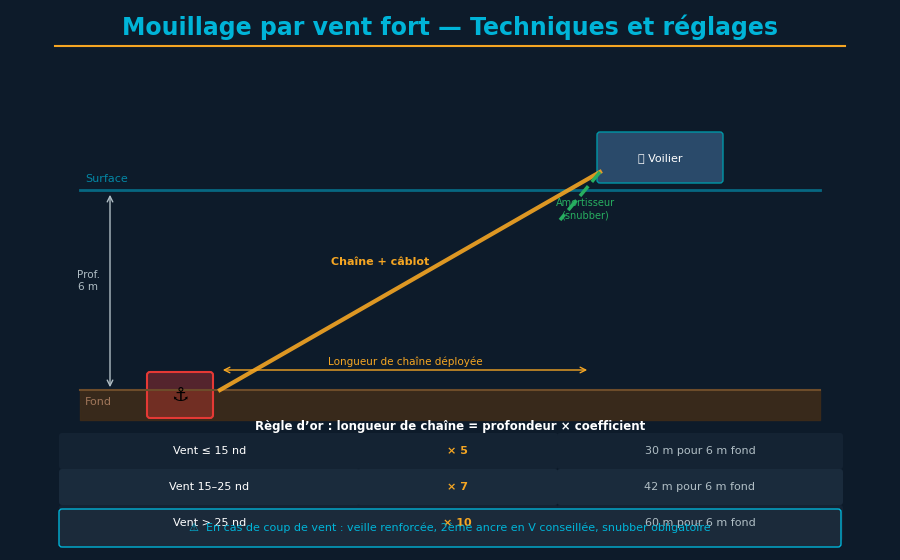
Chain scope (length ratio) is the critical factor determining anchor holding power in all conditions. A scope of 7:1 or 8:1 (seven to eight times water depth) is recommended for strong wind conditions. For example, in 8-meter depth, deploy 56 to 64 meters of chain to achieve proper loading angles. This generously high ratio creates a low angle between chain and bottom seabed, multiplying the friction effect that keeps the anchor securely in place without slipping. Longer chain also absorbs shock from sudden gusts by deploying progressively across the bottom and reducing peak loads. Experienced sailors rarely reduce this scope below 7:1, even in calm waters, to maintain a safety reserve for unexpected deterioration.
Progressive Deployment and Initial Monitoring
Approach the anchorage slowly into the wind, cut the engine before arriving at position, and let the boat drift slowly to windward. Stop chain deployment initially at approximately 20-30 meters to allow the anchor to penetrate the bottom gradually and develop initial holding. Observe if the boat falls back or pivots rapidly – this indicates the anchor is burying well into the seabed. Continue deploying chain progressively until reaching target scope calculated from water depth. Mark visual reference points ashore (distinctive trees, buildings, rocks) and observe the boat for 30 minutes minimum to verify it maintains the same position relative to chosen reference points and shows no drift.
Dragging Prevention (Continuous Verification)
Dragging occurs when the anchor moves across the bottom without maintaining holding power in strong winds. This can happen gradually or suddenly during intense wind gusts and changing pressure systems. Establish a monitoring routine: set visual "transits" – imaginary lines between distinct shore objects, trees, structures, rocks – and ensure the boat maintains the same position relative to these lines continuously. Install an anchor watch alarm on your GPS instruments if available: these alarms alert immediately if the boat exceeds a defined radius from the anchor point. At night, display the legally required anchor light (white light visible 360°) and arrange hourly watch rotations if possible to monitor both sides of the boat for drift or dangerous situations.
Dragging Prevention with a Secondary Anchor
For extremely difficult conditions (wind greater than 35 knots), use a tandem anchor system: a main anchor at shallow angle (scope 5:1-6:1) and a second anchor deployed approximately 45° from the first, at 7:1 scope to the seabed. This system distributes wind loads and provides complete redundancy if one anchor fails. If the first anchor drags, the second engages quickly and holds. Mediterranean navigators often employ this technique in November-December when Mistral winds reach extreme speeds (60-80 knots) and create hazardous conditions. Another time-tested technique is Mediterranean anchoring: deploy one anchor forward and one aft, perpendicular to wind, reducing dangerous swing and increasing overall stability of the moored vessel in strong conditions.
Supplementary Equipment and Safety
Beyond anchor and chain, several elements contribute to safe holding in strong wind conditions. A backup rope (galvanized steel cable 10-12 mm) stored on deck allows creating a second line quickly if necessary for emergency situations. Additional fenders protect the hull against impacts from other boats or coastal structures in emergency situations or high-traffic areas. A reliable communication system (marine VHF radio) allows contacting coastal authorities or other boats if the situation deteriorates dangerously and requires assistance. Always wear an automatic or manual lifejacket in difficult anchoring conditions: if you need to lean overboard to intervene with anchoring equipment, the lifejacket provides vital protection against drowning and keeps you afloat.
Preparing an Evacuation Plan
Even with best preparations, anchoring can fail in extreme conditions beyond equipment capabilities. Before anchoring, identify Plan B in detail: where to go if anchoring fails (accessible ports), what shelter ports are within reach in motoring distance (2-4 hours), what areas to avoid (rocks, shoals). Record GPS coordinates of backup ports, distinctive safety landmarks, and dangerous zones near your intended anchorage. In the Mediterranean, professional shelter ports like Toulon, Ajaccio, or Palma offer secure anchorages and emergency services available 24/7. Familiarize yourself with local maritime markers and emergency navigation procedures before anchoring in unfamiliar waters or difficult sectors.
In strong wind, measure scope by counting chain links accurately: each standard link (6-7 mm) measures approximately 35-40 cm total length. To achieve 8:1 scope, count links rather than estimate by eye or feel. Insufficient scope is the primary cause of dragging in difficult conditions and can lead to serious groundings or collisions.
"Chain is your best insurance in the Mediterranean. Nine extra meters of chain can save you a sleepless night and a dangerous situation." — Mediterranean coastal sailing wisdom and maritime tradition
Install a fluorescent fabric loop at mid-chain to quickly visualize how much chain you have deployed when anchoring. This avoids relying solely on manual counting of links, especially in difficult wind conditions or at night when visibility is poor and mistakes are more likely.
Equipment Maintenance and Regular Inspection
After each difficult anchoring situation in strong wind conditions, thoroughly inspect your equipment before storing it away. Look for cracks in the anchor, broken or bent links in the chain, and areas of active rust or corrosion needing immediate attention. Rinse chain and anchor with fresh water after each use in seawater, as salt accelerates corrosion of metal dramatically and causes long-term structural damage. Store chain in a well-ventilated area where it can dry completely and air-circulates freely around all surfaces. Every two years, have the chain professionally inspected: a chain house or boat yard can verify internal wear and detect invisible defects that visual inspection cannot find, ensuring safe operation.
Maintain an anchoring conditions log systematically: depth, bottom type (sand, mud, rock), recorded wind speed, and duration of each anchorage experience in different locations. This notebook becomes an invaluable resource for predicting future holding in similar conditions and identifying problem anchorages to avoid in future cruising seasons.