
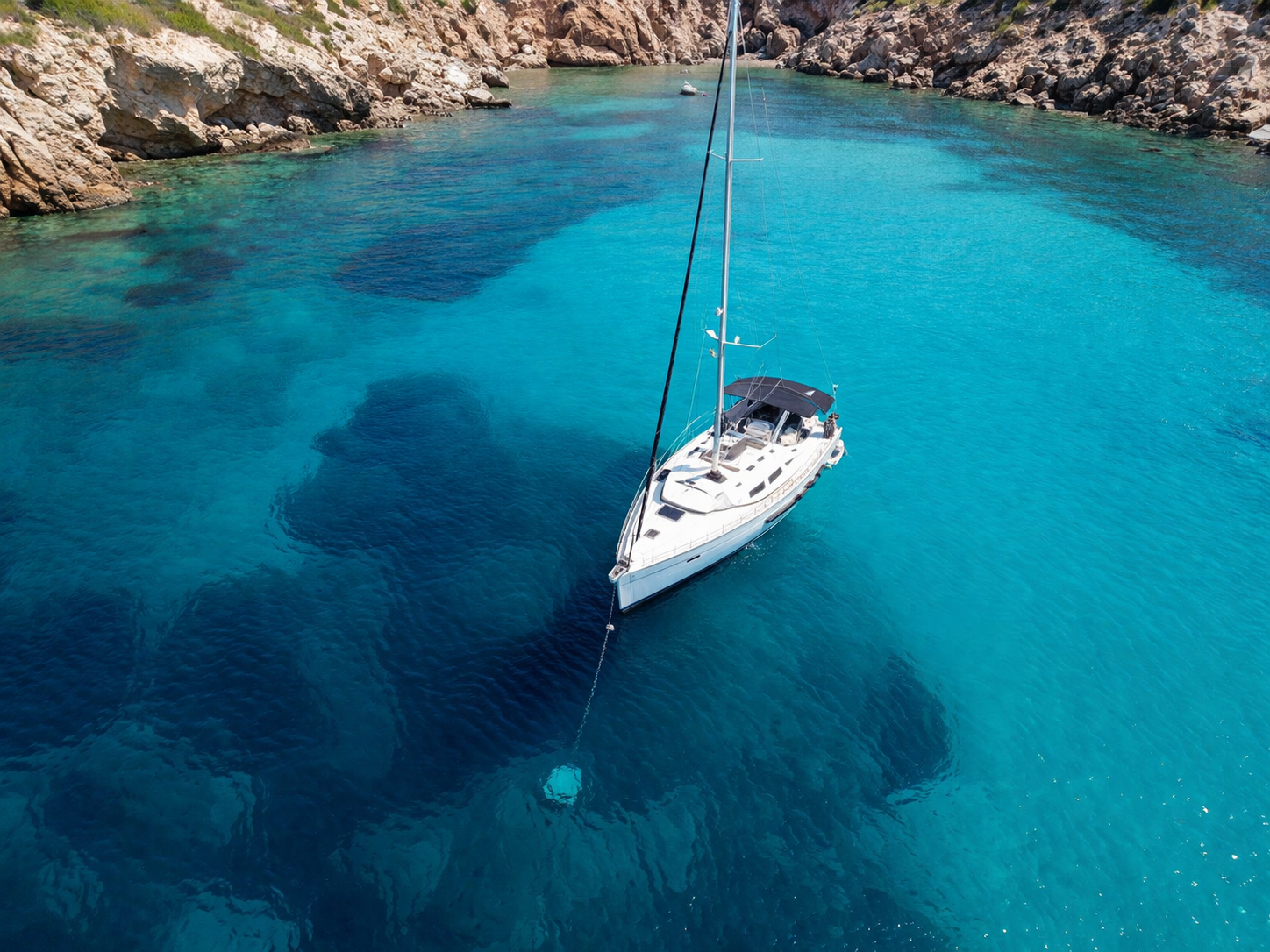
Anchoring is one of the most common manoeuvres in recreational sailing, yet it remains one of the most poorly executed. Whether you are a complete beginner or a seasoned sailor, a botched anchorage can turn a peaceful evening into a nightmare: silent drift, a dragging anchor, a collision with the boat next door. This guide gives you every key you need to anchor with confidence.
1. Choosing the right anchorage
Before you even think about your anchor, the choice of location is everything. A well-chosen spot means a quiet night; a poor one means stress, sleeplessness, and potentially a dangerous situation. Here are the criteria that matter most.
- Wind protection — Look for a cove or bay that is sheltered from the prevailing wind. Check the forecast for the next 24 hours at a minimum. A spot that feels calm at 5 pm can become a wind tunnel at midnight if a front passes through.
- Seabed type — Sand and mud offer the best holding. Avoid rock, posidonia grass beds (they are protected in the Mediterranean!) and thick weed, all of which prevent the anchor from digging in properly.
- Depth — Aim for 3 to 10 metres for a comfortable anchorage. If you are in a tidal area, factor in the full tidal range so you do not end up aground at low water or with an impossibly long chain scope at high water.
- Swinging room — Calculate your swinging circle (chain length plus boat length) and make sure you will not encroach on neighbouring boats when the wind shifts direction. Every boat in the anchorage will swing differently depending on hull shape, windage, and chain length.
- Regulations — Verify that anchoring is permitted in the area. Marine reserves, Natura 2000 sites, port approaches, and military zones are all off-limits or restricted in many countries.
On the YachtMate chart, popular anchorages are marked with community ratings. You can also see seabed type and depth before you arrive, so you can plan your stop with confidence.
2. How much chain to let out?
This is THE question every sailor asks. The golden rule is simple, and getting it right is the single most important factor in whether your anchor holds through the night or quietly drags you onto the rocks.
Let out at least 3 times the depth in calm conditions, 5 times the depth if wind is forecast, and 7 times in heavy weather.
A practical example
You are anchoring in 5 metres of water:
- Calm conditions: 5 × 3 = 15 metres of chain
- Moderate wind (15–20 kn): 5 × 5 = 25 metres
- Strong wind / gale warning: 5 × 7 = 35 metres
Do not forget to add the height of your bow roller above the waterline (often 1 to 2 metres) to your depth figure. It is the total distance from the seabed to the point where the chain leaves the boat that matters for the scope calculation.
Why does scope matter so much? A longer chain creates a more horizontal pull on the anchor, which helps it dig into the seabed. A short chain pulls upward, which is exactly how you retrieve an anchor — not how you want it to behave while you sleep. The physics are straightforward: more chain equals more holding power, up to a point of diminishing returns.
The AnchorFix feature automatically calculates the recommended chain length based on the depth and weather conditions at your location. No more mental arithmetic while you are trying to manage the windlass.
3. Step-by-step anchoring technique
A reliable anchoring routine is something you can practise until it becomes second nature. Here is the sequence that experienced sailors follow every single time.
- Approach head to wind — Motor slowly towards your chosen spot, heading into the wind or the dominant current. This gives you maximum control and allows the boat to stop naturally.
- Stop the boat — Shift into neutral and let the boat lose all forward momentum. It should be virtually stationary before you do anything with the anchor.
- Lower the anchor — Do not throw it! Lower it in a controlled manner using the windlass or by hand. The sound of chain screaming out of the locker at full speed is never a good sign — it means you have lost control.
- Let the boat drift back — The wind will naturally push the boat backwards. Pay out the chain steadily as the boat moves astern. If there is no wind, use a brief touch of reverse to create sternway.
- Cleat off and test — Once you have let out the desired length, cleat the chain and apply gentle reverse throttle. The chain should go taut and the boat should come to a firm stop. If it does, congratulations: the anchor has set.
- Take bearings — Record your GPS position and identify visual landmarks ashore (transit lines work best). These allow you to detect any drift later, especially at night when visual references are harder to assess.
If you are anchoring under sail without an engine, the approach requires more planning. Sail in on a close reach, drop the headsail early, and round up head to wind at the chosen spot. Have the anchor ready to go the moment the boat stops.
4. The 7 most common mistakes
Mistake 1: Not enough chain
This is the number one error by a wide margin. Sailors worry about taking up too much room in a crowded anchorage and err on the side of too little chain. The scope ratio is your best insurance policy — never compromise on it. If the anchorage is too crowded for adequate scope, find a different spot.
Mistake 2: Anchoring on bad holding ground
An anchor on rock or thick weed is an anchor that will not hold. Take the time to check the bottom with your depth sounder — a hard, flat echo usually means rock or hard sand, while a soft, fuzzy echo indicates mud or weed. If you can see the bottom, even better.
Mistake 3: Ignoring the tide
If the tide drops 3 metres overnight, your chain-to-depth ratio will change dramatically — and not in your favour. In tidal waters, always calculate your scope based on the depth at high water, not the depth when you arrive. Conversely, make sure you have enough water at low tide to stay afloat.
Mistake 4: Not testing the set
After letting out the chain, a firm burst of reverse throttle will tell you whether the anchor has dug in. If it skips or drags, you want to know now — not at 3 am when the wind picks up. Some sailors skip this step because they are tired or in a hurry. Never skip it.
Mistake 5: Forgetting the swinging circle
When the wind shifts, every boat in the anchorage swings around its anchor. If your neighbour is on a different amount of chain, or has a different hull shape, your swinging circles will not match — and that means a collision risk. Always check what the boats around you are doing before you settle in.
Mistake 6: No anchor alarm
You are asleep, the wind rises, the anchor starts dragging, and you do not notice until the hull crunches against rocks. An anchor alarm is not optional — it is essential. Modern GPS-based anchor alarms can detect drift of just a few metres and wake you instantly.
AnchorFix monitors your GPS position continuously and alerts you instantly if your boat moves outside the safe zone. The alarm works in the background, even with the screen off, so you can sleep with peace of mind.
Mistake 7: Anchoring too close to others
Respect distances. Every boat needs its full swinging circle. When in doubt, take more space rather than less. Your neighbours will thank you, and you will sleep better knowing a wind shift will not result in a midnight bumper-car session.
5. What to do if the anchor drags
Do not panic. Anchor dragging happens to everyone at some point, and the key is to respond quickly and methodically. Here is the procedure.
- Start the engine immediately — you need to be in control of the boat before anything else.
- Motor gently forward towards the anchor to relieve the load on the chain.
- Let out more chain if you have room, then cleat off and test again in reverse. Sometimes the anchor just needs more scope to dig in properly.
- If the anchor will not reset, retrieve it and start over in a better spot. Do not keep trying the same location — if the bottom is bad, it is bad.
If you are dragging towards a hazard (rocks, another boat, the shore), your priority is to get clear first. Motor out of danger, then deal with re-anchoring once you are in a safe position. There is no shame in leaving an anchorage — good seamanship means recognising when a spot is not working.
6. Anchoring at night
Spending the night at anchor is one of the great pleasures of sailing, but it requires extra precautions to keep things safe and comfortable.
- Display your anchor light (white light visible through 360 degrees) — this is a legal requirement in all waters under COLREGS and is essential for other vessels to see you.
- Let out more chain than you would during the day. Night-time thermals can bring unexpected wind increases, and you want extra margin while the crew is asleep.
- Activate a GPS anchor alarm before turning in. Set the radius conservatively — a few false alarms are far better than missing a real drag event.
- Have a plan B ready. Know where you would go if you had to leave the anchorage in a hurry. Identify the safest exit route in daylight and note it on your chart so you can follow it in the dark if needed.
- Check your chafe protection. If any part of the chain or rode is rubbing on the bow roller or fairlead, it can wear through overnight. Use a snubber or bridle to absorb shock loads and reduce chafe.
One final night-time tip: set a regular watch if conditions are unsettled. Even with an anchor alarm, a quick look around every couple of hours will catch problems early — a wind shift, a new arrival anchoring too close, or a change in swell that makes the anchorage less comfortable.
Conclusion
Good anchoring comes down to preparation: the right spot, the right amount of chain, a solid technique, and active monitoring. Master these fundamentals and you can enjoy your nights at anchor in complete tranquillity.
And for those who want to sleep truly soundly, AnchorFix keeps watch for you.
Read also
Anchor with confidence using YachtMate
AnchorFix calculates your chain, monitors your position and alerts you if you drift. Free.
Discover YachtMate