

There comes a moment in almost every passage when the wind moves aft and the boat seems to fall asleep. The genoa collapses in the mainsail's wind shadow, boat speed drops, and you find yourself eyeing the engine key. That is exactly where downwind sails — code 0, gennaker, spinnaker — change everything: used properly, they turn the dullest point of sail into the most enjoyable one on board.
Yet many cruisers leave them at the bottom of a locker. Not for lack of interest, but because the spinnaker carries a reputation as a temperamental beast, reserved for racers and quick to turn into a trawl net. That reputation is not entirely undeserved: a downwind sail hoisted badly, trimmed badly, or dropped too late really can ruin a day. But the difficulty lies less in the sail than in the method. With a clear procedure, a briefed crew and a respected wind limit, these sails become perfectly accessible for family cruising.
Understand the downwind angle before choosing the sail
Downwind, the logic reverses compared with upwind sailing. On the wind, you are trying to climb to windward and apparent wind is stronger than true wind. Downwind, the boat runs away from the breeze: its own speed is subtracted from the true wind. Sailing at 6 knots in 15 knots of true wind dead downwind leaves only 9 knots of apparent wind on deck. Hence that deceptive sense of calm — and the classic trap: you believe you are under-canvassed while the true wind is in fact building.
The second key concept is VMG (Velocity Made Good), the speed actually gained toward your destination. Counter-intuitively, running dead downwind at 180° is rarely the fastest route. At that angle the mainsail blankets the headsail, the flow separates, and the boat rolls. Most cruising yachts descend far faster by sailing a series of legs at 140-150° true and gybing between them. You cover slightly more distance, but noticeably faster — and far more comfortably.
Downwind, the straight line is rarely the quickest route. Two legs at 145° almost always beat a direct 180° course.
The three families of downwind sails
Under the catch-all word "spinnaker" sit several genuinely different sails, each with its own operating range. Picking the right one already solves half the problem.
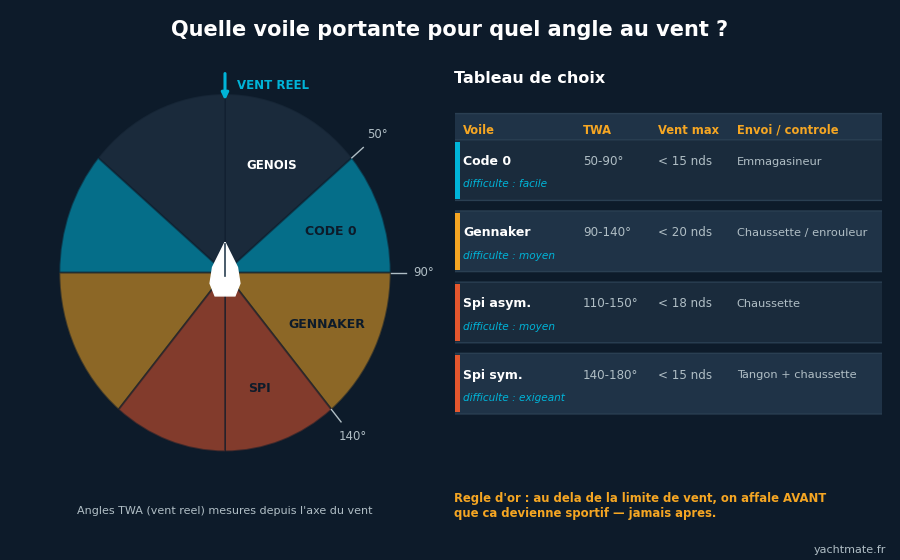
The code 0: an extension of the genoa
The code 0 is a flat sail, apparently full but cut for tight angles: from 50 to 90° true, in light air. Set on a top-down or continuous furler at the bowsprit or stem, it is deployed and rolled away from the cockpit with no foredeck work at all. It is the easiest downwind sail to live with, and often the best first purchase: it makes a cruising boat thoroughly enjoyable between 5 and 12 knots, exactly where the genoa alone stops being enough.
The gennaker and asymmetric spinnaker: the cruising compromise
The gennaker — often called an asymmetric spinnaker — has its tack fixed at the stem or on a bowsprit, with only one working sheet at a time. No pole, no guy: the manoeuvre is dramatically simplified. Its useful range runs roughly from 90 to 140°. It is today's cruising standard, and for good reason: it hoists in a snuffer with a short-handed crew, it forgives helming errors, and it can be recovered single-handed if necessary.
The symmetric spinnaker: performance and demands
The symmetric spinnaker, flown from a pole, remains king of the deep downwind range, 140 to 180°. It sails lower than anything else and it looks magnificent. But it requires a pole to trim, a guy and a sheet to coordinate, a foreguy and a topping lift — in other words, a practised crew. For family cruising it is not essential: the gennaker covers 90% of the need for a third of the mental load.
Write each downwind sail's wind limit on a label stuck inside its bag, in knots of true wind. The day the crew hesitates, the answer is written on the bag rather than left to the optimism of the moment.
Hoisting: the procedure that does not fail
Eighty percent of spinnaker mishaps are decided before the sail ever goes up. Preparation matters more than the manoeuvre itself.
1. Prepare alongside or at anchor
The first time, never prepare a spinnaker at sea. In calm conditions, take the sail out, identify the three corners (halyard, tack, clew), check it is not twisted inside its snuffer, and lead the sheets outside everything: shrouds, pulpit, lifelines, forestay. A sheet led inside the pulpit is a guaranteed failed hoist.
2. Choose the moment and the angle
Hoist a downwind sail on a broad reach, around 120-130° — never close-hauled and never dead downwind. At that angle the mainsail partially blankets the hoisting zone, limiting the load at the critical moment. The helm holds a steady course and calls the sequence out loud; this is not the moment to discuss lunch.
3. Hoist first, then set
The snuffer (or furler) lets you separate two steps that are too often merged: first hoist the smothered sail to the masthead, tension sheet and tack, and only then open the snuffer. The sail fills all at once, but the boat is already prepared for it. Doing the reverse — letting the sail fill while you are still hoisting — means fighting several hundred kilos of load.
Trim: three controls, no more
Once the sail is set, everything comes down to three adjustments. Contrary to received wisdom there is no esoteric secret: you ease, you watch the luff, you repeat.
- The sheet: the permanent control. Ease until the luff just begins to curl, then trim back a few centimetres. An over-trimmed sheet chokes the sail and makes the boat roll; this is by far the most common error.
- The tack line (or pole height): the stronger the wind and the deeper the angle, the higher you set it to open the sail. In light air or at tight angles, drop it fully to flatten the sail and project it forward.
- The mainsail: often forgotten, yet it must be eased generously with the vang on to stop the boom lifting. Otherwise it blankets the headsail and creates pointless heeling moment.
One last reflex: the helm. Under a downwind sail the boat tracks as if on rails as long as you follow the wind. If it starts rolling from side to side, the answer is almost always to bear away slightly and ease a little — not to fight it with the tiller.
Before hoisting, check the wind forecast in YachtMate: if the forecast gust exceeds your sail's limit within the next two hours, it is not a good window. A downwind sail is worth hoisting for at least 45 minutes of sailing — otherwise the effort is not worth it.
Gybing under a downwind sail
Gybing under spinnaker frightens people, often wrongly. Downwind, boat speed reduces apparent wind: the gybe is less violent there than on a reach. The danger comes not from the headsail but from the mainsail, which crosses the boat with considerable energy.
The sequence, for a gennaker: the helm calls it, bears away progressively to dead downwind, one crew member takes the mainsheet to the centreline and pays it out under control to the new side, while another passes the gennaker sheet around the forestay. You finish by gently heading up to the new course. None of this should be rushed: a good gybe is a slow gybe.
With a symmetric spinnaker you must additionally move the pole from one side to the other (end-for-end gybe), which requires someone on the foredeck and good coordination. It is entirely doable, but only makes sense after several practice runs in light air.
Dousing: the mark of a calm crew
If you remember only one thing: sails are dropped too late far more often than too early. The right window to douse is while the wind is building but the manoeuvre is still easy — not when the boat is broaching and the helm has gone heavy.
The procedure mirrors the hoist: bear onto a broad reach, blanket the sail behind the mainsail, ease the sheet slightly, pull the snuffer down (or roll the furler), and only then release the halyard. Smother first, halyard second: never the other way round.
Agree a crew rule before leaving: "we douse at X knots sustained." It prevents debate at the worst possible moment, when fatigue and the urge to press on always pull in the same direction.
The mistakes that come back most often
- Underestimating true wind. Reduced apparent wind downwind lies; always reason in true wind, whether displayed or calculated.
- Hoisting dead downwind. The sail blows to windward in the blanket zone, wraps around the forestay, and the day gets longer.
- Over-trimming the sheet. The boat rolls, you blame the sea: it is almost always the trim.
- Forgetting the boom vang. Without it, the gybe becomes markedly more dangerous.
- Stowing the spinnaker wet and twisted. The next hoist begins with the previous stow.
- Hoisting without a briefing. Everyone must know which line they hold and what they do with it on the call.
Where to start in practice
If you have never sailed under a downwind sail, a sensible progression has three steps. First a code 0 or a furling gennaker, used without leaving the cockpit, which removes the psychological barrier. Then snuffer hoists of the gennaker in 8 to 12 knots of steady breeze, in flat water, repeated until the sequence becomes mechanical. Finally, and only if your programme justifies it, the symmetric spinnaker and its pole.
What makes the difference is never the equipment: it is the repetition of a procedure everyone on board knows. A well-handled downwind sail is worth on average 1 to 2 knots downwind, an engine that stays off and — not a small thing — crew who ask to go sailing again.
Plan your downwind legs with YachtMate
Detailed wind forecasts, true wind angles and live tracking of your route: everything you need to pick the right sail at the right moment, and to know when to take it down.
Discover the appTo go further, read our guides on apparent wind and true wind, on reducing sail and on optimising sailing performance.