
You are sailing upwind in a forecast 12 knots, yet your anemometer reads 16. You tack, bear away downwind, and suddenly that same wind feels like it has dropped by half. The wind has not changed: it is the apparent wind that shifts with your point of sail. Understanding the difference between true and apparent wind is understanding why your sails behave the way they do — and how to trim them right.
1. Two winds, not one
The true wind is the meteorological wind: the one blowing over the sea that a perfectly still observer would measure — a buoy, a signal station, a boat at anchor. It is the wind of forecasts and GRIB files, defined by a direction and a speed.
The apparent wind is the wind you actually feel on board the moment the boat moves. Walk into a light breeze: it feels stronger than when you stand still. Ride a bike on a calm day: you "create" a headwind. Under sail it is exactly the same. A moving boat generates its own wind, which combines with the true wind to give the apparent wind.
The key takeaway: your sails never work in the true wind. They always work in the apparent wind.
2. How apparent wind is born
Apparent wind is the result of a simple addition of velocities. You add two "vectors": the true wind on one side, and the wind created by the boat's motion on the other (equal in strength to the boat's speed, but blowing in exactly the opposite direction to its track). The sum of the two gives the direction and strength of the apparent wind.
In practice this tells you two very useful things. First, the apparent wind always comes from further forward than the true wind: it is shifted toward the bow. Second, its strength depends on the point of sail: it can be greater or smaller than the true wind depending on whether the boat is sailing up or down the wind.
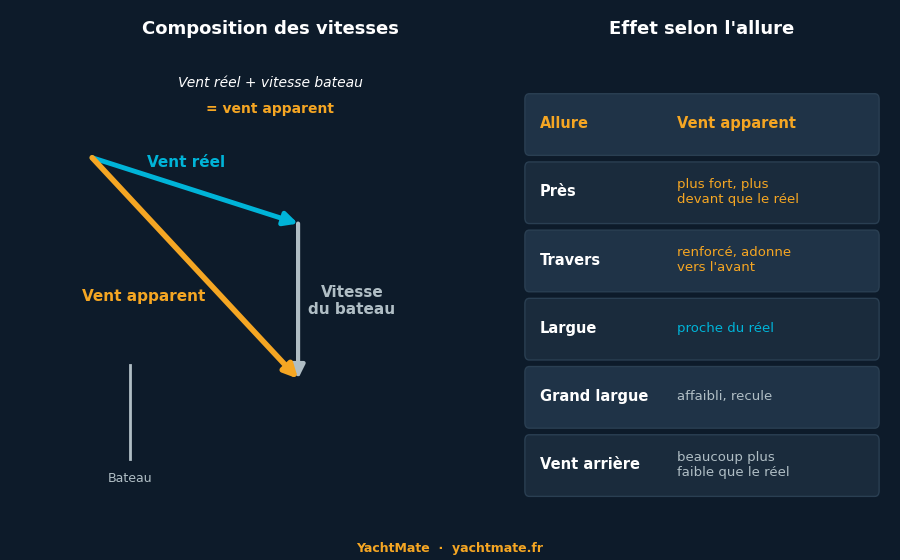
No need to reach for a calculator at sea: just keep the triangle in mind. The faster the boat goes or the closer it sails to the wind, the longer the "boat speed" arrow — and the more the apparent wind swings forward and builds.
3. What the point of sail changes
The gap between true and apparent wind is not constant: it varies with the angle at which you sail relative to the wind.
Upwind (close-hauled)
The boat partly moves toward the wind. Its motion adds to the true wind: apparent wind is stronger and comes from much further forward. That is why you heel and load up more upwind than the forecast suggests — and why a reef may be needed well before the "announced" figures.
On a beam reach
True wind at about 90° to the track. Apparent wind stays boosted and shifted forward, but less dramatically than upwind. This is often the fastest and most comfortable point of sail.
Broad reach and running
The boat starts to run away from the wind. Boat speed subtracts from the true wind: apparent wind weakens and moves aft. The sensation of wind fades, even though the true wind has not changed at all.
Dead downwind
The extreme case: the boat sails away in the wind's direction. Apparent wind equals true wind minus boat speed. In light air, making 5 knots in 8 knots of true wind leaves just 3 knots of apparent wind: the sail collapses and everything feels soft. It is a classic trap — the wind is there, but you are "carrying it with you".
Running downwind, we almost always underestimate the true wind. Before gybing or dropping sail, check the computed true wind (or look at the sea and the upwind boats around you): it is usually stronger than it feels.
4. Why it drives your trim
Since the sail only "sees" the apparent wind, it is the apparent wind that dictates how to sheet in or ease. You trim to the apparent wind angle, not the true wind. It is also why you must sheet in as you accelerate: when the boat speeds up (in a gust, surfing a wave), the apparent wind moves further forward, and a sail trimmed a moment earlier is suddenly too open.
This mechanism also explains the performance of fast boats. A catamaran or a foiler goes so fast that it generates a strong, very forward apparent wind, even sailing downwind: it is permanently sailing "apparent-wind upwind" and can travel faster than the true wind. On a typical cruising yacht the effect is more modest, but the principle is the same in every gust.
5. Reading your instruments
On board, the vane and the anemometer at the masthead always measure apparent wind: they move with the boat, so they "feel" what the sails feel. That is handy for trimming, but misleading for judging the actual weather.
Modern instrument systems then compute the true wind from three inputs: the measured apparent wind, the boat's speed (log) and its heading. Most display both: AWA/AWS (apparent wind angle and speed) and TWA/TWS (true wind angle and speed). Knowing which one you are looking at avoids a lot of confusion.
- To trim sails: rely on apparent wind (vane, AWA).
- For strategy and weather: think in true wind (TWA/TWS), comparable to forecasts and GRIBs.
- To choose a point of sail or a route: true wind tells you where the wind really comes from.
YachtMate cross-references your heading and GPS speed with the forecast to give you the true wind expected along your route — useful to anticipate a gust, a lift, or the right moment to reef.
6. Common mistakes
Trimming to the true wind
Trying to set your sails against the weather direction makes no sense: the sail only knows the apparent wind. Trim to the vane, not the forecast.
Underestimating the wind downwind
The apparent calm of a broad reach or run hides the true strength of the wind. When gybing, when luffing up, or if the boat slows, the apparent wind returns all at once: be ready.
Not sheeting in for gusts
When you accelerate, the apparent wind moves forward: a well-trimmed sail becomes too open and loses power. A small pull on the winch at the right moment makes all the difference.
Confusing AWA and TWA on screen
Taking an apparent-wind figure for true wind (or the reverse) distorts your read of the weather and your route choice. Always check which wind your instrument is showing.
Conclusion
True and apparent wind are not abstract notions reserved for racers: they are the key to understanding what you feel at the helm. True wind describes the weather; apparent wind drives your sails and always comes from further forward — stronger upwind, weaker downwind. Keep the velocity triangle in mind, know which wind your screen shows, and sheet in when you accelerate: your trim will sharpen at once — and so will your boat speed.
Read also
Sail with the right wind in mind
YachtMate combines your route and the forecast to display expected true and apparent wind, and warns you before the gust too far. Free.
Discover YachtMate