
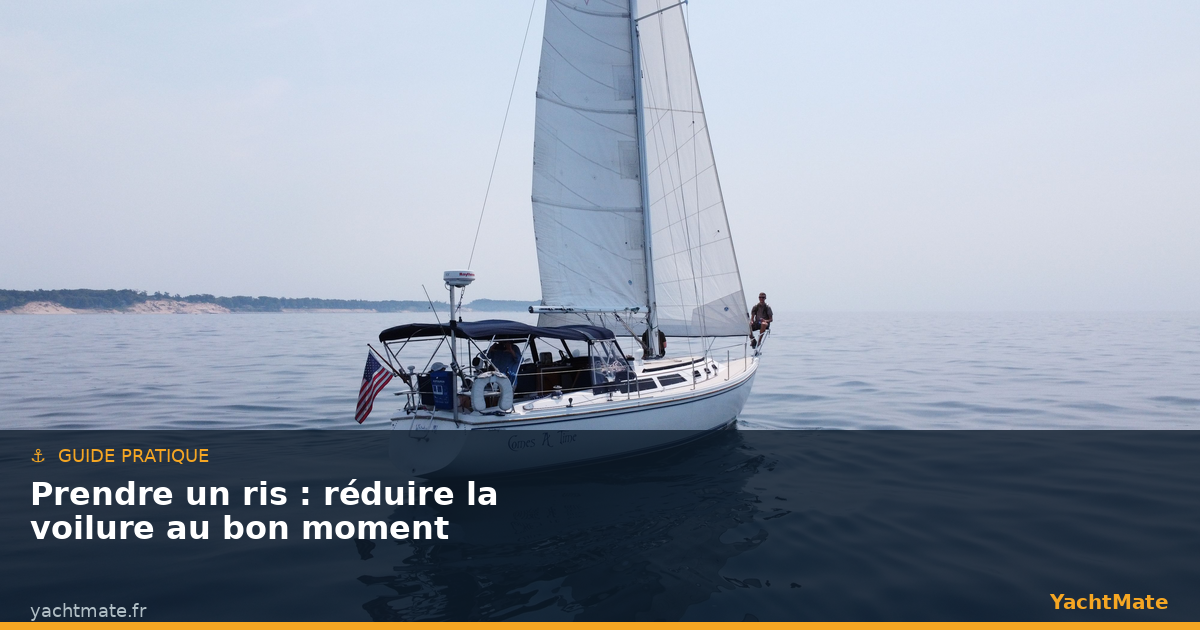
Every sailor knows the saying: "if you are wondering whether to reef, you should have reefed ten minutes ago". Behind the joke lies a simple truth: reducing sail is a decision you take early, calmly, while the boat is still easy to handle. Leave it to the last moment and you will be working on a deck heeling at 30 degrees, with a flogging mainsail and a crew that is already tired.
Reefing means reducing the area of the mainsail by pulling it down onto the boom at a reef band. Most cruising mainsails have two or three of them. This guide explains when to reduce sail, how to do it cleanly depending on the system fitted to your boat, and which mistakes cost the most.
Why reduce sail?
Contrary to a persistent myth, an overpowered sailboat does not go faster. Beyond a certain angle of heel the hull loses its hydrodynamic balance, the rudder stalls intermittently and the boat slips sideways instead of moving forward. Reefing at the right moment usually improves speed over ground while making the helm docile again.
- Safety: less heel, less risk of broaching, of being caught out by a gust or of taking a breaking wave beam on.
- Comfort: a boat heeling at 15 degrees is liveable; at 30, cooking, sleeping or navigating becomes an ordeal.
- Balance: an oversized mainsail creates weather helm that constantly pushes the bow up into the wind.
- Gear: the rig, the sails and the autopilot suffer far less with a sail plan matched to the wind.
Recognising the moment
What the boat tells you
The boat speaks before the wind does. Listen to it:
- Heel stays above 20 to 25 degrees and not only in the gusts.
- The helm becomes heavy with strong weather helm: you fight the wheel to hold your course.
- The boat rounds up in the gusts despite sail trim.
- The autopilot struggles, alarms or wanders off course.
- The windward deck takes water regularly; crew no longer move without holding on.
What the sea and the forecast tell you
The sea builds, foam forms streaks downwind and, above all, the forecast shows the wind increasing. Plan for the expected gust, not for the average wind. A steady 18 knots gusting 28 sails like a force 6, not a force 5.
Take your reef before leaving the shelter of a headland or a bay, or before nightfall if the trend is upward. On a stable deck the manoeuvre takes two minutes; in a seaway it takes ten, and carries real risk.
Practical reference figures
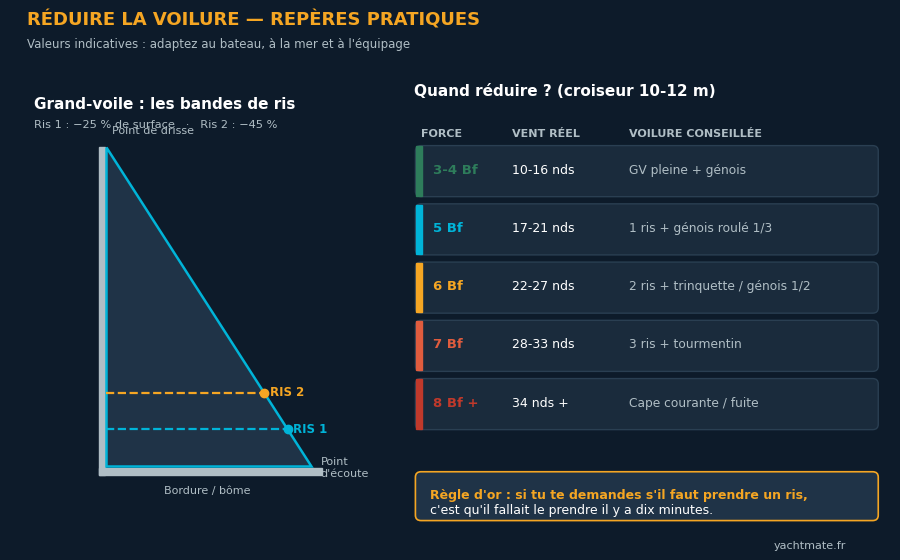
Every boat has its own thresholds, driven by ballast, hull shape and sail plan. The table below gives typical orders of magnitude for a 10 to 12 metre monohull cruiser, upwind or on a reach. Write yours in the logbook and refine them season after season: off the wind you can often carry sail longer, but beware of an accidental gybe.
The main reefing systems
Slab (classic) reefing
The halyard is eased, the reef tack is hooked onto a horn or block at the mast foot, then the reef line pulls the new clew down along the boom. It is the most robust and forgiving system, but it requires going to the mast, so a harness and jackstay are essential.
Single-line reefing
One line led back to the cockpit takes up tack and clew at the same time. Very comfortable and safe — you never leave the cockpit — but friction is significant: expect winch work and keep the sheaves in good condition. Check the lines for chafe regularly.
In-mast or in-boom furling
Furling systems allow infinitely variable sail area, which families love. The trade-offs are a less efficient sail shape (little or no roach) and the risk of a jam if you furl badly or under too much load. Always depower the sail before furling; never force it.
Step-by-step procedure
- Prepare: brief the crew, harnesses and lifejackets on, lines and halyard clear and free, vang ready to ease.
- Choose a favourable point of sail: close reach or beam reach, sail depowered but the boat still moving. Avoid running downwind (loaded boom) and head-to-wind (violent flogging).
- Ease the vang and support the boom (topping lift or rigid vang) so it does not drop onto the deck.
- Ease the mainsheet just enough to depower without letting the sail flog excessively.
- Lower the halyard to the reef mark — a marker-pen mark on the halyard saves guesswork.
- Secure the tack: horn, strop or tack line taken to the winch.
- Take up the reef line to pull the new clew down and well aft against the boom; the foot must be tight.
- Re-tension the halyard, sheet in and reset the vang.
- Tidy up: gather the loose sail on the boom and tie it with light sail ties, never with a line strong enough to tear the sail if it takes the load.
Practise the manoeuvre in calm weather once a season, rotating each crew member through each station. The night the wind builds at dusk, the moves must be automatic.
What about the headsail?
Reefing only the mainsail unbalances the boat forward: it becomes sluggish and refuses to point. Keep a coherent sail plan. With a furling genoa, roll it in thirds, re-tension the sheet and move the car forward to keep a decent sheeting angle. Past half furled the sail becomes baggy and inefficient: switch to a staysail or a solent if you have one.
Shaking out a reef
Going back to full sail is simpler but deserves the same care: ease the sheet and the vang, release the reef line, free the tack, then hoist the halyard fully before sheeting in. Never shake out a reef "to see" while the sea is still up: if the wind drops then builds again you will have done two manoeuvres instead of one. Wait for a confirmed lull — ideally ten minutes of steady wind below your threshold.
The most common mistakes
- Waiting too long — the first and most expensive one.
- Forgetting to ease the vang: the foot will not come down, the sail loads up, the reef line breaks.
- A poorly tensioned clew: the sail bags out, efficiency collapses and the cringle works in shear.
- Reefing downwind: loaded boom, gybe risk, exposed crew.
- Ignoring the headsail: unbalanced boat, impossible to hold a course.
- Not clipping on: in a seaway the mast foot is the most dangerous place on the boat.
A reef taken too early costs a few tenths of a knot. A reef taken too late can cost a sail, a crew member or a sleepless night.
Key takeaways
Reducing sail is not an admission of weakness, it is good seamanship: it puts the boat back inside its optimal operating range. Decide early, base the decision on forecast gusts, train your crew in fine weather and keep the sail plan balanced fore and aft. Speed, comfort and peace of mind follow naturally.
Sail with more confidence using YachtMate
Wind, gusts, marine forecasts and routing in a single app — everything you need to decide to reef before it is too late.
Download YachtMate for free