Tossing a plastic wrapper overboard, emptying bilge water in open sea, or disposing of a rubbish bag two miles from the coast: these practices, sometimes taken for granted, are now heavily penalised. The MARPOL (Marine Pollution) convention and its Annex V strictly regulate waste management on board all vessels, including leisure craft. Understanding these rules means protecting the oceans and avoiding potentially steep fines.
What is MARPOL Annex V?
The International Convention for the Prevention of Pollution from Ships, signed in London in 1973 and amended in 1978, is commonly known as MARPOL 73/78. It is organised into six annexes, each addressing a type of pollution. Annex V deals with garbage and solid waste.
Since its major revision which came into force in January 2013, Annex V has significantly tightened the rules. The central principle is simple: all garbage discharge at sea is prohibited by default, with very limited and strictly controlled exceptions. This general prohibition replaces the old approach which permitted certain discharges beyond a sufficient distance from shore.
Who is affected?
MARPOL applies to all vessels navigating at sea, including leisure sailboats and motorboats, with no minimum size threshold regarding the basic prohibitions. The obligation to keep a Garbage Record Book only applies to ships of 100 gross tonnes or more, and to ships certified to carry 15 persons or more — which excludes most leisure sailors. But the discharge prohibitions apply to everyone.
Even if you have no legal obligation to keep a garbage log on your 10-metre sailboat, getting into the habit of recording your legal discharges and port drop-offs is excellent practice in the event of an inspection by the maritime authorities.
What is strictly forbidden
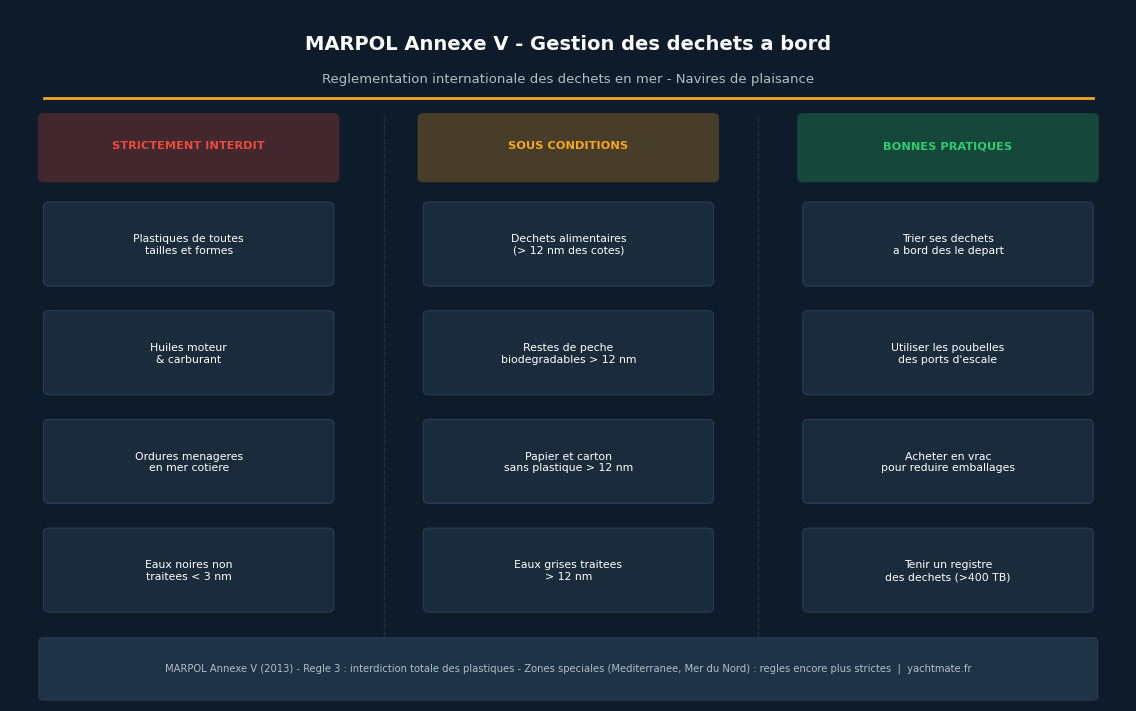
The most important article of the 2013 revision is Rule 3 of Annex V: a total ban on the discharge of all plastics at sea, regardless of distance from shore. Here is what you must never throw overboard:
- Plastics in all forms: bags, bottles, packaging, synthetic ropes, fishing nets, plastic films, polystyrene
- Engine oil, fuel and maintenance fluids (also covered by Annex I for hydrocarbons)
- Metals, glass, rags impregnated with chemicals
- Mixed household waste containing plastics or hazardous substances
- Incinerator ash containing toxic residues
Special areas: even stricter rules
Certain maritime zones are designated as "special areas" due to their particular ecological sensitivity. In these zones, nearly all garbage discharge is prohibited, including food waste. For Mediterranean and northern European sailors, the relevant special areas are the Mediterranean Sea, the Baltic Sea, the North Sea and the Black Sea. Sailing in these waters therefore requires even more rigorous on-board waste management.
What remains permitted under conditions
Outside special areas, a few discharges remain theoretically permitted, but subject to very strict distance requirements from the nearest land:
- Food waste (not ground): prohibited within 12 nautical miles of shore
- Ground food waste (pieces smaller than 25 mm): prohibited within 3 nautical miles
- Animal carcasses: permitted beyond 12 miles, with certain health conditions
- Fishing remains that are 100% biodegradable: beyond 12 miles outside special areas
In practice, during a coastal cruise or sailing in the Mediterranean, these distances are rarely reachable. The wisest course of action remains to throw nothing overboard and to bring everything back to port.
For food waste, use a small on-board composter or refrigerated airtight bags. If you are genuinely offshore (more than 12 nm), vegetable peelings and meal scraps without packaging may be discharged — but be cautious in the Mediterranean, which is a MARPOL special area.
Penalties
In most countries that have ratified MARPOL, penalties for violations can be severe. Fines for legal entities can range from tens of thousands to millions of euros, with criminal liability for the most serious infringements. For leisure sailors, dropping a plastic bag overboard can result in several hundred euros in fines if caught by maritime police. Surveillance has intensified in recent years, with drones and cameras increasingly used in popular anchorages and harbour approaches.
Mandatory on-board display
Leisure vessels over 12 metres are required to display a garbage management plan on board, describing procedures for collecting, storing, treating and disposing of waste. This document must be written in the working language of the crew. Even if your boat is smaller, following this framework is excellent practice.
Organising waste management on board
Good waste management starts before you even leave port. With planning and organisation, you can significantly reduce the amount of waste generated on board.
Before departure: reduce at source
The best waste is the waste you do not produce. Before setting off:
- Remove excess packaging from products and dispose of it at the marina's bins
- Transfer food into reusable containers (airtight boxes, reusable bags)
- Choose large quantities over individually wrapped items
- Select biodegradable, concentrated cleaning products
- Bring reusable water bottles and avoid single-use plastic bottles
Prepare at least three separate bins on board: recyclables (plastic, metal, glass), food waste, and residual waste. Colour-coded rubbish bags make it easy to distinguish categories. When in port, find collection points through the YachtMate app.
At sea: store cleanly
Space is limited on board, but waste storage must be planned. Use sturdy, airtight bags to prevent smells and leaks in the bilge. Compact packaging to save space. Some sailors use external nets for clean, rinsed bottles, but ensure they are well secured to prevent accidental loss overboard.
Grey water (kitchen, washbasin, shower) may generally be discharged at sea outside special areas, but using biodegradable cleaning products is strongly recommended. Black water (toilets) is subject to specific rules and must be stored in a holding tank and emptied only at authorised port facilities, or beyond 3 miles (12 miles in special areas).
In port: use collection facilities
The vast majority of marinas are now equipped with waste collection points. European regulations require ports to provide garbage reception facilities. Take advantage of every stopover to empty your bags into the appropriate containers. Some ports even offer collection points for used oils, filters, batteries and chemicals.
The real impact on the oceans
Understanding why these rules exist reinforces the motivation to follow them. Every year, between 8 and 12 million tonnes of plastic end up in the oceans. Leisure sailing represents a portion of this pollution, a minority compared to commercial shipping or land-based sources, but not negligible. A single plastic bag can take up to 400 years to break down, fragmenting into microplastics that contaminate the marine food chain — and ultimately, our plates.
The Mediterranean, a semi-enclosed sea with very slow water renewal, is one of the most plastic-polluted seas in the world. As sailors, we are both witnesses to this degradation and part of the solution.
"Sailing means belonging to the sea. Taking care of it is preserving that privilege for future generations."
YachtMate: your responsible cruising co-pilot
Easily find waste collection points in port, consult local regulations and plan your cruises with marine protected areas in mind.
Download YachtMate for free