
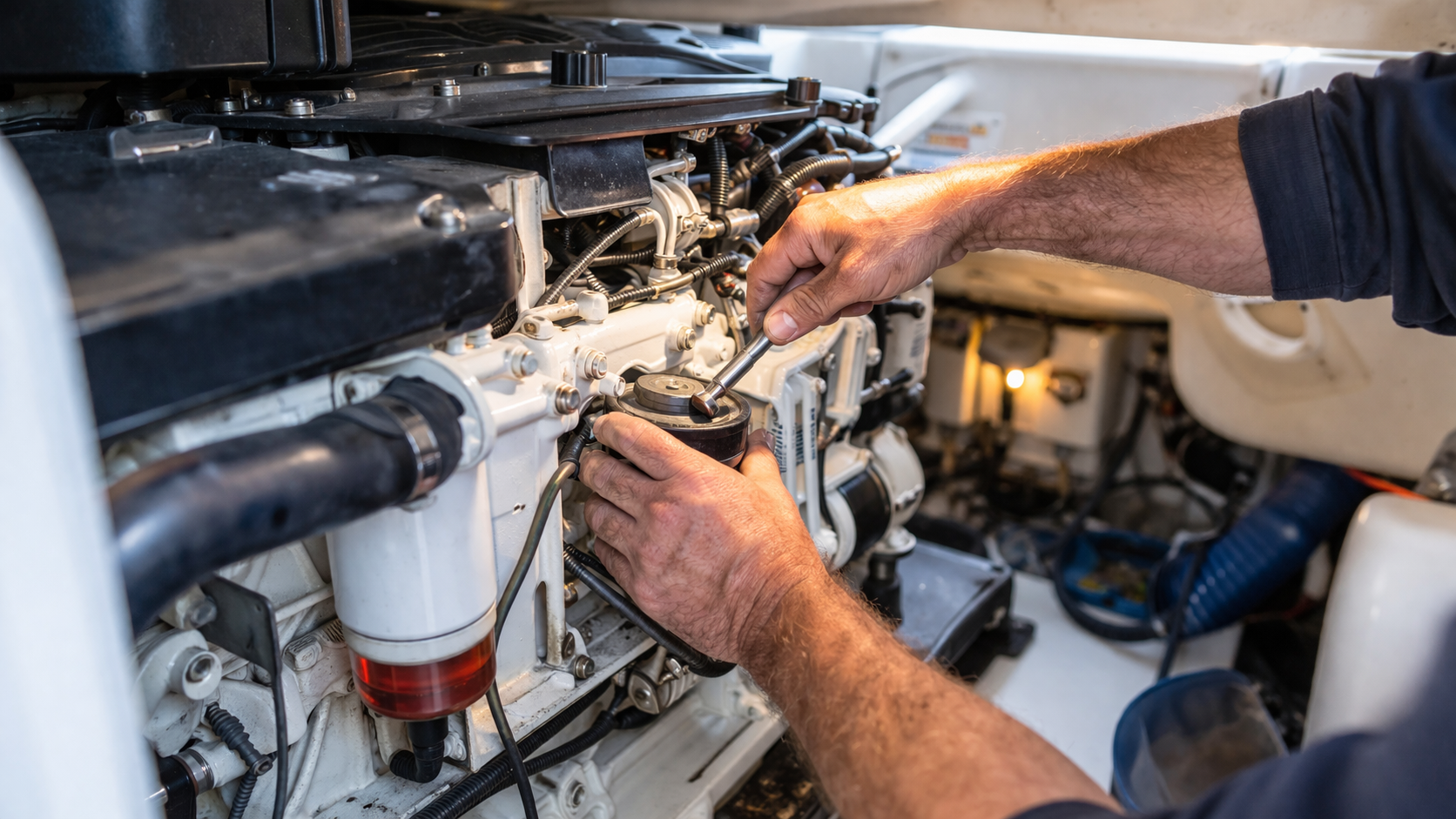
The diesel engine is the heart of your boat. At sea, an engine failure can quickly escalate from inconvenience to emergency: drifting towards rocks, unable to return to port in a calm, or stranded in the dark with no power. Yet the vast majority of engine breakdowns are entirely preventable with regular, disciplined maintenance. This guide gives you everything you need to keep your marine diesel running reliably, whether you sail a cruising yacht, a RIB, or a motor cruiser.
"A well-maintained engine eliminates 90% of breakdowns at sea." — a saying every marine mechanic knows by heart.
Why marine diesel engine maintenance matters
Unlike a car engine that runs on smooth roads in a controlled environment, a marine diesel operates in one of the harshest settings imaginable: constant humidity, corrosive salt air, relentless vibration, and often intense bursts of high-load running followed by months of sitting idle during winter lay-up. Each of these factors takes a toll on every component — from the cylinder head gasket to the smallest hose clamp.
Many recreational sailors use their engines for fewer than 200 hours per year, which creates its own set of problems. Fuel degrades in the tank, seals dry out without lubrication, batteries self-discharge, and condensation builds up inside the crankcase. A marine diesel that sits unused is often in worse condition than one that runs regularly.
There is also a strong financial incentive for proper maintenance. A well-documented service history significantly increases the resale value of any boat. Prospective buyers always ask about engine hours and maintenance records, and a complete logbook with dates, tasks and parts used is one of the most compelling selling points you can offer.
Essential maintenance tasks
1. Engine oil change
This is the most fundamental maintenance task, and arguably the most important. Engine oil lubricates all moving parts, absorbs heat, and traps metallic particles produced by friction. Over time, it becomes saturated with contaminants and loses its lubricating properties, accelerating wear on bearings, pistons and cylinder walls.
Recommended interval: every 100 to 150 engine hours, or at least once a year before laying up. Consult your engine manual for the exact specification — Yanmar, Volvo Penta, Nanni, Beta Marine and other manufacturers each have their own recommendations.
- Run the engine for 10 minutes before draining to warm the oil and help it flow more freely.
- Use an extraction pump if the drain plug is not easily accessible — most marine installations require this approach.
- Always replace the oil filter at the same time as the oil. A new filter with old oil or old filter with new oil defeats the purpose.
- Use oil that meets your engine manufacturer's viscosity and API/ACEA specifications. Marine diesel oil is not the same as automotive diesel oil.
- Record the exact quantity added and check the level with the dipstick after filling. Overfilling is nearly as harmful as underfilling.
In YachtMate, you can log every maintenance task in the digital logbook with the date, engine hours and products used. A notification reminds you when the next oil change is due — no more searching through paper notebooks at the bottom of a locker.
2. Fuel filter (diesel)
Water and contaminants in diesel fuel are the number one enemy of a marine diesel engine. Fuel tanks are prone to condensation, which encourages the growth of bacteria and fungi — the dreaded "diesel bug" that produces a black sludge capable of blocking filters and fuel lines entirely. A clogged fuel filter causes engine misfires, loss of power, difficulty starting, and ultimately a dead engine at the worst possible moment.
Recommended interval: every 200 to 250 engine hours, or at the first sign of trouble (engine coughing, loss of power, rough running).
- Most installations include a pre-filter/water separator (often with a transparent bowl) upstream of the engine-mounted filter. Drain the water separator regularly and inspect for water or sludge.
- When replacing the filter, bleed the fuel system to remove air bubbles — follow the procedure in your engine manual precisely. Air in the fuel line will prevent the engine from starting.
- Add a biocide treatment to your fuel tank annually to prevent bacterial contamination.
- Fill the tank at the end of the season to minimise the air space where condensation forms.
3. Raw water pump impeller
This is the component that catches out most novice boat owners, yet it is one of the most critical. The impeller is a flexible rubber turbine that pumps raw seawater through the engine's cooling system. When it ages, the vanes crack, split and break off — these rubber fragments can block the heat exchanger and cause catastrophic overheating within minutes.
Recommended interval: every year, without exception, even if the impeller looks fine. Rubber deteriorates during winter storage, especially in dry conditions.
- Always carry a spare impeller on board — it is inexpensive (15–40 euros) and could save your engine.
- Never run the engine dry, even for a few seconds. Without water, the impeller is destroyed instantly.
- When replacing, account for every vane of the old impeller. If a piece is missing, it is lodged somewhere in the cooling circuit and must be found.
- Lubricate the new impeller with washing-up liquid (never petroleum-based grease) to ease installation.
A simple warning sign: if your engine is discharging less water than usual from the exhaust outlet, inspect the impeller immediately.
4. Drive belts
The timing belt (or timing chain, depending on the engine) synchronises the internal components of the engine. A failure is catastrophic and immediate. Auxiliary belts drive the alternator, water circulating pump and other accessories. Their failure is less dramatic but still causes serious problems — no alternator belt means no battery charging and eventually no electrical power.
Recommended interval: as specified by the manufacturer, typically every 1,000 to 1,500 hours or every 5 years. Inspect belts visually every season: cracking, fraying, glazing and excessive slack are all warning signs.
5. Sacrificial anodes (zincs)
Galvanic corrosion is a silent electrochemical process that attacks underwater metal fittings: propeller, shaft, stern gear, rudder fittings. Sacrificial anodes — typically zinc in saltwater, aluminium in brackish water, magnesium in freshwater — corrode preferentially, protecting the expensive components they are attached to.
Recommended interval: visual inspection every time the boat is lifted out. Replace when they are 50% consumed. Using the wrong anode material for your water type provides no protection at all.
YachtMate lets you photograph and log the condition of your anodes at each haul-out. A visual history of their wear rate helps you predict exactly when replacements are needed, so you never forget from one season to the next.
Spring commissioning checklist
Before the first outing of the year, run through every item on this list. It takes an afternoon and can save you an entire season of headaches.
- Engine oil level and quality — check colour and consistency. Milky oil means water contamination — do not start the engine.
- Coolant level in the closed cooling circuit (if your engine has one)
- Impeller condition — annual replacement recommended
- Seacock — open, no leaks, valve operating smoothly
- Belts — correct tension, no cracking or glazing
- Fuel filter and water separator — inspect for water or sludge
- Electrical connections — no corrosion on battery terminals, tight connections
- Exhaust — no blockage, hose in good condition
- Engine mounts — flexible mounts not cracked, bolts tight
- Propeller — no damage, anodes in acceptable condition
Winterizing checklist
Proper winterizing is the single most neglected aspect of boat maintenance, yet it directly determines how smoothly your engine starts in the spring. A well-winterized engine fires up first time; a poorly winterized one delivers expensive surprises.
Recommended winterizing procedure
- Change the engine oil at the end of the season, not in the spring. Used oil is acidic and attacks seals and gaskets if left to sit for months.
- Replace the impeller if it was not done during the season. Leaving a deformed impeller in place over winter sets its shape permanently.
- Flush with fresh water — run the engine while drawing fresh water through the raw water intake to flush salt from the cooling circuit.
- Fog the cylinders — spray corrosion inhibitor (or engine oil) into the cylinders via the injector ports to protect the bore from rust over winter.
- Batteries — disconnect, partially charge, and store in a dry place away from freezing temperatures. A trickle charger is ideal.
- Fuel tank — fill to the brim to minimise condensation. Add a fuel stabiliser if the diesel will sit for more than three months.
- Close seacocks — always, when the boat is not in use.
- Grease control cables and throttle linkages to prevent seizure.
The Maintenance & Checklist section in YachtMate offers customisable spring and winter checklists. Tick off each step as you go, and share the status with your co-skipper or mechanic. No more costly oversights.
Engine warning signs to watch for
Even with perfect maintenance, problems can occur. Learning to recognise the warning signs lets you react before a minor issue becomes a major failure.
- White exhaust smoke — normal on a cold start (steam). If persistent, it may indicate water entering the cylinders (head gasket failure).
- Black exhaust smoke — incomplete combustion. Causes include a dirty air filter, faulty injectors, or engine overloading.
- Blue exhaust smoke — burning oil. Worn piston rings or valve stem seals are the usual culprits.
- Overheating — failed impeller, blocked heat exchanger, stuck thermostat, or blocked raw water strainer. Shut down immediately to prevent damage.
- Unusual vibration — fouled propeller (rope or net around the shaft), worn engine mounts, bent shaft.
- Difficulty starting when hot — often related to fuel supply problems (air leak, clogged injectors) or a failing lift pump.
- Milky oil on the dipstick — water in the oil. This usually means a blown head gasket. Stop the engine and seek professional help immediately.
DIY vs. professional?
The honest answer: both, depending on the task. Oil changes, fuel filter replacement, impeller swaps and anode inspection are all well within the capabilities of any motivated boat owner with basic tools and a willingness to get dirty. Manufacturer tutorial videos are generally excellent, and the manuals for most marine diesels are clearly written.
However, some jobs genuinely require a professional: injector calibration, timing belt replacement on complex engines, fuel system diagnosis, and electronic engine management diagnostics. A qualified marine mechanic has the tools, training and experience to get these right first time. The cost of professional servicing is always less than the cost of a replacement engine.
Regardless of who does the work, keep every receipt and log every task. Maintenance records protect your investment, simplify future diagnostics (because the mechanic knows the full history), and make your boat significantly easier to sell.
Essential onboard toolkit
For dealing with minor repairs or emergencies at sea, carry at least the following:
- Spare impeller (matched to your engine model)
- Spare fuel filter
- Spare oil filter
- Engine oil (1–2 litres)
- Spare alternator belt
- Assorted gaskets and O-rings
- Stainless steel hose clamps in various sizes
- Self-amalgamating repair tape
- Multimeter for electrical diagnostics
- Engine manual (paper copy or PDF downloaded for offline use)
Old salt's tip: stick a label on your engine showing the recommended oil type, impeller part number and fuel filter reference. When you need parts urgently in an unfamiliar port, this saves enormous time.
Conclusion
Marine diesel maintenance is not glamorous work, but it is the foundation of safe, reliable sailing. The vast majority of engine failures at sea are caused by neglected basics: old oil, a blocked fuel filter, a cracked impeller, or corroded anodes. Stay on top of these simple tasks and your engine will reward you with years of dependable service.
Read also
Manage your boat maintenance with YachtMate
Log maintenance tasks, set custom reminders, manage seasonal checklists — all from your smartphone. YachtMate, your digital logbook and all-in-one navigation assistant.
Discover YachtMate