
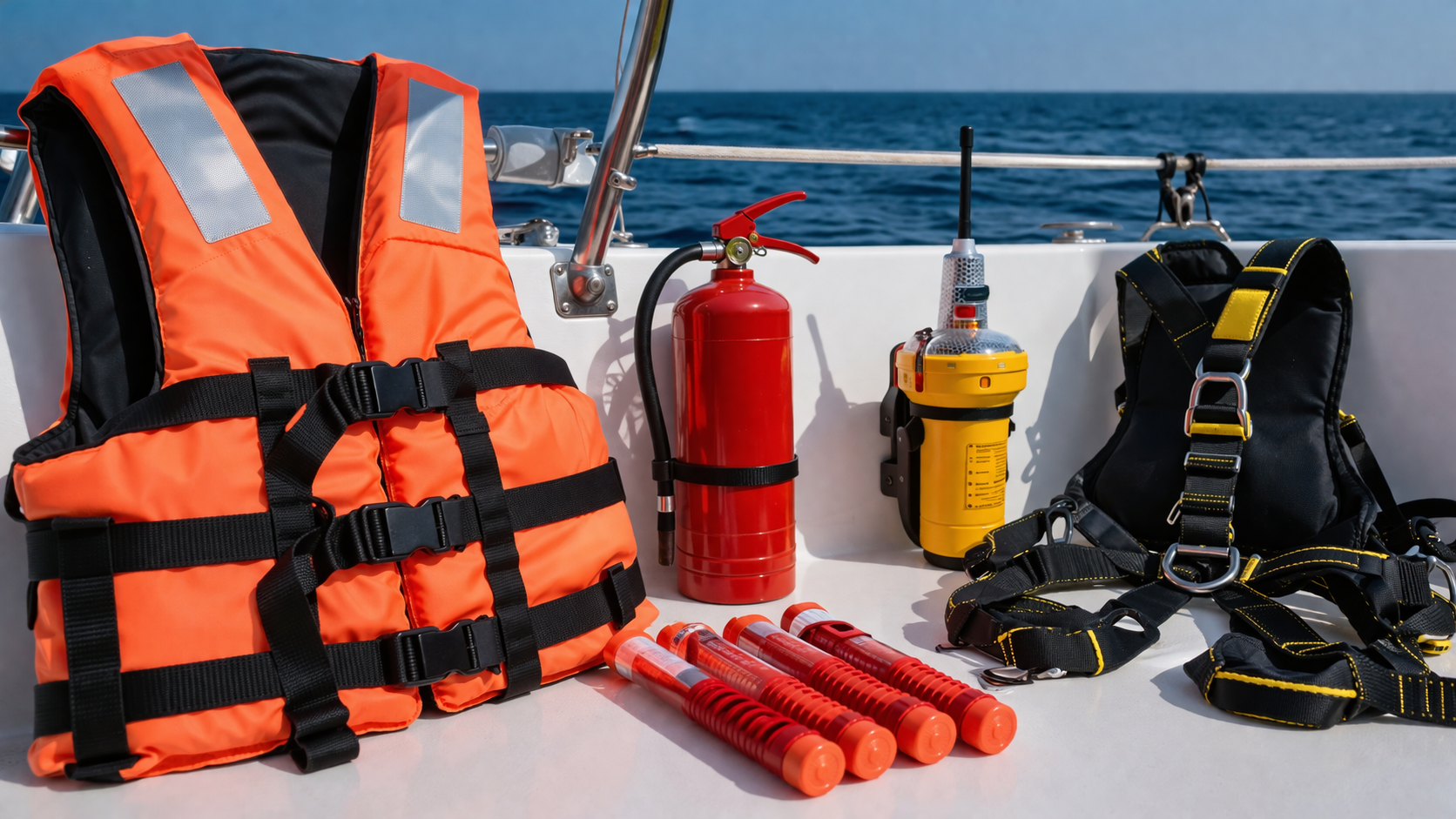
Safety inspections at sea are becoming more frequent across Europe, and fines for missing or expired safety equipment are no laughing matter. While every country has its own regulatory framework, the underlying principles are remarkably similar: the further you go from shore, the more safety gear you need to carry. This guide provides a comprehensive checklist based on the French Division 240 regulations — widely regarded as one of the most thorough systems in Europe — and serves as an excellent reference for any sailor in European waters or beyond.
Navigation zones explained
Most maritime nations divide their waters into zones based on distance from shelter, with equipment requirements escalating accordingly. The French system uses four zones, which provide an excellent framework regardless of where you sail.
- Basic Up to 2 nautical miles from shelter — Inshore, close-to-coast sailing
- Coastal Up to 6 nautical miles from shelter — Standard coastal cruising
- Semi-offshore Up to 60 nautical miles from shelter — Extended passages and island crossings
- Offshore Beyond 60 nautical miles — Open ocean, transatlantic
"Shelter" means the nearest port, harbour or protected bay where a vessel can safely take refuge. The distance is measured from the nearest shelter, not from shore, which is an important distinction that many sailors overlook.
1. Personal flotation equipment
Basic Up to 2 miles
- 1 buoyancy aid (50N minimum) per person on board
- Children must have a properly fitting child-sized device
Coastal Up to 6 miles
- 1 life jacket (100N minimum) per person — 150N recommended
- Life jackets sized appropriately for children if applicable
- Crotch straps recommended to prevent ride-up in the water
Offshore Beyond 6 miles
- 1 life jacket (150N minimum) per person
- Safety harness and tether per person (or life jacket with integrated harness)
- Personal locator beacon (PLB) strongly recommended for each crew member
When choosing life jackets, pay attention to the servicing schedule. Inflatable life jackets typically need professional inspection every 1–2 years, including cartridge replacement and bladder testing. A life jacket that does not inflate when you need it is worse than useless — it gives you false confidence.
2. Distress signals and signalling equipment
Basic Up to 2 miles
- 1 light source for signalling (waterproof torch or cyalume stick)
- 1 signalling mirror (heliograph)
- 1 steering or bearing compass
Coastal Up to 6 miles
- 3 red hand flares (within expiry date!)
- 1 signalling mirror
- 1 steering compass
- Chart of the navigation area (paper or electronic)
- COLREGS summary (International Regulations for Preventing Collisions at Sea)
Offshore Beyond 6 miles
- 3 red hand flares
- 3 parachute rocket flares
- 2 orange smoke signals
- 1 signalling mirror
- 1 steering compass + 1 bearing compass
- Charts, navigation tools, COLREGS
- Light list for the area
Watch those expiry dates! Distress flares have a shelf life of 4 years from the date of manufacture. Expired flares are considered non-compliant during an inspection, and they may not work when you actually need them.
The Safety Equipment tool in YachtMate lets you log all your gear with expiry dates. You receive an alert before anything expires, so you are never caught out during a safety inspection — or, more importantly, in an emergency.
3. Collective safety equipment
Basic Up to 2 miles
- 1 means of reboarding from the water (ladder, sling, or similar)
Coastal Up to 6 miles
- 1 lifebuoy with 30m of throwing line
- 1 means of reboarding from the water
- 1 fire extinguisher (capacity matched to engine power)
- 1 bilge pump or bailer
Offshore Beyond 6 miles
- 1 life raft (annual inspection mandatory)
- 1 lifebuoy with throwing line
- 1 means of reboarding from the water
- Fire extinguishers matched to engine power
- 1 fixed VHF radio (portable VHF also recommended)
- 1 EPIRB distress beacon (mandatory beyond 60 miles, strongly recommended beyond 6)
- 1 radar reflector (for vessels not easily detected by radar)
Life raft servicing is expensive but non-negotiable. A life raft that has not been inspected within the last 12 months may not deploy correctly, and the food, water and medical supplies inside will have expired. Budget for annual servicing as a fixed cost of boat ownership.
4. Required documents on board
Regardless of where you sail, you should always carry:
- Vessel registration — Proof that the boat is officially registered. In France, this is the Carte de Circulation.
- Boating license — Coastal or offshore, depending on your zone of navigation. Not all countries require a license for all vessels, but if you are sailing in foreign waters, having one avoids problems during inspections.
- Insurance certificate — Third-party liability insurance is mandatory in many European countries. Carry a copy on board at all times.
- Ship's log — While not legally mandatory in all jurisdictions, a ship's log is strongly recommended and can be invaluable in case of an incident or insurance claim.
- Crew list — Particularly important for international passages. Some countries require you to file a crew list on entry.
When sailing between countries, also carry your passport and any relevant visas. Post-Brexit, UK sailors visiting the EU now need to comply with Schengen entry requirements, and vice versa.
5. Fines and penalties
Maritime authorities across Europe conduct regular inspections, especially during the summer season. The penalties for non-compliance are designed to be dissuasive:
- Missing life jackets: up to €750 per missing jacket (France)
- Expired distress flares: up to €750
- Operating without a license: up to €1,500
- No insurance: fine plus potential impounding of the vessel
- Missing fire extinguisher: up to €450
In the UK, while fines may differ in amount, the Maritime and Coastguard Agency (MCA) can issue improvement notices, prohibit vessels from sailing, or prosecute in serious cases. Spain and Italy have similarly robust enforcement systems with fines that often exceed French levels.
Beyond the financial penalties, being found non-compliant during an emergency can have devastating consequences for insurance claims. If your vessel is not properly equipped and an incident occurs, your insurer may refuse to pay out.
6. Quick pre-departure checklist
Before every single trip, run through this checklist. It takes five minutes and gives you peace of mind.
- Life jackets for all passengers — correct sizes, accessible, serviced
- Distress flares in date — check the expiry printed on each flare
- Fire extinguisher accessible and in date — check the gauge and service tag
- VHF charged and working — do a quick radio check if possible
- Fuel level sufficient — rule of thirds: one-third out, one-third back, one-third reserve
- Weather checked and favourable — including forecast for the return trip
- Someone ashore knows your plan — departure time, destination, expected return, number of people on board
- Bilge dry — check bilge levels before departure
- Navigation lights working — if there is any chance of being out after dark
- Engine checks complete — oil level, coolant, belt tension, seacock open
Conclusion
Safety equipment is not a bureaucratic burden — it is what can save your life when things go wrong at sea. Invest in quality gear, check expiry dates religiously, and make the pre-departure checklist a habit that is as natural as starting the engine. Your crew is counting on you.
Read also
Manage your safety equipment with YachtMate
Log your equipment, track expiry dates and receive automatic reminders. Free.
Discover YachtMate