
The sound is unmistakable: that sharp, steady beep of the temperature alarm, which turns a peaceful cruise into a rush of adrenaline in a single second. On a marine engine, overheating is no minor incident — it is the leading cause of serious mechanical damage, the kind that can seize a piston or warp a cylinder head in a matter of minutes. The good news is that in the vast majority of cases, the fault lies in a simple circuit that any boater can understand and often repair themselves.
Understanding where the water flows, recognising the symptoms and knowing the five or six usual points of failure: that is what separates the skipper who shuts down in time and limps home from the one who discovers a bill of several thousand euros at the yard. This guide covers the whole subject, without unnecessary jargon.
How does a marine engine cool itself?
A boat engine produces an enormous amount of heat and, unlike a car, cannot rely on an airflow to dissipate it. So it uses the element that surrounds it: seawater. Two main architectures exist, and it is essential to know which one your boat uses.
Direct cooling (or "open circuit") circulates seawater directly through the engine jackets. Simple, but aggressive: salt and deposits scale up the block over time. It is mostly found on small outboards and older engines.
Indirect cooling (or "closed circuit"), by far the most common on modern inboard diesels, works like a car radiator. An internal circuit of fresh water and antifreeze cools the engine; this fresh water is itself cooled by seawater in a heat exchanger, without ever mixing with it. The seawater, after absorbing the heat, is ejected with the exhaust gases — hence the characteristic little jet of water at the stern.
That jet of water at the exhaust is your best health indicator. Get into the habit of checking it at every start-up: no jet means immediate shutdown.
The path of the water, step by step
Whether the circuit is direct or indirect, the seawater always follows the same upstream path. Knowing it means already knowing where to look when the temperature climbs.
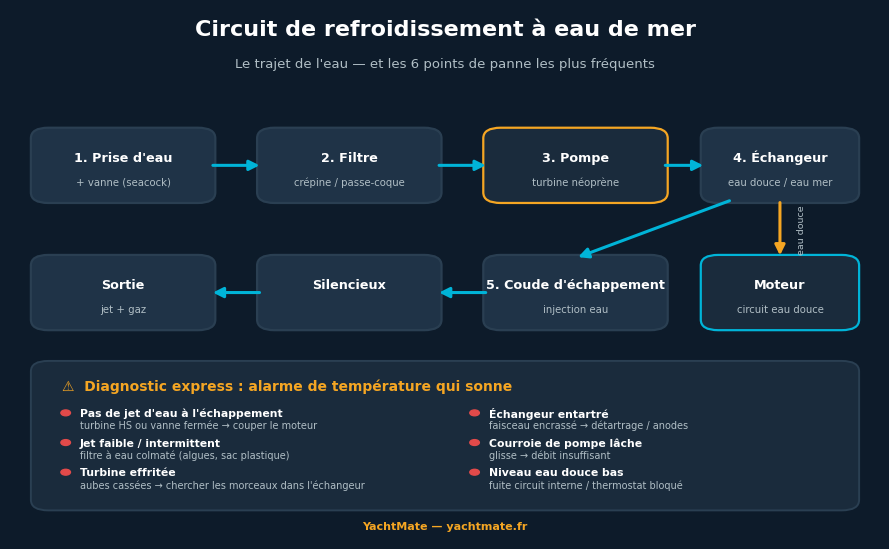
It all begins at the water intake, an opening below the hull fitted with a seacock that you open before starting. The water then passes through a sea strainer, whose job is to catch weed, plastic bags and debris. It reaches the raw-water pump, at the heart of which is a neoprene impeller with flexible vanes that draw and push the water. From there, the water reaches the heat exchanger (on a closed circuit), gives up its heat, then travels to the exhaust elbow where it is injected into the gases before being expelled to the sea.
Any one of these links can fail. And because the circuit is in series, a single blockage is enough to raise the whole temperature: water that does not reach the end has not cooled the rest.
Spotting overheating before the alarm
The audible alarm and the red light are the last warnings, not the first. An attentive skipper often spots overheating before they even trigger:
- The exhaust jet weakens or becomes intermittent. A jet that spits instead of flowing steadily signals insufficient water flow.
- Steam or a burnt smell appears near the exhaust — a sign that injection water is lacking and the elbow is heating up.
- The temperature gauge rises beyond its usual zone (typically 75-90 °C on a diesel). Note mentally where it settles under normal conditions: any drift should alert you.
- A drop in revs or an unusual noise may accompany advanced overheating.
Build the "stern glance" reflex: as soon as the engine is running, someone visually checks the exhaust jet. It is the simplest and most reliable check on board — it catches 80% of cooling faults before they turn serious.
What to do when the alarm sounds
The golden rule is three words: reduce, then shut down. Sustained overheating destroys an engine in minutes. A stopped engine is better than a broken one.
- Immediately reduce the throttle to idle. Less power means less heat produced, which sometimes buys a few minutes to manoeuvre.
- Assess your nautical situation. Are you in a narrow channel, able to sail, near a danger? Secure the boat first before shutting down.
- Shut down the engine as soon as the situation allows. On a sailboat, hoist the sails or anchor if the bottom permits.
- Let it cool before any intervention. Opening the fresh-water circuit while hot risks serious burns from steam spray.
Once the engine is cold, diagnosis can begin, working back up the circuit in order.
Diagnosis, link by link
1. The seacock and water intake
It sounds obvious, but the most common fault is also the silliest: the seawater seacock has been left closed. Check it first. Then the intake itself can be blocked by a plastic bag or weed, especially after cruising in dirty water or over a seagrass bed.
2. The sea strainer
This is the prime suspect for progressive overheating. The strainer's clear bowl lets you see the accumulated debris. Close the seacock, open the strainer, empty and rinse the basket. A clogged strainer cleans in five minutes and solves a large share of cases. Remember to close it properly and reopen the seacock afterwards.
3. The pump impeller
If the flow stays insufficient with a clean strainer and open seacock, the neoprene impeller is to blame. Its flexible vanes harden, crack or break over time and from running dry. Remove the pump cover (a few screws): if vanes are missing, you absolutely must find the pieces, because they lodge downstream in the heat exchanger and block it. An impeller is replaced in twenty minutes with a little practice.
A spare impeller, a cover gasket and a little silicone grease: that is the cooling circuit's survival kit. It fits in a pocket, costs little, and turns a show-stopping breakdown into a twenty-minute repair. Never leave on a cruise without it.
4. The heat exchanger and exhaust elbow
On an otherwise well-maintained engine, a heat exchanger scaled up or blocked by impeller fragments limits heat transfer. Its tube bundle is descaled at a workshop or with a suitable product. The exhaust elbow (or "mixing elbow") clogs with carbon and salt: it is a wear part that must be replaced periodically, or water may leak into the cylinders.
5. Belt and fresh-water level
On many engines, the raw-water pump is driven by a belt. If it is slack or glazed, it slips and the flow drops. Check its tension and condition. Finally, on a closed circuit, check the fresh-water level in the expansion tank: a low level betrays a leak or a stuck thermostat, which prevents the water from circulating through the engine.
Prevention beats reaction
Overheating is almost always avoidable. It results from neglected maintenance far more than from bad luck. A few regular actions are enough to keep the risk away for the season:
- Clean the sea strainer regularly, and systematically after cruising in dirty water.
- Replace the impeller every year, or every 200 hours, even if it looks fine. It is a wear part, not a lifetime part.
- Check the anodes and have the heat exchanger descaled according to the manufacturer's recommendations.
- Monitor the level and condition of the antifreeze in the closed circuit, whose anti-corrosion properties wear out.
- Never run the engine dry, even for a few seconds: the impeller hates it.
An up-to-date maintenance log beats the best of memories. Note every impeller change and every cleaning: the cooling circuit is managed by anticipation, not in an emergency.
The mistakes that make it worse
- Carrying on "just to get home". A few minutes of overheating is enough to damage the engine: the cost of a tow is always less than that of a cylinder head.
- Opening the fresh-water circuit while hot. Pressurised steam causes serious burns. Wait for it to cool completely.
- Forgetting to reopen the seacock after cleaning the strainer. This is the classic false repair that reproduces the fault immediately.
- Not searching for broken impeller vanes. They migrate into the exchanger and create a new blockage a few hours later.
- Sailing without a spare impeller. The part costs a few euros; its absence can cost a whole stopover.
In summary
A marine engine's cooling circuit is a logical chain: intake, seacock, strainer, pump, heat exchanger, exhaust. When the temperature rises, you simply work back up this chain in order to find the faulty link — most often a clogged strainer or a tired impeller, two repairs within reach of any equipped boater. The real secret is not mechanical: it is to shut down the engine early enough and maintain the circuit before it fails. A skipper who checks the exhaust jet at every start-up has already done the essential.
Cruise with peace of mind using YachtMate
Route tracking, sheltered anchorages in case of a breakdown and detailed weather to choose your windows: YachtMate helps you anticipate and react calmly, engine or no engine.
Discover the appTo go further, revisit our guides on maintaining the marine diesel engine, on diesel fuel contamination and on saving fuel while cruising.