
The most frustrating engine failure is almost never mechanical. It strikes at the worst possible moment — entering a channel, in a shipping lane, or just as the wind builds — and its origin lies in the tank: contaminated diesel that clogs the filters and starves the supply. Sailors have a familiar name for this: the diesel bug. Behind that slightly comical term lies a very real problem made of water, micro-organisms and sludge that thrive in the silence of a neglected tank.
Understanding how this contamination takes hold, knowing how to spot it before a breakdown, and adopting a few simple habits is enough to avoid almost every incident. Here is a complete guide to keeping a healthy fuel system, season after season.
What is the diesel bug?
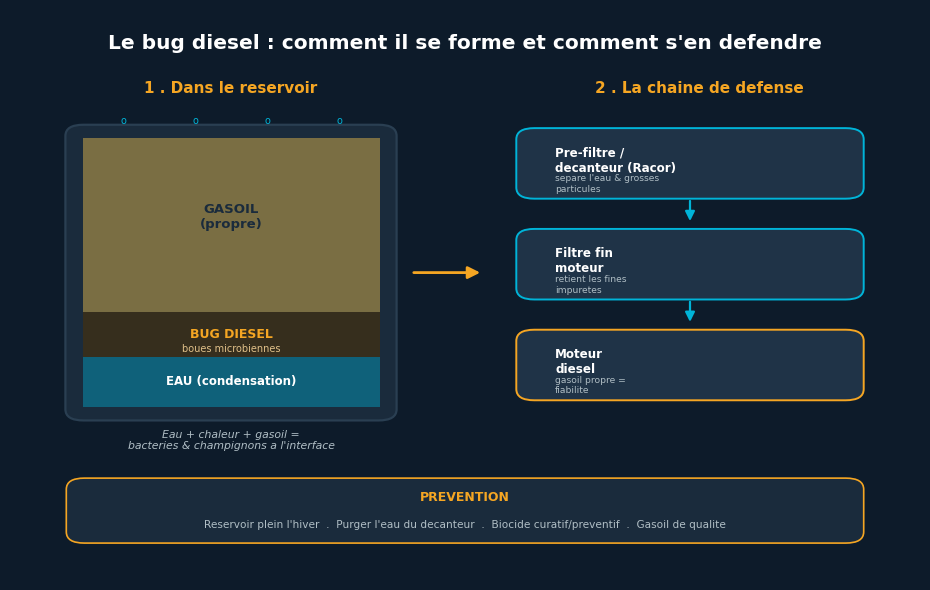
The "diesel bug" refers to the proliferation of micro-organisms — bacteria, yeasts and fungi — that develop in a tank's diesel. Contrary to what you might think, these organisms don't live in the fuel itself: they grow at the interface between the diesel and the water that always ends up collecting at the bottom of the tank. The diesel provides the carbon (food), the water provides the medium they need to reproduce.
The result is a kind of black-brown, slimy sludge that forms at the base of the tank and on its walls. It breaks off in flakes when the boat moves, gets drawn towards the engine and clogs the filters. At that point the engine chokes, loses power, or stops dead. The problem has worsened in recent years with the arrival of diesel containing biofuels (FAME / biodiesel), which are more hygroscopic: they hold more water and feed the micro-organisms better than diesel of old.
Where does the water in the tank come from?
No water, no diesel bug. Controlling moisture is therefore the heart of the problem. And water finds its way into a tank in several ways:
- Condensation: this is the most insidious source. A partly empty tank leaves humid air above the fuel. With the temperature swings between day and night, that moisture condenses on the walls and runs down into the diesel. A boat laid up with a half-full tank is a textbook case.
- Fuelling up: filling at a little-used pump whose own storage tank contains water transfers the problem straight on board.
- Deck fillers and caps: a tired seal lets in rainwater or spray with every wave that comes aboard.
- A poorly placed tank vent that draws in spray in heavy weather.
Water, being denser than diesel, sinks to the bottom of the tank — precisely where the pick-up strainer often sits. That is where the bug settles in and the trouble begins.
Recognising the signs of contamination
The diesel bug gives no warning, but it does leave clues. The sooner you spot them, the simpler the repair. The most common symptoms:
- A drop in revs or surging under load, typically when the engine is working hard — a sign of a filter clogging up.
- Fuel filters that darken quickly: a pre-filter fouled after just a few hours of motoring betrays a dirty tank.
- Visible water in the clear bowl of the Racor separator, or a dark deposit at the bottom.
- An unpleasant, sulphurous smell when you open the tank.
- Abnormal exhaust smoke and rising fuel consumption.
An engine that always stalls when the sea gets up but restarts in calm water is almost always the victim of sludge stirred back into suspension by the motion. Look for the diesel bug before blaming the mechanics.
Before a slightly rough passage, open YachtMate to anticipate the sea state and swell on your route. A tank carrying a little sediment that passes unnoticed in calm water can let you down in a chop: if a developed sea is forecast, check and drain your water separator before you leave, not at the worst possible moment.
The chain of defence: separator and filters
No diesel-powered boat should sail without two-stage filtration. It is the first line of defence, and the best placed to turn an engine failure into a routine job.
The pre-filter / water separator (Racor type)
Fitted between the tank and the engine, the water separator is the key component. Its clear bowl lets the heavier water separate from the diesel and settle at the bottom, where it is visible and easy to drain through a tap. Its element filters out the largest particles. This is where to focus your attention: a glance at the bowl before every outing instantly reveals the presence of water or sludge. Many serious installations fit two separators in parallel, with a switchover valve, so you can change to the clean filter without stopping the engine if the first clogs mid-manoeuvre.
The engine's fine filter
Downstream, the fuel filter mounted on the engine catches the fine particles the separator let through, protecting the injection pump and injectors — costly, sensitive parts. It is replaced at the intervals specified by the manufacturer, and more often if the tank is suspect.
Good practice is always to carry spare elements for both stages, along with a suitable wrench, and to know how to bleed the air from the system after a filter change. It is that re-priming procedure, simple but often poorly understood, that makes the difference between a ten-minute fix and a drift towards the shore.
Treating a contaminated tank
Once contamination is confirmed, changing the filters is not enough: they will keep blocking as long as the tank stays dirty. You have to tackle the source.
Drain the water and clean
The first step is to remove the water collected at the bottom, through the separator's drain tap or, better still, through a low point in the tank if it has one. In advanced cases you carry out a tank clean: pumping out the bottom, or even opening an inspection hatch to scrape away the sludge. It is a messy job that many entrust to a professional with "fuel polishing" equipment — a system that filters and recirculates the diesel to rid it of water and particles.
Biocide
To kill off the living micro-organisms, you use a biocide made specifically for diesel. Used as a curative treatment, it kills the colony; the dead matter then settles and must be filtered or pumped out. Used afterwards at a preventive maintenance dose, at every fill or before lay-up, it stops recolonisation. Be careful: biocide is dosed precisely according to tank volume, and overdosing brings no extra benefit. Nor does it replace moisture control — it is a complement, not a magic fix.
Note in your logbook the date of every filter change, every drain and every biocide treatment. A clear history tells you straight away whether fouling is accelerating — and therefore whether the tank needs a thorough clean — instead of discovering the problem at the next breakdown.
Prevention beats cure
The good news is that the diesel bug can be prevented almost entirely with simple habits:
- Lay up with a full tank: less air above the fuel means less condensation. A fill at the end of the season drastically reduces water ingress during the inactive months.
- Fuel at busy stations, with quality diesel, and avoid filling up just after a delivery to the pump (the churning stirs deposits back into suspension).
- Drain the separator regularly and check its bowl before every outing: thirty seconds that save a lot of grief.
- Check the seals on fillers, caps and vents — often-overlooked routes for water to get in.
- Dose a maintenance biocide at fill-ups, especially in hot climates where growth is faster.
- Use the boat regularly: fuel that circulates and a boat that goes out age better than a tank left to sleep for a whole season.
The diesel bug is far from inevitable. It is the symptom of a forgotten tank, where water has crept in without being driven out. By keeping the tank full at rest, watching the separator and treating the fuel when needed, you avoid the most common — and most avoidable — engine failure at sea. A healthy fuel system means the peace of mind to focus on what matters: the navigation, the weather and the pleasure of being aboard.
Sail with peace of mind using YachtMate
Weather, sea state, tides and charts in one place: YachtMate helps you pick the right window and anticipate conditions before every outing. Available on iOS and Android.
Discover YachtMate →