Fuel efficiency in boating represents a major economic consideration and growing environmental responsibility. Whether piloting a marine diesel engine or a hybrid motor-sail system, fuel-efficient strategies significantly reduce operational expenses while minimizing your maritime carbon footprint. This detailed guide explores engine optimization, ideal cruising speed selection, mixed sail-motor navigation techniques, and modern technologies documenting and continuously improving energy consumption.
Engine Optimization and Preventive Maintenance
The marine diesel engine constitutes the primary energy consumption source for motorized boats. A well-maintained engine consumes 15-20% less fuel than a neglected engine presenting carbon buildup and dysfunction. Systematic preventive maintenance involves regular oil changes, fuel filter inspections, fuel injector verification, and periodic engine performance testing.
Efficient Engine Maintenance Schedule
Establish a maintenance calendar based on engine operating hours. Change engine oil every 200-300 hours (approximately 3-4 months for active navigators). Inspect and replace air filters every 6 months. Clean fuel injectors annually using specialized detergent products eliminating carbon deposits. Fouled injectors reduce combustion efficiency and increase consumption up to 25%.
- Engine compression testing — Test engine compression annually detecting valve leaks or ring wear. Insufficient compression signals need for overhaul.
- Turbocharger maintenance — Turbocharged engines require regular turbine blade and intercooler inspection maintaining boost efficiency.
- Radiator and cooling circulation — A fouled radiator forces engine operation hotter reducing efficiency. Clean radiator semiannually.
Use YachtMate's motorized maintenance log recording all engine services, filter replacements, and oil changes. This digital traceability identifies abnormal consumption patterns preventing progressive efficiency degradation.
Cruising Speed Selection and Optimal Consumption
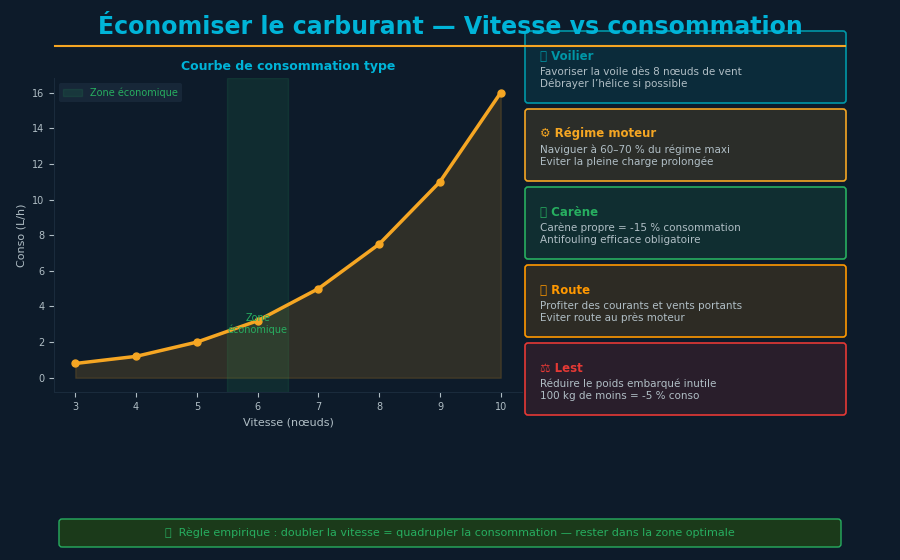
Cruising speed dramatically influences fuel consumption. Navigating below optimal economic speed increases voyage duration without significant energy benefit. Economic speed represents the equilibrium point where hourly consumption multiplied by navigation duration minimizes total fuel consumption. For most pleasure boats, this speed ranges 6-8 knots in non-current waters.
Economic Speed Calculation and Route Planning
Determine economic speed through controlled testing in calm conditions. Record hourly consumption and speed over ground for multiple engine regimes. Plot fuel consumption curve; the minimum point represents optimal economic speed. For long-distance navigators, reducing cruising speed 1-2 knots reduces total consumption 20-30% exchanging for modest voyage duration increase.
- Constant engine regime — Navigating at constant engine speed (typically 60-75% maximum RPM) offers better combustion efficiency than variable regimes.
- Electrical appliance reduction — Minimize non-essential electrical appliance usage reducing alternator load. Alternator overload increases engine consumption 5-10%.
- Onboard weight optimization — Reduce boat weight eliminating water from non-essential ballast tanks minimizing inventory. Each additional 1000kg increases consumption 5-7%.
Mixed Motor-Sail Navigation Techniques
Boats equipped with sailing capability offer exceptional fuel-saving opportunities. A sailboat can navigate at economic speeds of 5-6 knots without engine use for weeks in favorable wind conditions. Even motorboats with auxiliary rigging can reduce engine hours 20-40% annually through planned sail utilization.
Mixed Navigation Strategies and Weather Forecasting
Integrate weather forecasting into route planning. Consult surface wind charts and circulation patterns identifying favorable wind windows. A coastal crossing normally completed under power might be accomplished entirely under sail through simple departure schedule adjustment. Accepting one additional day for sail-assisted crossing reduces fuel consumption 90-100%.
An efficient navigator isn't the fastest, but one knowing when to ignore the engine exploiting wind and current natural forces.
- Auxiliary sail and motor assistance — Use engine at minimal RPM assisting sail during light winds rather than full-power solo engine operation.
- Weather windows — Await favorable weather before departure. One day's wait for favorable wind significantly reduces fuel consumption.
- Favorable currents — Plan navigation exploiting tidal currents and permanent coastal currents reducing required groundspeed.
Modern Technologies and Energy Monitoring Systems
Hybrid energy systems and digital monitoring revolutionize navigational energy efficiency. Auxiliary electric motors, solar panels, and high-capacity battery systems offer operational flexibility reducing fossil fuel dependence. Real-time monitoring systems document granular energy consumption revealing optimization opportunities before performance degradation.
Hybrid Energy and Integrated Electrical Systems
Boats equipped with auxiliary electric motors and batteries recharged by solar panels or water generators offer superior energy efficiency. A 10kW electric motor consumes fuel equivalent of 2-3 liters diesel hourly versus 15-20 liters for conventional diesel engines. For short-range coastal navigation (15-20 nautical miles), auxiliary electric propulsion reduces total fuel consumption 50-70%.
- Solar panels and water generators — Install renewable energy generation systems recharging auxiliary batteries reducing diesel engine cycles.
- Intelligent energy manager — A computerized system distributes electrical consumption across energy sources prioritizing solar and wind.
- High-capacity batteries — Modern LiFePO4 batteries offer superior energy density and extended recharge cycles versus traditional lead-acid batteries.
Activate YachtMate's real-time energy dashboard displaying engine consumption, battery charge, and solar panel output. This instant visibility enables immediate regime adjustments optimizing efficiency minute-by-minute.
Route Planning and Consumption Documentation
Fuel consumption optimization begins with strategic route planning and systematic consumption documentation. Identify variables affecting consumption: speed, sea state, engine load, water temperature, and weather conditions. Document these variables in detailed navigation logs establishing correlations revealing unsuspected optimization opportunities.
Predictive Analysis and Continuous Improvement
Accumulate history of 50-100 navigation hours covering various engine regimes and environmental conditions. Analyze this dataset identifying speeds and conditions producing maximum energy efficiency. Use this data creating personalized consumption profile for your specific boat accounting for engine age, maintenance, and hull modifications.
- Detailed navigation log — Record engine hours, fuel consumption, speed, engine RPM, marine conditions, and crew load for each outing.
- Trend analysis — Identify abnormal consumption trends signaling engine problems (fouled injectors, turbo dysfunction, propeller fouling).
- Benchmarking and comparison — Compare your consumption to reference data for your boat model identifying improvement margins.
Crew Education and Efficient Navigation Practices
Energy efficiency depends as much on human behaviors as technical equipment. Train your crew in fuel-efficient practices: progressive acceleration, avoiding engine jerking, and reducing propeller cavitation. Conscious crew reduces fuel consumption 10-15% compared to inattentive crews.
- Progressive acceleration and deceleration — Increase/decrease engine RPM gradually rather than abruptly avoiding transient consumption peaks.
- Propulsion maintenance — Regularly clean propeller biofouling (algae, barnacles) increasing drag 10-20%.
- Hull trim optimization — For monohulls, optimize boat trim reducing hydrodynamic drag. More efficient hulls require less propulsion.
Create a shared energy efficiency dashboard with your crew displaying hourly consumption versus targets. Light gamification of energy-saving goals involves crew in optimization creating responsible navigation culture.
GPS Technology and Marine Current Optimization
Strategic exploitation of marine currents reduces ground distance and total fuel consumption. A favorable 1-knot current reduces total consumption 12-15% for typical crossings. Use YachtMate's integrated current data planning routes exploiting tidal currents and permanent coastal currents.
- Tidal current planning — Schedule departure coinciding with favorable tidal current gaining 1-2 knots speed without additional motor consumption.
- Permanent ocean currents — The Atlantic Gulf Stream and Mediterranean currents offer significant gains if strategically exploited.
- Distance optimization — A slightly longer route exploiting favorable currents consumes less fuel than shorter routes against current.
Master Your Consumption
YachtMate records detailed consumption, calculates economic speed, and optimizes routes exploiting currents.
Calculate Savings →