
Sooner or later, you have to go up. A wind vane that no longer responds, a halyard that has jumped its sheave, a dead masthead light, a block to replace: the top of the mast concentrates essential gear that you can neither see nor reach from the deck. Going aloft is not an acrobatic feat reserved for professionals, but it is genuine work at height, with safety stakes that do not forgive improvisation. A ten-metre fall onto a hard deck, at sea, leaves no second chance. The good news: with the right gear, the two-halyard principle and a rigorous method, the manoeuvre becomes perfectly manageable. Here is how to do it.
1. Why and when to go up
You climb the mast to inspect, repair or replace. Inspection is the most frequent and most virtuous reason: at least once a season, you go up to check the state of the masthead, blocks, sheaves, clevis pins, upper chainplates and the whole standing rigging. Spotting a pin starting to work loose or a chafing halyard means avoiding a major failure offshore.
Then come the interventions: replacing a wind vane or anemometer, changing a masthead light bulb, retrieving a halyard gone up the mast, fitting a new block, repairing a stay. Some of these jobs can wait for the return to harbour and a professional; others, like re-reeving a halyard, take a few minutes at anchor once you are up there. In every case, the question is not only "how to climb" but "under what conditions".
Pick your moment: at anchor or alongside, in calm sea and light wind, never in swell or beating to windward. The mast amplifies the slightest roll — ten metres up, a gentle rocking of the boat becomes a violent whipping motion. Check the forecast and the weather window before you gear up.
2. The essential gear
The heart of the setup is the seat that carries you. The bosun's chair comes in two main families. The traditional soft canvas chair is light and cheap but offers little support. The modern harness-and-leg-loop, derived from climbing and rope access, wraps the pelvis and thighs: far safer, it prevents you tipping backwards and spreads the load. For any serious work at height, it is the one to choose.
Around the chair, a few items are non-negotiable:
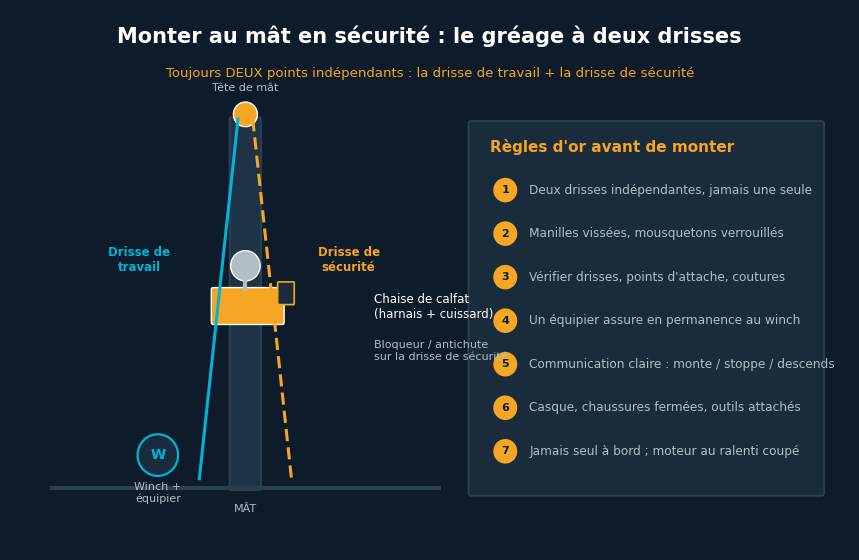
- Two halyards in good condition, each easily able to bear a person's weight, taken to two independent points.
- Screwed shackles and locking carabiners on every connection: never a plain snap hook that could open by itself.
- Ascenders or a self-locking descender if you self-belay on the way up, or to secure your position once aloft.
- A closed tool bag, tethered to the chair by a lanyard, so nothing drops on the crew below.
- A helmet, closed shoes and gloves: the mast, spreaders and fittings are all sharp edges.
3. The two-halyard principle
This is the fundamental rule, the one everything else depends on: you never go up on a single line. A halyard can be fatigued with nothing showing, a shackle can unscrew, a masthead block can fail, a cleat can slip. By linking the chair to two independent halyards, each taken to its own winch or cleat, you ensure that the failure of one does not cause a fall.
In practice, you distinguish the working halyard, on which the crew actively hoists, from the safety halyard, kept slightly slack and taken in as the climb progresses. The safety halyard must never stay long and loose: a crew member takes it up continuously so that if the first line breaks, the fall is reduced to a few centimetres. Preferably choose two halyards running through different sheaves at the masthead, so that a single point of failure cannot compromise both at once.
Two independent anchor points, two different sheaves, two attentive people: safety at height never rests on a single element.
4. Pre-climb checks
Before the person leaves the deck, a methodical check is essential — preferably out loud, in pairs. First check the halyards themselves: no frayed cover, no exposed core, no hardened or worn zone at the chafe point. Then inspect every connection: shackles done up fully, pins properly screwed, carabiners locked, chair stitching intact.
Make sure the hoisting winch is free, that the line runs correctly in the jaws of the clutch or under several turns of winch, and that no halyard risks jamming during the climb. Finally, agree on clear language between the person going up and the one belaying: "up", "stop", "hold", "down slowly". At height, wind covers voices: agree on hand signals as a backup.
Cut the engine or lock the anchor: no one should manoeuvre the boat while a crew member is in the air. And warn neighbouring boats at anchor — an unexpected wake that rolls the hull can turn a quiet climb into a dangerous ordeal.
5. The climbing technique
Two methods coexist. The most common when crewed: the crew hoists on the winch while the person uses hands and feet against the mast to ease the effort. The rhythm settles between the two — a few turns of winch, a pause, take in the safety, off again. The person going up does not just hang: they help, guide the chair along the mast and flag any snag.
The second method, solo or self-reliant, relies on self-belaying ascenders fitted to both halyards: you raise yourself, one ascender after the other, as on a climbing rope. It requires specific gear and practice, but lets you go up without depending on a third party's strength. In both cases the principle is identical: at every moment, two points hold you.
The climb must stay steady and free of jerks. Avoid swinging, keep the body close to the mast, and protect your hands from spreaders and fittings as you pass them. On reaching the work point, stabilise yourself and lock off both halyards before starting anything.
6. Working once aloft
The hardest part is not going up, it is working effectively once up there, in an uncomfortable and exposed position. Take time to settle: pass a strap around the mast if needed to pin yourself against it and free both hands. Take tools out of the bag one at a time, always tethered to a lanyard, and close the bag between each use.
Communicate regularly with the deck, if only to say all is well. If you need to send a part down or up, use a small messenger line rather than throwing it. And above all, do not rush: fatigue and discomfort push you to cut corners, but it is precisely at height that the smallest error costs dear. A job done calmly, even coming down to fetch a forgotten tool, beats work rushed in tension.
For the descent, proceed in reverse, under control: the crew on the winch eases off slowly, one turn at a time, always keeping several turns on the winch and watching the safety halyard. A free-fall descent, even a short one, is a serious fault: it burns hands, shears lines and can throw the person against the rigging.
7. Mistakes to avoid
Most mast accidents stem from a small number of recurring faults, all avoidable:
- Going up on a single halyard "to save time": this is the fault that kills. The second line is never optional.
- Skipping the gear check: a poorly screwed shackle or a frayed cover goes unnoticed until the moment it lets go.
- Leaving the safety halyard too slack: it only protects if taken in continuously.
- Choosing a bad moment: swell, wind, passing boats — the mast amplifies every movement of the hull.
- Dropping an untethered tool: a wrench falling ten metres is a projectile for the crew below.
- Coming down too fast: the controlled descent, turn by turn, matters as much as the climb.
Going up the mast is part of a sailboat's normal maintenance. Well prepared, the manoeuvre is nothing to fear: it simply demands rigour, good gear and absolute respect for the principle of two independent points. Record every inspection in your logbook — what was checked, what needs watching — and you will turn a dreaded chore into a mastered safety routine.
Keep a record of every inspection
YachtMate centralises your maintenance check-lists, your rigging history and your logbook, kept up to date from one season to the next. Free.
Discover YachtMate