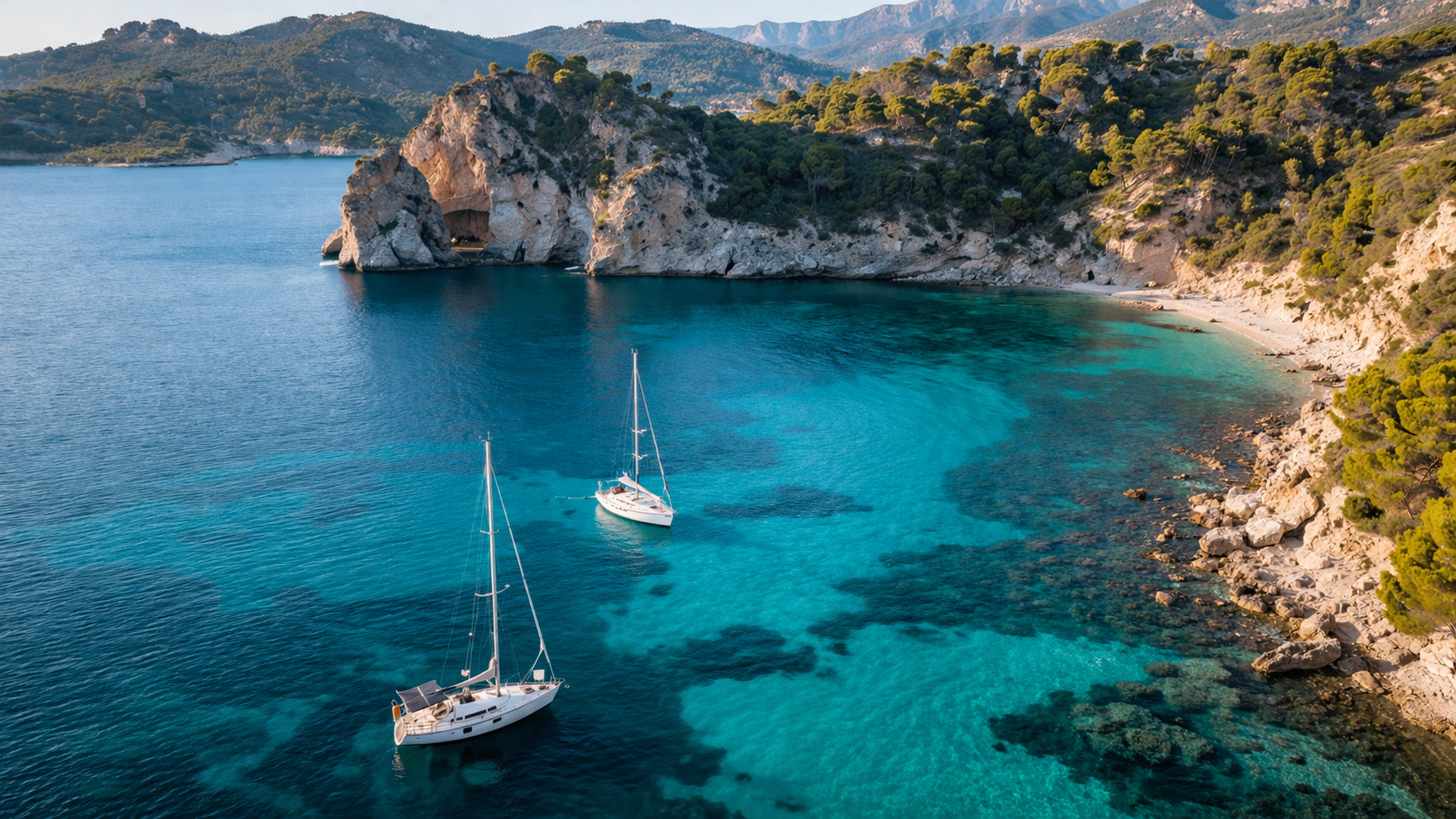
Dropping anchor in a turquoise cove is the quintessential image of Mediterranean sailing. But in France, anchoring is governed by a dense web of legislation: the Transport Code, the Environmental Code, prefectoral decrees, and local municipal regulations. Ignorance of these rules can prove extremely costly — both financially and legally. This guide provides a complete overview of French anchoring regulations so you can enjoy your anchorage in peace, knowing you are on the right side of the law.
1. The legal framework
Under French law, anchoring by recreational vessels falls under several overlapping pieces of legislation. The Code des Transports (Transport Code, articles L5241-1 onwards) sets the general rules for navigation and vessel stationing. The Code de l'Environnement (Environmental Code) comes into play whenever marine habitat protection is involved, particularly for ecosystems like posidonia seagrass beds and coral reefs.
On top of these national laws sit the arrêtés préfectoraux maritimes — regional decrees issued by the maritime prefects (one for the Mediterranean in Toulon, one for the Atlantic in Brest, one for the Channel in Cherbourg) and by departmental prefects for the shoreline. These decrees specify which zones are open, restricted, or closed to anchoring in each sector.
Finally, coastal municipalities have their own local policing powers and can regulate anchoring in waters under their jurisdiction through local bylaws and harbour regulations.
The overriding principle: wild anchoring on the public maritime domain is free unless there is a regulation to the contrary. That caveat changes everything, because contrary regulations are now extensive.
2. Restricted and prohibited zones
Several categories of zone are totally or partially off-limits for anchoring in France. As a visiting sailor, it is your responsibility to check before you drop the hook.
Natura 2000 sites
Natura 2000 marine sites cover a significant portion of the French coastline. While anchoring is not automatically banned, many sites have management plans (DOCOB) that restrict or prohibit anchoring to protect benthic habitats. Always check the specific rules for each site.
Marine reserves and national parks
Marine nature reserves (such as Scandola in Corsica) and national park core zones (Port-Cros, Calanques) have extremely strict regulations. Anchoring is generally prohibited except on designated mooring buoys. Each park publishes specific rules on its official website.
Port approaches and channels
Anchoring is prohibited in port access channels, turning basins, and manoeuvring zones. These no-anchor areas are marked on marine charts and in the pilot books published by SHOM (the French hydrographic service).
Military zones
Areas reserved for the French Navy (firing ranges, naval bases, exercise zones) are strictly off-limits for both anchoring and navigation. They are identified by prefectoral decrees and marked on official charts.
Posidonia seagrass beds
Since the prefectoral decree of June 2023, reinforced in 2024, anchoring on Posidonia oceanica beds is banned for vessels over 24 metres throughout the French Mediterranean. For smaller recreational vessels, the ban applies in numerous specifically mapped zones available from the maritime prefectures and harbour offices. Anchors tear up the rhizomes and cause irreversible damage to an ecosystem that grows only a few centimetres per year.
On the YachtMate chart, regulated zones and marine protected areas are displayed as overlays. You can see at a glance which areas are restricted or prohibited before you arrive, avoiding unpleasant surprises.
3. Wild anchoring: rules and limits
Mouillage forain (wild anchoring) means anchoring on your own anchor outside of a port or an organised mooring area. It is the traditional freedom of the mariner: drop the hook wherever you please, provided it is not prohibited.
In practice, this freedom is increasingly regulated:
- Time limits — Depending on the municipality and the applicable prefectoral decree, wild anchoring is limited to 24 or 48 hours. After that, the vessel may be ordered to leave.
- Watchkeeping obligation — The Transport Code requires that someone capable of manoeuvring the boat must be on board, or at least contactable, at all times.
- Anchor light — A white light visible through 360 degrees is mandatory at night and in reduced visibility, in accordance with COLREGS (the International Regulations for Preventing Collisions at Sea).
- Environmental responsibility — Discharge of black water and grey water is regulated: in many zones, no discharge is permitted within 300 metres of the shore. All waste must be taken ashore for proper disposal.
Some heavily visited municipalities (Saint-Tropez, Porquerolles, Bonifacio) have implemented reinforced regulations that limit the number of boats at anchor, prohibit anchoring during certain periods, or require the use of organised mooring buoys.
4. ZMEL: organised mooring zones
ZMEL (Zones de Mouillage et d'Équipements Légers — Light Equipment Mooring Zones) are officially authorised mooring areas managed by a local authority or concessionaire. They offer a legal and environmentally friendly alternative to wild anchoring.
- Eco-friendly moorings — Buoys are attached to ecological anchoring systems that do not damage the seabed
- Legal certainty — You are in an authorised and regulated zone
- Longer stays — ZMELs typically allow several days or even seasonal mooring, longer than wild anchoring permits
- Services — Some ZMELs offer shuttle boats, waste collection, and water supply
Prices vary widely by location and vessel size. Expect between €15 and €80 per night in high season for a 10–12 metre yacht. ZMELs are becoming more numerous, particularly along the Mediterranean coast, where the maritime prefects are actively promoting them to reduce the environmental impact of wild anchoring.
To secure a spot, contact the ZMEL operator (usually the local harbour office or a syndicate). Some ZMELs accept online reservations; others operate on a first-come, first-served basis.
5. Mediterranean-specific rules
The Mediterranean coast has the strictest anchoring regulations in France, driven by intense tourist pressure and the fragility of its marine ecosystems.
Posidonia protection
The 2023 Mediterranean prefectoral decree, strengthened in 2024, prohibits anchoring on posidonia beds for vessels over 24 metres across the entire French Mediterranean. For smaller recreational vessels, the prohibition applies in numerous specifically identified zones — detailed maps are available from the maritime prefectures and harbour offices.
Department-specific decrees
Each Mediterranean coastal department has its own local decrees:
- Bouches-du-Rhône — Strengthened regulations in the Calanques National Park; mandatory mooring buoy use in certain calanques
- Var — Limited anchoring zones around Porquerolles and Port-Cros; total prohibition in certain national park sectors
- Alpes-Maritimes — Time limits (often 24 hours) in the most popular bays
- Corsica — Reinforced protection around nature reserves (Scandola, Bouches de Bonifacio); mandatory ZMELs at several popular anchorages
AnchorFix integrates Mediterranean regulated zones. If you drop your anchor in a prohibited or restricted sector, you receive an immediate alert so you can move to an authorised area.
6. Atlantic and Channel coast rules
The Atlantic and Channel coasts present different challenges, primarily related to tides and shellfish farming.
Shellfish farming zones
Anchoring is strictly prohibited in shellfish concessions (oyster parks, mussel bouchots). These zones, common in Brittany, Charente-Maritime and Normandy, are marked on charts but can be difficult to spot at high water. Check your chart carefully and watch for the distinctive stakes and trestles.
Tidal considerations
With tidal ranges exceeding 10 metres in parts of the Channel, anchoring in tidal waters demands particular attention:
- Risk of grounding if the depth is insufficient at low water
- Chain scope must be calculated based on high water depth
- Some areas are only accessible at high tide and prohibited for overnight anchoring
Marine parks and protected areas
The Iroise Marine Park, the Arcachon Basin marine park, and various Atlantic nature reserves regulate anchoring through specific charters and decrees. Wild anchoring generally remains possible but with identified sensitivity zones where it is discouraged or prohibited.
Estuaries and roadsteads
In major estuaries (Loire, Gironde, Seine) and military roadsteads (Brest, Cherbourg), anchoring is regulated by harbour authorities. Designated anchorage zones for transiting yachts are sometimes available — check the pilot books and contact the harbour office on VHF.
7. Fines and penalties
Penalties for non-compliance with anchoring regulations are graduated according to the severity of the offence.
Regulatory offences
- Anchoring in a prohibited zone (outside protected areas) — 5th class fine: up to €1,500 (€3,000 for repeat offences)
- No anchor light displayed — 4th class fine: up to €750
- Exceeding the time limit at a wild anchorage — 4th class fine
Environmental offences
- Damage to a protected habitat (posidonia, coral, reef) — Criminal offence under the Environmental Code (article L415-3): up to €150,000 fine and 3 years imprisonment
- Anchoring in a nature reserve in violation of a protection order — up to €150,000
- Discharge of sewage in a protected zone — fine plus potential impounding of the vessel
Inspections are carried out by the Maritime Affairs, the maritime gendarmerie, national park rangers, and customs. During the summer season, enforcement is significantly stepped up, particularly along the Mediterranean and in the most popular anchorages.
In 2025, the maritime gendarmerie issued over 800 fines for anchoring violations on the Mediterranean coast alone. The trend is clearly towards stricter enforcement.
8. How to check if anchoring is allowed
Before dropping anchor anywhere in French waters, make it a habit to verify the local regulations. Here are the reliable sources:
- Official marine charts (SHOM) — Prohibited zones, ZMELs and protected areas are all plotted on official charts. Make sure your charts are up to date (SHOM publishes weekly corrections).
- Notices to Mariners (AVURNAV) — Published by the maritime prefectures, these announce temporary or permanent changes to regulations.
- Maritime prefecture websites — All prefectoral decrees are published online: Mediterranean (Toulon), Atlantic (Brest), Channel-North Sea (Cherbourg).
- Harbour offices — When in doubt, a quick VHF call to the nearest harbour office will give you the information in real time.
- Navigation apps — Modern apps integrate regulatory layers and alert you when you are entering a restricted zone.
With YachtMate's community features, you can read other sailors' experiences at each anchorage: local regulations, recent inspections, seabed quality, wind protection. The information is continuously updated by the community.
Conclusion
Anchoring regulations in France are becoming more complex every year, driven by legitimate environmental imperatives. For sailors, the bottom line is simple: check before you anchor. The fines are hefty, but more importantly, respecting these rules means helping to preserve the stunning marine environments that make French coastal waters so special.
The habit to adopt: before every anchorage, consult the chart, verify the local regulations, and if in doubt, head for a ZMEL or call the harbour office. Your holiday will be all the more relaxing for it.
Read also
Anchor legally with YachtMate
Regulated zones on the chart, AnchorFix alerts, community feedback: everything you need to anchor within the law. Free.
Discover YachtMate