
Every summer, the same scene plays out on our beaches: a motorboat skimming the shore at full speed, swimmers looking up, a lifeguard blowing a whistle. Behind this seasonal classic lies a fundamental rule every boater must know by heart: the 300-metre zone. This buffer strip between land and open water concentrates the most sensitive uses — swimming, diving, windsurfing, kayaking — and is subject to strict regulation. Understanding it means avoiding accidents, fines, and navigating in harmony with everyone else on the water.
1. What is the 300-metre zone?
The 300-metre zone is the maritime strip stretching from the shore out to 300 metres from the waterline, measured from the level reached by the sea at its highest (the high-water mark). It is a zone of special jurisdiction: inside this strip, the authority responsible for regulating navigation and water activities is not the maritime prefect, but the mayor of the coastal town.
This municipal competence explains why the rules can vary from one town to the next. The mayor is responsible for the safety and public health of swimming and water activities carried out from the shore, within this coastal strip.
Beyond 300 metres, authority returns to the maritime prefect and the general navigation regime applies. The 300-metre zone is therefore not an arbitrary legal boundary: it is the dividing line between two logics — protecting shore users and freedom of navigation offshore.
The guiding principle: within 300 metres, the safety of swimmers and shore activities takes precedence over a boater's speed and freedom of manoeuvre.
2. The 5-knot rule
This is the best-known and most important rule: within the 300-metre zone, the speed of all vessels and craft is limited to 5 knots, about 9 km/h. This limit applies to everyone without exception: sailboats, motorboats, RIBs, jet-skis, tenders.
Why 5 knots? At that pace, a boat produces little wake, its stopping distance stays short and the helmsman has the reaction time needed to avoid a swimmer who suddenly appears. It is a speed of prudence, designed to coexist with vulnerable users who are hard to spot from the helm.
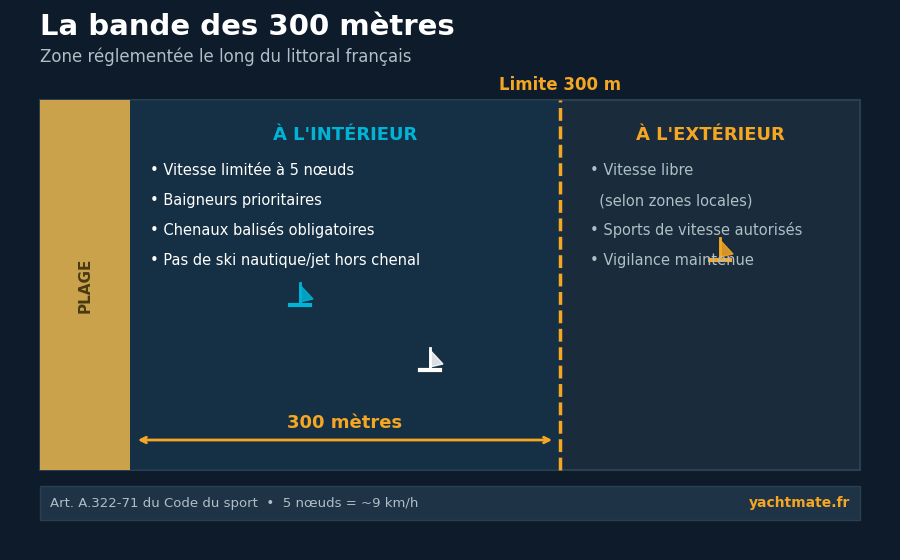
Note: some towns reduce this speed further in busy areas, or extend the limit beyond 300 metres by municipal order. Conversely, no town can legally authorise a speed above 5 knots within the strip without a specific arrangement (transit channel, dedicated activity area). When in doubt, the 5-knot rule remains the default reflex.
5 knots is slower than you think: barely faster than a jogger. In YachtMate, the large speed readout (SOG) lets you check at a glance that you stay below 5 knots as you approach the shore.
3. Swimmers and swimming areas
Within the 300-metre zone, the swimmer is king. A swimmer, even far from shore, always has priority over a boat. The boater is required to avoid them and to adjust course and speed accordingly. A swimmer drifts, may not see you and does not always hear an engine: vigilance rests entirely on the helmsman.
Reserved swimming areas
Supervised beaches often have an area reserved exclusively for swimming, marked at sea by a line of buoys, usually yellow or green. Inside this area, all navigation is strictly prohibited, including under sail, oar or motorised paddleboard. These areas are signposted onshore.
Areas closed to swimming
Conversely, some sectors are off-limits to swimmers (channels, harbour approaches, mooring areas). Onshore signage and sea markings identify these zones. A prudent boater learns to read this coastal marking just like the nautical charts.
4. Transit channels
So how do you reach open water with a jet-ski, a fast RIB or a windsurf board, if the whole strip is limited to 5 knots? The answer lies in transit channels.
A transit channel is a marked corridor that crosses the 300-metre zone perpendicularly, linking the shore to open water. It lets craft transit, but always at 5 knots maximum inside the channel. Only once past the 300-metre limit, at the channel exit, does speed become free again (within the general rules of navigation).
Channel marking follows a precise code:
- Red cylindrical buoys to port and green conical buoys to starboard, in the shore-to-sea direction
- A channel may be reserved for a specific use: beach craft, windsurfers, water skiing
- Priority applies in the outbound or inbound direction depending on the local order
Using a channel also means never anchoring or stopping in it: it must stay clear for traffic, notably for any rescue craft.
5. What is allowed and prohibited
Let us review practices within the 300-metre zone, keeping in mind that the mayor may tighten these rules locally.
Allowed (at 5 knots and with vigilance)
- Sailing or motoring while respecting the speed limit
- Reaching or leaving a mooring, a launch beach, a slipway
- Transiting through a marked transit channel
- Anchoring, if the sector is not closed to anchoring by order
Prohibited
- Exceeding 5 knots, for any reason
- Navigating in a reserved swimming area
- Water skiing, wakeboarding or towing (ringos) outside a dedicated channel
- Riding a jet-ski at full speed or performing tricks
- Discharging waste water: black water is prohibited in this sensitive zone
Before approaching an unfamiliar beach, check the YachtMate chart: swimming areas, channels and regulated zones are displayed. You anticipate your approach rather than discovering it at the last moment.
6. Penalties and enforcement
Failure to respect the rules of the 300-metre zone is an offence, enforced by the maritime gendarmerie, the maritime affairs service, the municipal police and the coastguard. In summer, patrols are frequent, especially around supervised beaches.
Penalties depend on the nature of the offence:
- Speeding within the strip — a fine of up to several hundred euros, worsened in case of endangerment
- Navigating in a swimming area — a heavily sanctioned offence given the direct risk to people
- Endangering the life of others — in case of clearly dangerous behaviour, the charge can go beyond a simple fine
Beyond the amount, it is the liability in case of an accident that should give pause: injuring a swimmer with a propeller engages the helmsman's civil and criminal liability. No fine matches the weight of such a tragedy.
The 5-knot rule is not an administrative constraint: it is the safety margin that separates a fine day at sea from an irreparable accident.
7. Navigating the 300-metre zone well
A few simple reflexes let you cross this sensitive zone with peace of mind:
- Slow down early — don't wait until you're at 300 metres to slow. Anticipate your deceleration so you are already at 5 knots at the edge of the strip.
- Increase the lookout — if possible, post a crew member forward to spot swimmers, buoys and small craft hard to see from the helm.
- Identify the markings — locate the swimming area and transit channel before entering the strip.
- Respect shore users — kayaks, paddleboards, boards and swimmers have priority and are vulnerable; give them room.
- Check local rules — a municipal order may tighten the rules (speed, zones, hours). When in doubt, the harbour office or lifeguard post can advise.
Adopting these habits turns the 300-metre zone from a regulatory trap into a shared space where everyone finds their place.
Conclusion
The 300-metre zone perfectly illustrates a reality of modern boating: the sea is shared. Between swimmers, kayakers, jet-skis and sailboats, this buffer strip imposes a simple discipline — slow down, watch, respect. The 5-knot rule, priority to swimmers and the mandatory use of channels are not there to curb the pleasure of sailing, but so that no one comes back from the sea with an accident on their conscience.
The right reflex: as soon as the shore draws near, hand on the throttle, eye on the water, mind on others. That vigilance is the mark of a true sailor.
Read also
Approach the shore safely with YachtMate
Swimming areas, channels, local rules and real-time speed: everything to navigate near beaches without stress. Free.
Discover YachtMate