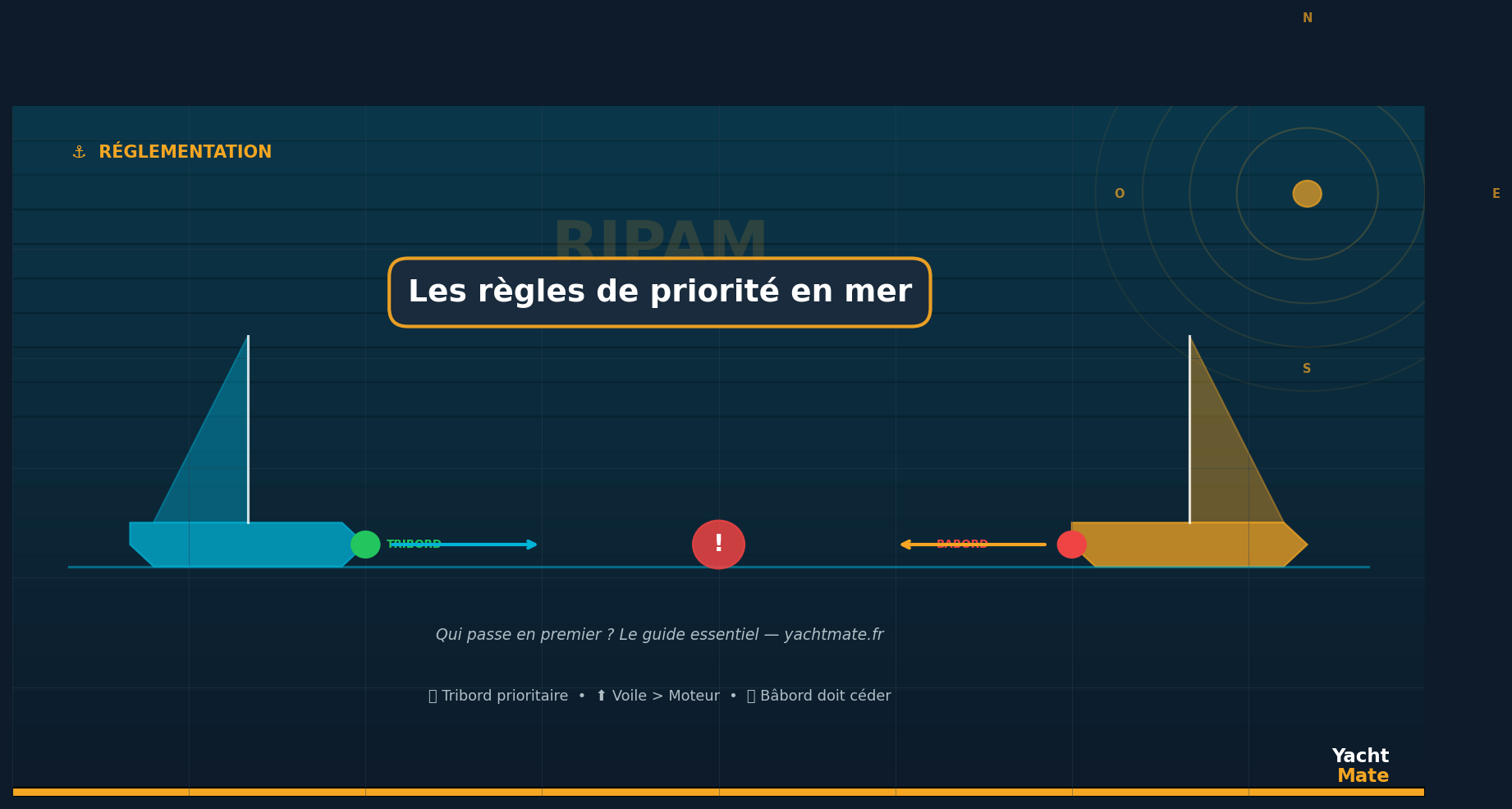
At sea, hundreds of vessels of different types and sizes must coexist safely. The framework that makes this possible is the COLREGS — International Regulations for Preventing Collisions at Sea. Adopted in 1972 under the International Maritime Organization (IMO), the COLREGS are the highway code of the sea. They precisely define who has the right of way, what manœuvres are permitted or forbidden, and what signals must be displayed depending on conditions. Every recreational sailor, whether under sail or motor, in the Mediterranean or the Atlantic, is required to know and follow them.
Contrary to popular belief, the COLREGS are not simply a matter of "starboard has priority." They form a coherent set of principles, some of which take precedence over others depending on the nature of the vessels involved. Here is a complete guide to understanding and memorising the essentials.
The Core Principles of COLREGS
Before diving into specific right-of-way rules, you need to understand a few fundamental principles that structure the entire COLREGS framework.
The Hierarchy of Vessels
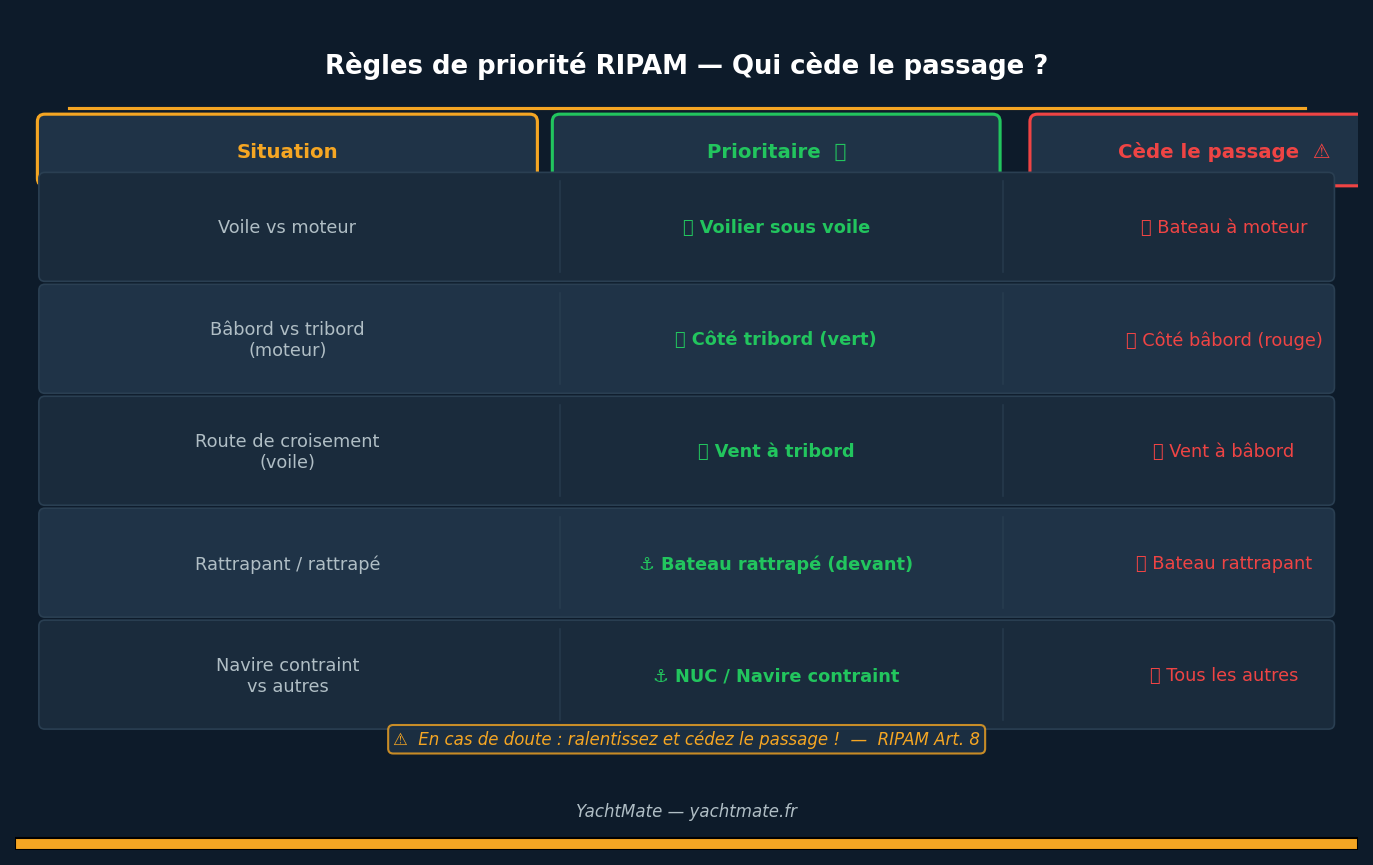
COLREGS establishes a hierarchy among vessel types based on their manoeuvrability. A less manoeuvrable vessel must be given way by others. From least to most manoeuvrable, the priority order is:
- NUC (Not Under Command) — A vessel unable to steer (broken rudder, engine failure…). Absolute priority.
- RAM (Restricted in Ability to Manœuvre) — Vessel with restricted manoeuvrability: minesweeper, cable layer, vessel replenishing at sea…
- Vessel engaged in fishing — A trawler with nets deployed cannot freely change course.
- Sailing vessel under sail alone — Without an engine, her manoeuvrability is limited by the wind.
- Power-driven vessel — The most free to manœuvre.
- Fishing vessel not engaged in fishing — Treated as a power-driven vessel.
- Seaplane — On the fringe of maritime traffic, gives way to all.
Fundamental rule: a vessel higher in this hierarchy ALWAYS has priority over those below it. A sailing vessel under sail has right of way over a motorboat; a NUC has priority over everyone.
The General Rule of Vigilance
Whatever your right of way, COLREGS requires you to maintain a proper lookout at all times (Rule 5) and to navigate at a safe speed appropriate to the conditions (Rule 6). Having priority never exempts you from vigilance and taking necessary precautions to avoid collision.
The YachtMate app displays AIS vessels around you in real time on your navigation chart, with their heading, speed and vessel type. You can anticipate crossing situations well before they become critical, and assess who must give way according to COLREGS.
Right-of-Way Rules Between Power-Driven Vessels
When two power-driven vessels approach each other, Rules 12 to 18 of COLREGS define precisely who manœuvres and how.
Crossing Situation: Starboard Priority
This is the most well-known rule: when two power-driven vessels are on crossing courses with risk of collision, the vessel that sees the other on its starboard side (right) must give way. More precisely:
- The vessel with the other on its starboard side is the give-way vessel. It must manœuvre to avoid collision, preferably by passing astern of the other.
- The vessel with the other on its port side is the stand-on vessel. It maintains its course and speed, unless collision becomes imminent.
Memory aid: think of it like driving a car. You yield to traffic coming from your right. At sea, you yield to the vessel approaching from your starboard (right).
Head-On Situation
If two power-driven vessels are on opposite or nearly opposite courses with risk of collision, each shall alter course to starboard to pass port-to-port. This is the maritime equivalent of "keep to the right."
Overtaking
A vessel overtaking another (approaching from within 135° of the other's stern) must always give way, whether under sail or power. The overtaken vessel always has priority.
Sail vs Motor: The Sailing Vessel's Priority
A sailing vessel proceeding under sail alone (no engine) has priority over power-driven vessels. But be aware: this rule applies only when the sailing vessel is not using its engine. The moment it starts its engine — even if the sails remain up — it becomes a power-driven vessel and loses this hierarchical advantage.
YachtMate lets you easily switch between "sail" and "motor" mode in your navigation profile. This information is shared with your crew and automatically reminds you of your regulatory obligations based on the propulsion mode in use.
Rules Between Sailing Vessels
When two sailing vessels under sail alone approach each other, the right-of-way rules depend on the wind direction:
- Different tacks: the vessel on the starboard tack (wind from the starboard side) has right of way. The vessel on the port tack must give way.
- Same tack: if both vessels are on the same tack, the vessel to windward (closer to the wind) must give way to the leeward vessel.
- Uncertainty: if a vessel on the port tack cannot determine the tack of another vessel she sees to windward, she must give way as a precaution.
Special Situations
Vessels with Restricted Manoeuvrability
Certain vessels display specific lights or signals indicating they cannot manœuvre freely. These include vessels engaged in underwater operations, minesweepers, and vessels replenishing at sea. They carry three all-round lights in a vertical line (red-white-red) and have priority over almost all other vessels, including sailing vessels.
Vessels in Narrow Channels and Traffic Separation Schemes
In narrow channels and Traffic Separation Schemes (TSS), special rules apply. Small vessels (including most recreational sailing vessels) must not impede large vessels constrained to remain in the channel. This rule overrides the normal hierarchy: even if you are under sail and theoretically have priority over a cargo ship, a large vessel in a narrow channel takes priority because it cannot leave the channel.
In practice: when facing a commercial vessel in a narrow channel, a recreational sailor must always stand clear, regardless of propulsion mode. COLREGS Rule 9 is unambiguous on this point.
Vessels Constrained by Their Draught
A vessel that cannot deviate from its course due to its draught (too deep to navigate outside the channel) may display special lights and is then considered a priority vessel. Sailors should be especially vigilant in the approaches to large commercial ports where such vessels are common.
YachtMate's chart integrates bathymetric data and channel limits, allowing you to see at a glance where vessels constrained by their draught are likely to be present — and to leave yourself adequate sea room.
Manœuvres to Avoid Collision
COLREGS not only defines who has priority but also specifies how avoidance manœuvres must be made (Rule 8):
- Any action must be positive, large enough and made in ample time. A small last-second helm movement is not COLREGS-compliant.
- Where possible, avoid crossing ahead of another vessel's bow: it is better to pass astern of her stern.
- If necessary, slow down or stop your vessel to allow the other to pass.
- Never manœuvre in a way that places the other vessel in an impossible situation.
Quick Reference: Right-of-Way at a Glance
Here is a summary of the most common situations you will encounter as a recreational sailor:
- Sailing vessel (sail only) vs powerboat → sailing vessel has right of way
- Two sailing vessels, opposite tacks → starboard tack has right of way
- Two powerboats crossing → vessel with the other on its port side has right of way
- Overtaking situation → the overtaken vessel always has priority
- Two vessels head-on → each alters to starboard
- Sailing vessel vs cargo in a narrow channel → cargo has priority (Rule 9)
- Any vessel vs NUC or RAM → NUC/RAM always has priority
Mastering COLREGS is not only a legal obligation but also the most effective tool for collision prevention. At sea, communication between vessels is limited, and this common code — known to mariners worldwide — is what allows everyone to anticipate each other's intentions and navigate safely.
Navigate more safely with YachtMate
YachtMate displays AIS vessels around you in real time, with their heading, speed and type — exactly the information you need to apply COLREGS while underway. Available on iOS and Android.
Discover YachtMate →