
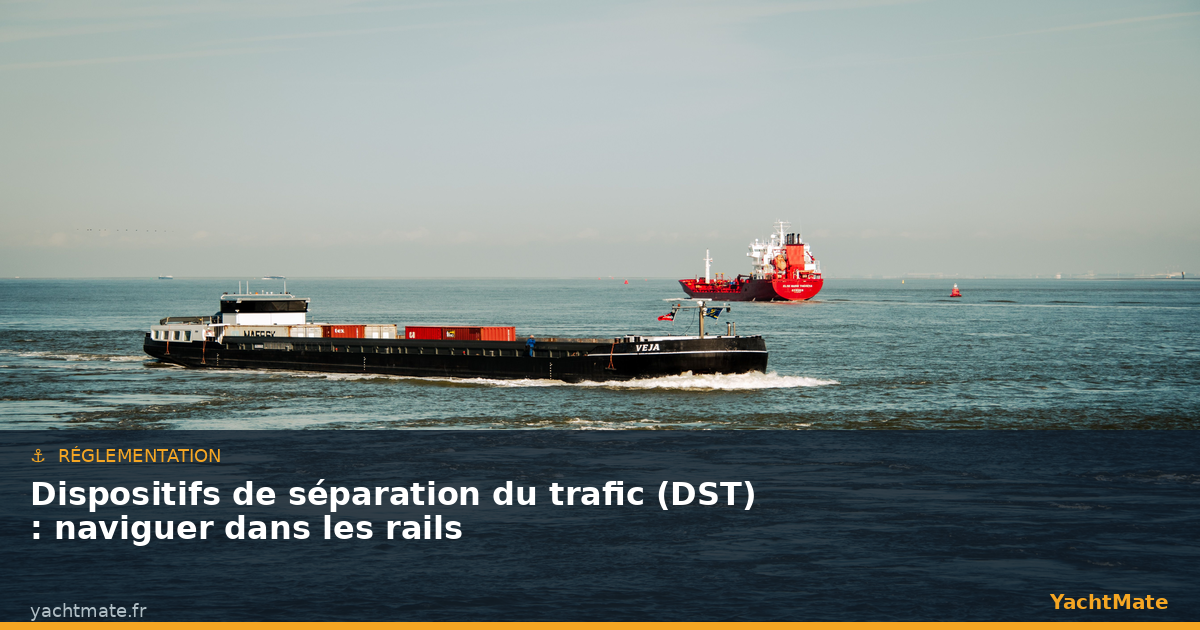
Off Ushant, in the Dover Strait, at the entrance to Gibraltar or through the Strait of Bonifacio, maritime traffic is so dense that merchant vessels don't move around at random: they follow sea motorways called traffic separation schemes, or TSS. For the recreational boater, understanding these schemes is no theoretical nicety. Crossing a shipping lane without knowing the rules means risking a head-on encounter with a 300-metre container ship doing 20 knots, which will take several miles to alter course — when it can do so at all.
The good news: the rules are simple, clear and written in black and white in the COLREGs. You just need to know them and be able to apply them in practice. Here is everything a boater should master before approaching a TSS.
What is a traffic separation scheme?
A TSS is a maritime traffic pattern established by the International Maritime Organization (IMO) in areas where traffic density, geography or navigational hazards make sailing particularly risky. Its purpose is to organise the flows of vessels travelling in opposite directions, like the lanes of a motorway, to reduce the risk of head-on collision.
The components of a TSS
A traffic separation scheme is made up of several elements that are clearly shown on nautical charts:
- The traffic lanes — Corridors in which vessels all travel in the same direction, shown by large purple arrows on the chart.
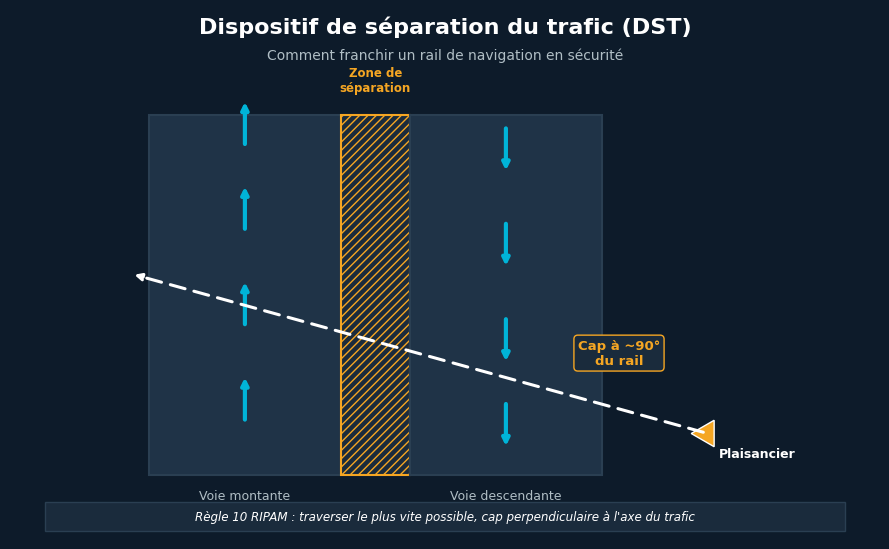
- The separation zone — A central strip (often tinted) that separates the two opposite-direction lanes. Vessels must not navigate in it, except in exceptional cases (emergency, crossing).
- The inshore traffic zones (ITZ) — Located between the TSS and the coast, reserved for local traffic and small craft that have no need to use the lane.
- The precautionary areas — At the ends or junctions of several TSS, where vigilance must be at its highest.
Where do you find TSS around Europe and the Mediterranean?
Several TSS punctuate the shipping routes frequented by boaters: the Ushant TSS (one of the busiest in the world), the Dover Strait TSS, the Casquets TSS off the Channel, the Cap Corse TSS, the Strait of Bonifacio, and the Strait of Gibraltar. All are shown on official paper and electronic charts.
The YachtMate navigation chart displays traffic separation schemes with their lanes and direction of flow. You can see your position relative to the lane and prepare your crossing in advance, choosing the right heading and the right moment to cross the TSS.
COLREGs Rule 10: the heart of the matter
All obligations relating to TSS are gathered in Rule 10 of the COLREGs. This is THE rule to know. It distinguishes two situations: navigating within a TSS lane, and crossing the scheme.
If you use a traffic lane
A vessel using a TSS lane must:
- Proceed in the appropriate traffic lane in the general direction of traffic flow for that lane (never against it).
- Keep as far as practicable clear of the traffic separation line or zone.
- Normally join or leave a traffic lane at the termination of the lane. When joining or leaving from the side, do so at as small an angle as practicable to the general direction of traffic flow.
If you cross the scheme
This is the most frequent case for a boater: you are not following the lane, you simply want to get to the other side. The rule is unambiguous: a vessel crossing a TSS must do so on a heading as nearly as practicable at right angles to the general direction of traffic flow.
Why at right angles? Because it is the track that minimises the time spent in the lane, makes your intentions immediately readable to other vessels, and presents your beam — your most visible profile — to ships travelling in the lane.
Beware a classic mistake: it is the heading of the boat that must be perpendicular, not the course over ground. In a current, your actual track will differ from your heading. You must keep the bow of the boat at 90° to the traffic, even if the current makes you drift diagonally — that is what neighbouring vessels understand best.
The boater facing large vessels
Rule 10 contains a provision that is essential for pleasure craft. A vessel less than 20 metres in length or a sailing vessel shall not impede the safe passage of a power-driven vessel following a traffic lane.
Concretely, this means that even if you are sailing — and therefore, in normal circumstances, have priority over a power-driven vessel under the COLREGs hierarchy — that priority does not apply in a TSS. The cargo ship following its lane keeps the de facto "right of way", because it cannot easily get out of the way. It is up to you to anticipate and keep clear.
"Not to impede" has a precise meaning in maritime law: you must manoeuvre early enough that the large vessel never has to alter its course or speed because of you. If the cargo ship has to slow down or come off its heading, then you have impeded its passage.
With YachtMate's AIS display, you see in real time the vessels travelling in the lane, with their heading, speed and closest point of approach (CPA). You can therefore pick a clear crossing window and slip through the TSS between two ships with complete peace of mind.
The right reflexes before and during the crossing
Before approaching the lane
- Identify the TSS on your chart and note the direction of each lane as well as the separation zone.
- Calculate your perpendicular crossing heading, accounting for current to anticipate your drift.
- Observe the traffic on AIS and by eye: how many vessels, at what speed, in which direction.
- Choose your moment: it is better to wait a few minutes for a gap to open than to commit between two closely-spaced ships.
During the crossing
- Hold a stable, perpendicular heading to make your intentions clear.
- Cross at your best reasonable speed: the less time you spend in the lane, the better.
- Never cut across the bow of a large vessel thinking you'll "just slip in front". Distances and speeds are deceptive.
- Keep a permanent lookout and don't hesitate to use the VHF (channel 16, then a working channel) to signal your intentions if in doubt.
Inshore traffic zones: the smart alternative
If your route hugs the coast and a TSS lies in your path, the best solution is often not to enter the lane at all. The inshore traffic zones (ITZ), located between the TSS and the land, are precisely intended for local traffic and craft under 20 metres.
By using the ITZ, you stay clear of the large merchant vessels and sail in a space designed for you. Rule 10 indeed specifies that small craft and sailing vessels should use the inshore traffic zones rather than the TSS lanes when it is practicable and consistent with their route.
Common mistakes to avoid
- Going the wrong way in a lane to "save time": it is prohibited and extremely dangerous.
- Crossing diagonally to take a shortcut: an oblique track lengthens the time spent in the lane and blurs your intentions.
- Confusing heading with course over ground in a current: it is the boat's heading that must be at 90°.
- Believing sail-over-power priority applies in a TSS: it is suspended by Rule 10.
- Anchoring or fishing in a separation zone or in a lane: forbidden except in an emergency.
Mastering TSS is above all about adopting a posture of humility towards commercial traffic. A large vessel can neither stop quickly nor manoeuvre like a sailboat. By crossing the lanes cleanly — perpendicular, fast, anticipated — you protect your crew while respecting a regulatory framework designed for everyone's safety.
Cross the lanes with confidence using YachtMate
YachtMate displays traffic separation schemes, AIS vessels and their closest point of approach, to help you choose the right heading and the right moment. Available on iOS and Android.
Discover YachtMate →