

Every voyage begins long before you cast off the lines. Preparation is the sailor's first skill: a rigorous checklist protects you from forgotten items, breakdowns at sea and avoidable emergencies. Even the most experienced sailors use one — airline pilots do too, and for the same reasons.
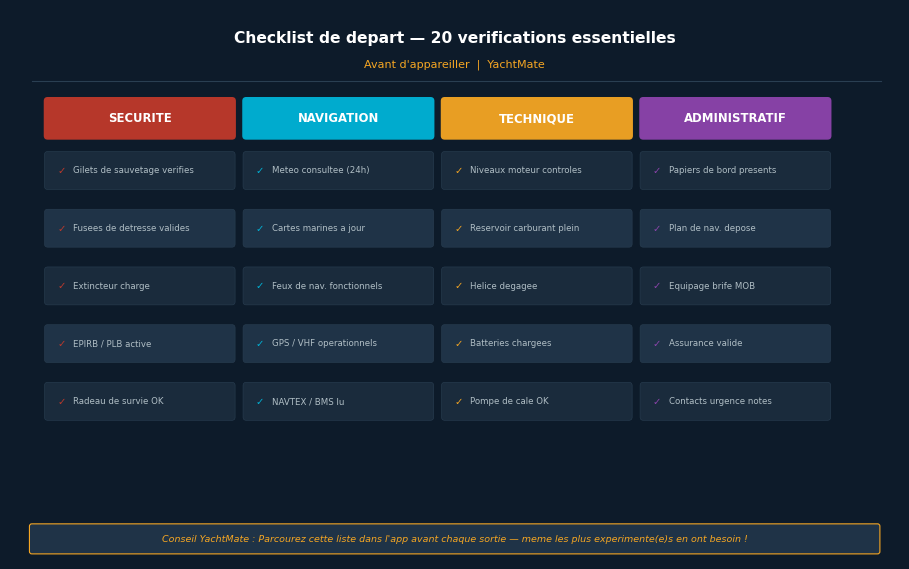
In this article, we offer a complete 20-point checklist organised into four main categories: safety, navigation, engine/technical and paperwork. Make it a habit to go through it before every departure, regardless of how long you plan to be out.
Why a checklist is indispensable
At sea, memory alone is not enough. Fatigue, the excitement of departure, conversations with crew — all of these distractions lead to forgetting the essentials. Maritime safety research shows that the majority of avoidable incidents at sea (breakdowns, damage, accidents) could have been prevented by a systematic pre-departure inspection.
A checklist is not a sign of inexperience — on the contrary, it marks a serious sailor. It creates a verification routine that becomes natural and reassuring for the whole crew.
Save your checklist in the YachtMate app to access it before every trip, customise it for your boat and tick items off in real time from the cockpit.
Category 1: Safety (items 1 to 5)
Safety is non-negotiable. Before any other check, make sure your rescue equipment is operational and accessible.
1. Life jackets
Check that you have one life jacket per person on board, suitable for each crew member's weight. Inspect the automatic inflator service dates and CO₂ cartridge condition. For offshore passages, 150N lifejackets with harness and personal light are recommended.
2. Distress flares
Your pyrotechnic equipment must be within its expiry date (maximum 4 years). Check the date stamped on each flare: parachute rockets, hand flares and smoke signals. Store them in a dry, quickly accessible location.
3. Fire extinguisher
Every motorboat must carry at least one approved fire extinguisher. Check the pressure gauge (needle in the green), the service date and accessibility. A second extinguisher near the engine compartment is strongly advisable.
4. EPIRB or PLB
For offshore sailing, the EPIRB must be registered with the relevant authority, charged and set to automatic mode. For coastal sailing, a personal PLB for each crew member is an excellent additional safety measure.
5. Life raft (if applicable)
Check the life raft's service date. An unserviced raft may fail to inflate when triggered. Also make sure it is secured in a way that allows quick release in an emergency.
Category 2: Navigation (items 6 to 10)
Good nautical preparation starts with the weather forecast and extends to checking all navigation instruments.
6. Marine weather (24 to 72 hours ahead)
Consult multiple sources: official marine forecasts, NAVTEX bulletins and a reliable weather app. Pay particular attention to expected winds, sea state and storm risks. Don't hesitate to delay the trip if conditions are marginal for your skill level.
7. Up-to-date charts
Whether you sail with paper or electronic charts, make sure they are current for your sailing area. Electronic Navigation Charts (ENCs) are updated regularly and reflect the latest Notices to Mariners.
8. Navigation lights
Test all your lights: bow lights (green/red), stern light (white), anchor light, masthead lights. An undetected blown bulb can be dangerous at night and make you less visible to other vessels.
9. GPS and VHF radio
Verify your GPS is correctly configured and your VHF is on channel 16. If your VHF has DSC (Digital Selective Calling), ensure the MMSI is registered and the unit is connected to GPS.
10. NAVTEX / Notices to Mariners
Check the latest notices for your area: reported wrecks, moved buoys, active military zones, offshore works. This takes two minutes and can prevent a nasty surprise.
YachtMate integrates real-time marine weather data and shows risk areas directly on your navigation chart. No more excuses for heading out without a weather check!
Category 3: Engine & Technical (items 11 to 15)
Mechanical breakdowns are among the most common reasons for assistance at sea. A quick check before departure can save you an embarrassing — and expensive — tow.
11. Engine fluid levels
Check engine oil, coolant and raw-water cooling levels. An overheated engine at sea is a serious breakdown. Also check belts and visible hoses for wear or cracks.
12. Fuel
Calculate your estimated fuel consumption for the planned trip, with at least a 30% reserve. The golden rule for motorboating: one third to go, one third to return, one third in reserve.
13. Clear propeller
Make sure no lines, fishing nets or plastic bags are trailing near the propeller. A fouled prop just outside the marina is a common and frustrating breakdown. If you have a shaft seal system, check its condition.
14. Batteries
Check the charge level of your battery banks (engine and house). Dead batteries mean no electronics, no lights, no VHF — a dangerous situation. Also inspect battery terminals for corrosion.
15. Bilge pump
Manually test your bilge pump and verify the automatic float switch is free and working. Also confirm there is no abnormal amount of water in the bilge before departure.
Category 4: Paperwork (items 16 to 20)
Paperwork may not be the most glamorous part of sailing, but it is essential for legal and safe navigation.
16. Boat documents
Always carry: the vessel registration certificate, the skipper's licence, identity documents for each crew member (especially for international passages), and insurance papers.
17. Float plan (for longer trips)
For any trip beyond a few hours or into offshore waters, leave a float plan with someone ashore: departure port, destination, intended route, ETA and emergency contacts. If you haven't returned by the expected time, they can alert the authorities.
18. MOB crew briefing
Before each departure, especially with unfamiliar crew, run a quick brief on emergency procedures: Man Overboard (MOB), use of safety equipment, location of extinguishers and life rings. Everyone on board must know what to do.
19. Valid insurance
Confirm your marine insurance is valid for the intended sailing area and type of navigation. Some policies exclude night sailing, navigation beyond certain distances or sailing in foreign waters. Sailing uninsured exposes you to devastating financial consequences in the event of an accident.
20. Emergency contacts
Keep essential numbers easily accessible: your regional coastguard, VHF channel 16 (distress), and the national maritime emergency number. This information should be posted in the cockpit or saloon.
YachtMate lets you store all your boat documents digitally and securely. Licence, registration, insurance certificate: accessible in seconds, even offline.
Tailoring the checklist to your boat
These 20 points form a universal baseline, but every boat has its own specifics. An ocean cruiser will require additional checks (rigging, autopilot, watermaker), as will a catamaran or a powerboat. Take the time to build your own personalised checklist by adding items specific to your vessel.
How often you sail also affects how thorough each check needs to be. A sailor who heads out every weekend on the same boat can run a quick 10-minute check. For a long cruise after a winter layup, plan a full morning of inspections.
"The sea does not forgive lack of preparation. But it rewards those who face it with method and humility."
By adopting this pre-departure routine, you will not only develop solid safety reflexes but also gain peace of mind once at sea. Knowing that everything has been checked allows you to fully enjoy the sailing.
Sail with YachtMate
Add your pre-departure checklist to the app, access real-time marine weather and keep all your boat documents at your fingertips.
Download YachtMate for free