
Buoy, sinker, pennant: getting the words right
In many organised anchorages, natural harbours and protected zones, the anchor gives way to a fixed fitting: the mooring. A very heavy sinker sits on the seabed – a concrete block, a screw anchor, an old propeller or a cast-iron weight – connected to the surface by a chain and a floating buoy. Making fast to it is "picking up a mooring". The advantage is twofold: the sinker holds far better than a light anchor and it reduces the swinging radius, letting boats pack more tightly into a crowded bay.
There are usually two configurations. A ring buoy has a shackle or ring on top through which you pass your own line directly. A pennant buoy carries a ready-made strop (often backed by a thin pick-up line) that you simply haul aboard and turn up on a cleat. Knowing which one awaits you changes the whole preparation: ask the harbour office before you enter.
Why choose a mooring over the anchor
In some areas the question does not even arise: anchoring is forbidden to protect seagrass meadows or fragile seabeds, and only moorings are allowed. Elsewhere, a mooring is often the safer choice over poor holding ground (rock, soft mud) or when the bay is too busy to let every boat swing on 30 metres of chain. A properly sized sinker will also absorb gusts that would drag most light anchors.
The downside is that you control neither the condition of the submerged gear nor its maintenance. A worn chain or a corroded shackle can fail without warning. Hence a simple rule: on an unknown mooring, stay as vigilant as at anchor – transits ashore, GPS alarm, and if the weather turns, do not hesitate to back it up with your own anchor.
Preparing boat and crew before the approach
The essential gear
Success is decided before you even reach the buoy. Get out and prepare:
- a strong boat hook, within reach of the bow crew;
- a mooring line ready, rigged doubled from a bow cleat with the free end in hand;
- gloves (the mooring chain is often coated with weed and sharp shellfish);
- a large snap shackle or carabiner if the ring is small.
Open the bow pulpit gate, clear the rail and check that no sheet is trailing along the topsides on the approach side.
Crew briefing and roles
A successful mooring pick-up comes down to three clear roles: the helm managing speed and heading, the bow crew catching the buoy with the hook, and possibly a relay who takes the line and turns it up while the bow crew holds the hook. Agree on simple words and hand signals, because engine noise and wind drown out the voice. Golden rule: never lunge over the rail, never wrap a line around your hand.
The approach: reading wind and current
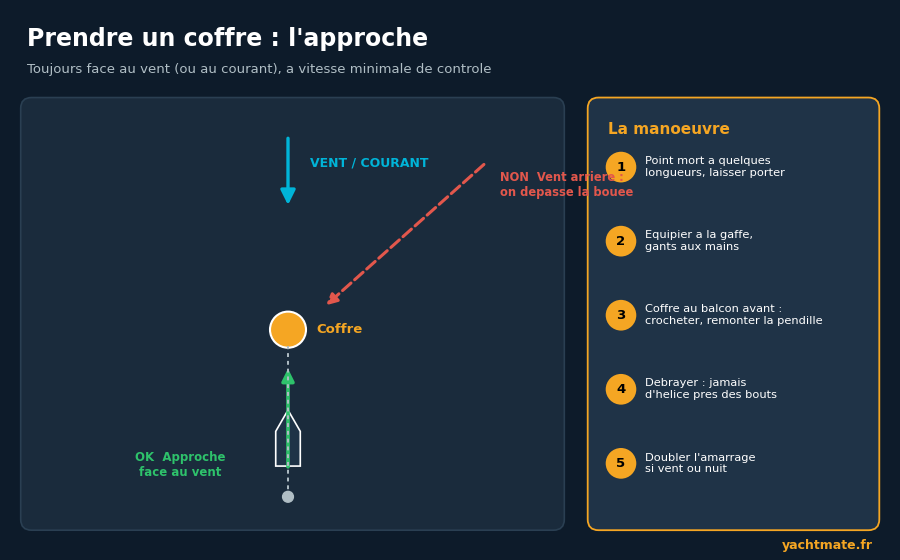
The strongest element rules. In a sheltered harbour it is usually the wind; in a channel or estuary it is often the tidal current. Watch how the boats already moored lie: they all line up facing the resultant. Always approach head to wind (or current), exactly as when coming alongside a pontoon: the element becomes your natural brake and you keep control at very low speed.
Approach at minimum steerage speed
Aim for the buoy while slowing progressively to the lowest speed that still gives you steerage. Plan for the boat to stop just as the buoy reaches the bow pulpit, not under the stem where the crew can no longer reach it and where the chain may pass under the hull. A fast downwind approach is the number-one cause of botched manoeuvres: you overshoot the buoy, have to power up again, and start over.
The pick-up manoeuvre, step by step
Once lined up into the element, run the sequence calmly:
- A few lengths off, shift to neutral and let the way carry the boat toward the buoy.
- The bow crew points at the buoy with an outstretched arm: the helm steers to that mark.
- When the buoy reaches the pulpit, the crew hooks it and hauls up the pennant (or passes the line through the ring).
- The helm goes fully to neutral: no propulsion while lines are handled near the propeller.
- Turn up temporarily with a round turn and half hitches on the cleat, then adjust.
If you miss the buoy, no panic: do not force it, do not reach past the rail. The helm adds a touch of throttle, clears head to wind and presents the boat cleanly again. One more circuit beats a crew overboard.
On a ring buoy, never run your line directly through the metal ring: chafe will wear it through in a single night. Instead shackle a large stainless shackle or carabiner onto the ring and make fast to that. You protect your rope and you will slip more easily on departure.
Making fast: one line or two?
For a short stop in calm weather, a single line rigged doubled (both ends turned up aboard) is enough and makes leaving easy. As soon as you stay the night or wind is forecast, double up: two independent lines on two separate cleats give a backup against chafe or failure. Leave a little slack to absorb the chop, but not so much that you touch your neighbours as you swing.
"A mooring well taken is a slow approach, a sure hook and two lines that do not chafe. The rest is just haste."
On a pennant, haul the strop up to its eye and pass your own line through it rather than trusting the harbour rope alone, whose age you do not know. Protect the fairlead points with a length of hose or a chafe guard.
Common mistakes and safety
Mooring incidents all look alike: too fast an approach, a hand wrapped in a line, the engine engaged while hauling the pennant, or a single line chafing all night on a sharp ring. Add to that the nasty surprise of a sinker undersized for your boat. Before trusting a mooring for the night, ease gently astern on the engine to test its hold, and watch your transits ashore just as at anchor.
In a crosswind, let the wind drift the bow onto the buoy instead of fighting the helm. Present the boat slightly to windward of the buoy: as you slow, she will naturally fall off and the buoy will come to you at the right spot.
Slipping the mooring on departure
Leaving is prepared like arriving. Restart the engine and let it warm, share out the roles, then take the strain on one line while casting off the other. Pick the moment when the bow points toward a clear exit. On the word, the crew lets the last line run – recovering it fully aboard so it cannot go into the propeller – and the helm motors straight out, not engaging until the rope is completely clear of the water. A last look astern to check nothing is trailing, and the departure is clean.
Sail with peace of mind using YachtMate
Charts, marine weather and mooring-zone spotting: YachtMate is with you at every stop.
Discover the app →