Night falls, fog rolls in or visibility drops: these are precisely the conditions where navigation lights become your best allies — and those of other sailors crossing your path. Yet many recreational boaters are unaware of the exact rules: which lights are mandatory, in which angular sector, what colour and at what range? This complete guide covers COLREGS regulations and best practices.
Why are navigation lights mandatory?
Navigation lights are governed by the COLREGS (International Regulations for Preventing Collisions at Sea), adopted by the International Maritime Organization (IMO). These international rules apply to all vessels at sea, including sailing boats and small pleasure craft. They are incorporated into national maritime law in all signatory countries.
The goal is simple: allow every mariner to identify the nature, size, direction and behaviour of a vessel at distance, at night or in poor visibility. A collision can be fatal; regulation lights are the first line of defence against this disaster.
Navigation lights must be switched on from sunset to sunrise, and in restricted visibility (fog, rain, mist) regardless of the time of day.
The three fundamental lights: starboard, port and stern
Green starboard light
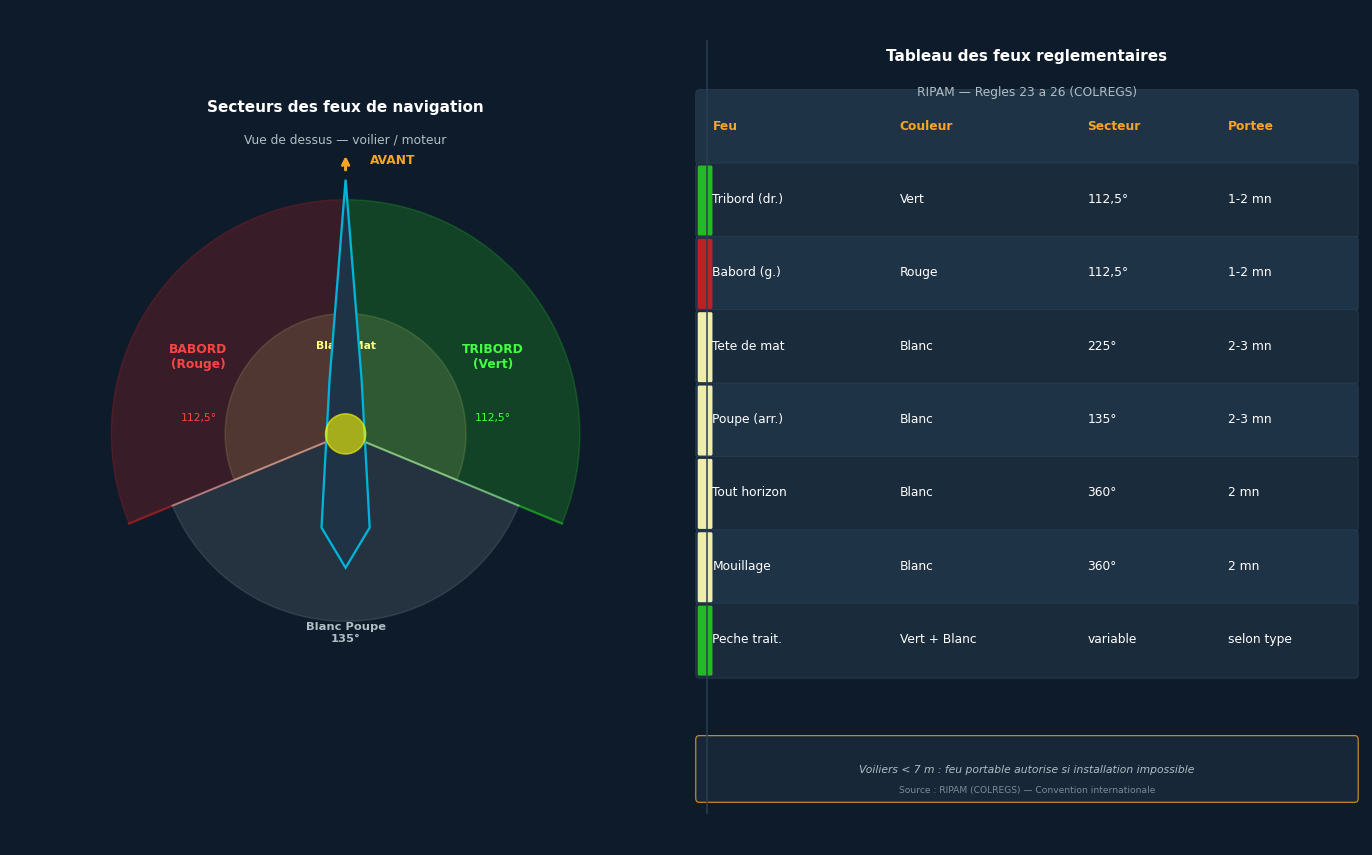
Located on the right side of the vessel (starboard), the green light covers a sector of 112.5° from the bow to the aft-right. Minimum range is 1 nautical mile for vessels under 12 m, and 2 miles for vessels between 12 and 50 m. This light tells other vessels they are on your starboard side.
Red port light
Symmetrical to the starboard light, the red light covers the left side (port) over an identical sector of 112.5°. Same range requirements. When a vessel sees a red light to its left and green to its right, it knows another boat is heading towards it.
White stern light
Visible from astern, this white light covers a sector of 135° centred on the direction opposite to travel. It completes the two side lights to cover the full 360°. Range is 2 miles for small vessels, 3 miles for vessels over 50 m.
Easy mnemonic: red = port = left (you give way if you see red from another vessel), green = starboard = right = go. In maritime navigation, the vessel seeing the red side of another must manoeuvre to give way.
The masthead light (white 225° light)
Power-driven vessels (and sailing boats under engine) must display a white masthead light visible over a sector of 225°, covering the entire forward arc (from aft-starboard to aft-port, passing through ahead). Minimum range is 2 miles for vessels under 20 m, and 3 miles for larger ones.
This light immediately identifies a vessel under mechanical propulsion. A sailing boat under sail alone has no masthead light — that is precisely what distinguishes it from a motor vessel.
Lights by vessel type
Sailing vessel under sail
A sailing vessel under sail may use two configurations: separate side lights (red port + green starboard) plus a white stern light; or a tricolour masthead light combining all three colours in one fitting — permitted for sailing vessels under 20 m. The tricolour option is very energy-efficient. Combined bi-colour bow lights (red-green) are also allowed for vessels under 20 m.
The tricolour masthead light and the conventional side/stern lights must never be used simultaneously. Choose one configuration before departure. YachtMate can help you build personalised pre-departure checklists so you never forget your lighting setup.
Motor vessel under 7 metres
Vessels under 7 m with a maximum speed of 7 knots may display a single all-round white light (360°) instead of separate lights — but only if installation of regulation lights is not practicable. Use this derogation sparingly.
Vessel at anchor
An anchored vessel must display an all-round white light (360°), as high as practicable: at the bow for vessels under 50 m, at both bow and stern for larger ones. This light is mandatory from sunset and must never be confused with a navigation light.
Minimum regulatory ranges
For a standard sailing or motor pleasure vessel (12 to 50 m), COLREGS requires: side lights (red/green) at 2 nautical miles; masthead light at 3 nautical miles; stern and all-round lights at 2 nautical miles. For vessels under 12 m, minimum side-light range is reduced to 1 nautical mile.
LED vs halogen: which to choose?
LED technology has transformed marine lighting. LED navigation lights consume 5 to 10 times less power than equivalent halogens, last far longer (20,000–50,000 hours) and resist vibration and moisture better. Their adoption is strongly recommended for new installations or equipment upgrades.
However, make sure any LED lights you choose are COLREGS-certified and have the correct angular coverage. An overly directional LED may not cover its required sector properly.
Perform a full navigation light check before every night passage: switch on each light and walk the deck to verify no obstruction (sail, spar, cable). A partially obscured light can cause fatal confusion. Add this item to your departure checklist in YachtMate.
Common mistakes to avoid
The most frequent errors include: forgetting to switch lights on or turning them off too early; sailing under engine without the masthead light — very common on sailing boats; confusing the tricolour masthead light with the all-round anchor light; and misaligning lights after a replacement. Never use torches or non-compliant lighting as a stopgap — it is both dangerous and illegal.
Navigate safely with YachtMate
YachtMate helps you build personalised checklists for night passages, manage safety equipment and stay up to date with regulations — all from your smartphone.
Download YachtMate for free