
In dense fog, moonless nights, or busy shipping lanes, the marine radar is one of the most valuable instruments on any sailing yacht or motorboat. Where AIS only detects vessels equipped with a transponder, radar sees everything that reflects radio waves: coastlines, reefs, buoys, fishing nets, and even rain fronts. This comprehensive guide covers how radar works, how to choose, install, and get the most out of it.
1. How Marine Radar Works
A radar (Radio Detection And Ranging) emits pulses of electromagnetic waves in the X-band (9 GHz, 3 cm wavelength) or S-band (3 GHz, 10 cm wavelength). The rotating antenna — typically 24 or 48 rpm — picks up reflected echoes. The elapsed time between transmission and reception gives the precise range, while the antenna's orientation provides the bearing.
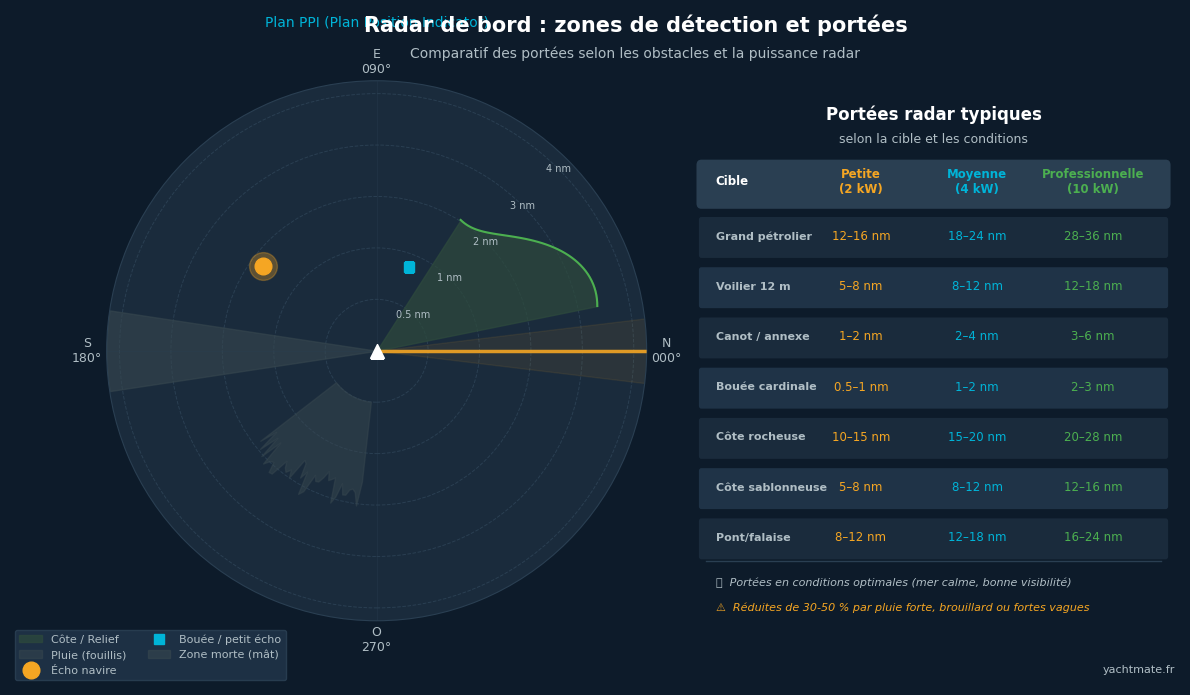
The result is displayed on a PPI (Plan Position Indicator) screen: your vessel is at the centre, and echoes appear as bright spots at their relative positions. Concentric circles represent distance rings in nautical miles.
X-band or S-band?
X-band is the most common for leisure craft: its fine angular resolution (<0.9°) distinguishes two nearby targets. S-band, with longer wavelengths, penetrates rain better and delivers longer range in downpours, but requires a larger, costlier antenna. For coastal sailing, X-band is perfectly adequate.
In X-band, a 60 cm antenna delivers roughly 3 dB more gain than a 45 cm unit — translating to about 40% more range on small targets. If your stern rail or radar arch allows it, go for the 60 cm.
2. Choosing Your Radar
The market spans from around €800 to over €6,000 for professional units. For offshore cruising, three criteria guide the decision:
Transmit Power (kW)
Peak power determines maximum range. Leisure radars run from 2 kW (coastal, ~18 nm on large targets) to 6–10 kW (offshore, >40 nm). For coastal cruising, 4 kW is a solid compromise. Beyond that, power draw and antenna size become serious considerations.
Dome or Open Array Antenna
- Enclosed dome (25–80 cm): compact, protects the antenna from spray, runs continuously. Ideal on sailboats (stern arch, pushpit). Slightly lower resolution.
- Open array (60 cm–4 ft): superior angular resolution and range. Bulky — impractical on tall-rigged sailboats without a dedicated radar arch. Perfect on cruisers and catamarans with deck space.
Pulse Radar vs FMCW
FMCW (Frequency Modulated Continuous Wave) radars such as the Garmin Fantom or Navionics Halo offer excellent close-range resolution (targets from 3–4 m) and lower power consumption. They are more expensive but game-changing for entering a marina in fog or spotting a drifting dinghy a few cable lengths away.
3. Installation on Board
Antenna placement is critical. Two constraints oppose each other: height (the higher the antenna, the greater the range due to Earth's curvature) and safety (the radar beam is mildly harmful within 2–3 m; crew must not stand in front of a transmitting antenna).
On a Sailboat
Common solutions include a radar arch (2–3 m above deck, on stern rail or pushpit) and a mainmast mount via a dedicated bracket. Avoid placing the antenna in the cockpit's direct line of sight. Use low-loss coaxial cable (LMR-400 or manufacturer-supplied), run as a single unjointed length.
On a Motorboat
A T-top or flybridge is the ideal location. Watch for shadow sectors: a metal structure across the 180° forward arc creates a blind zone. Check the manufacturer's documentation for acceptable masking angles.
Before drilling, mock up the antenna position with a cardboard template and check that no shroud, reefing line, or winch arm passes in front of the antenna during manoeuvres. A 10° dead sector is acceptable; beyond 30°, look for a different location.
4. Essential Settings
A poorly adjusted radar is nearly useless. Three parameters need attention from the moment you power up:
GAIN (signal amplification)
Too much gain saturates the screen with noise; too little and you miss small targets. Classic method: increase GAIN until a light speckle (grain noise) appears across the screen, then back off one click until it disappears. Repeat at every range change.
STC – Sea Clutter
In rough seas, wave crests reflect radar pulses and mask close-range targets. STC (Sensitivity Time Control) automatically attenuates returns within a configurable radius (1–3 nm). Avoid pushing STC to maximum — you risk masking a dinghy or fishing net dead ahead.
FTC – Rain Clutter
Rain fronts produce large fuzzy patches. FTC (Fast Time Constant) enhances only rapid signal variations, erasing diffuse rain returns while keeping solid echoes. Use only when it's actually raining — it slightly degrades detection of small targets.
"Good radar tuning takes 30 seconds and shapes your entire watch. Make it a habit to check GAIN, STC and FTC every time you leave port."
5. Reading the PPI Display
The PPI screen represents your surroundings in real time. Here's how to interpret the main elements:
- Range rings: evenly spaced according to the selected range (e.g. 0.25 nm per ring at 1.5 nm range).
- Landmass / coastline echo: compact, bright patches on constant bearings. Overlay vector charts (radar/chart overlay) to cross-check.
- Vessel echo: bright dot, often with a short tail. Enable radar trails to visualise relative motion and detect collision risk.
- Dead sector: angular arc with no echoes, caused by an on-board obstruction (mast, safety dome). Note the angle and compensate with periodic course changes.
- Rain arcs: fuzzy, diffuse patches with ill-defined edges. Reduce range and enable FTC to confirm.
ARPA and Vectors
Most modern multifunction displays include ARPA (Automatic Radar Plotting Aid): the system automatically tracks moving targets and computes their CPA (Closest Point of Approach) and TCPA (Time to CPA). Set an alarm at CPA < 0.5 nm / TCPA < 10 min for all night passages or fog navigation.
To confirm an ambiguous echo (buoy or vessel?), watch whether it moves over several sweeps: a buoy stays fixed in the chart frame, a vessel creates a moving track. Switch to True Motion mode to better assess real movements.
6. Maintenance & Lifespan
A few simple actions prolong radar lifespan significantly: rinse the dome with fresh water after every sea passage; check the coaxial connector seal each season (apply silicone sealant or grease); never cover the dome with a waterproof cover for long periods — condensation attacks internal contacts; during lay-up, run the radar in Standby mode for a few minutes weekly to keep the magnetron warm and dry.
7. Radar and COLREG Regulations
COLREG Rule 7 states that every available means must be used to assess collision risk — explicitly including radar. On a radar-equipped vessel, failing to use it in restricted visibility could be considered negligence in the event of a collision. Rule 5 on visual and auditory lookout extends to radar watch: a radar running but unmonitored does not discharge the skipper's responsibility.
Manage all your navigation data with YachtMate
YachtMate centralises your instruments, routes and alerts for stress-free navigation — even in fog or at night.
Download YachtMate for free