Before every trip to sea, every skipper must ensure that all documents required by French and international regulations are on board. An inspection by the Maritime Affairs authority, Customs or the Maritime Gendarmerie can happen at any time — in harbour, at anchor or underway. Ignoring these obligations can lead to heavy fines or even the immobilisation of the vessel. This guide provides a complete inventory of the mandatory documents on board, depending on the navigation zone, engine power and type of boat.
1. Administrative Documents for the Vessel
The Registration Certificate (Carte de Circulation)
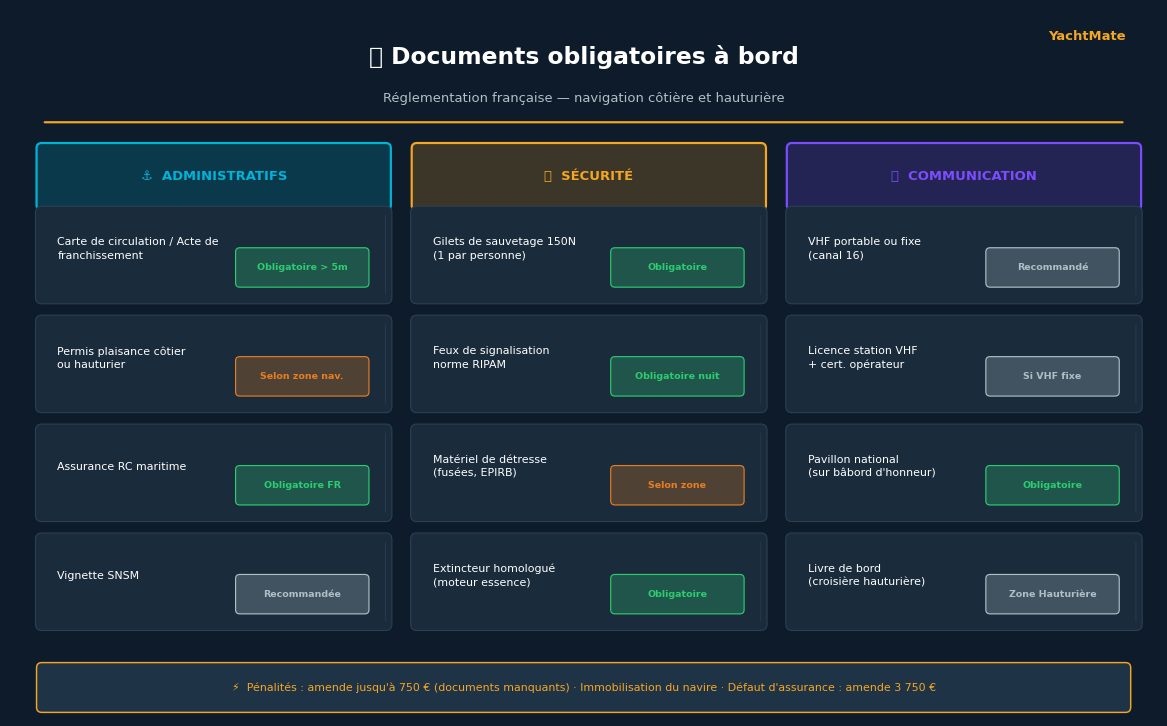
Any pleasure craft used for personal purposes with a length exceeding 7 metres, or with an engine power greater than 22 kW (30 hp), must be registered and hold a registration certificate (carte de circulation) issued by the Maritime Affairs authority. This document certifies the vessel's nationality and its right to fly the French flag. For boats under 7 m and under 22 kW, a simple pleasure craft card suffices. It is mandatory to present it to any authorised officer during an inspection.
The Act of Francisation for Larger Vessels
Pleasure craft with a length exceeding 15 metres (measured according to tonnage rules) are subject to a more formal francisation procedure. The act of francisation, issued by the General Directorate of Customs, replaces the registration certificate. It must be kept on board in original form, not as a copy.
Digitise all your documents and store them in the YachtMate app. If you lose the originals at sea, you can still present digital copies to facilitate procedures — although this does not exempt you from carrying the originals on board.
2. The Pleasure Craft Driving Licence
Coastal Licence and Offshore Extension
In France, a boat licence is mandatory as soon as engine power exceeds 6 hp (4.5 kW). There are two levels: the coastal licence, which authorises navigation up to 6 nautical miles from a shelter, and the offshore extension (formerly the hauturier permit), which allows unlimited-distance navigation. For sailing boats without an engine or with an engine not exceeding 6 hp, no licence is required, regardless of the boat's length.
Inland Waterway Licence
If you navigate on French rivers and canals, an inland waterway licence (carte de plaisance fluviale) is required when the boat exceeds 20 m in length or 4.5 kW in power. This licence is distinct from the sea licence and does not authorise maritime navigation.
3. Third-Party Maritime Insurance
Since the law of 1 January 1983, third-party liability (RC) insurance is mandatory for any motor pleasure craft navigating in French waters and in the territorial waters of the European Union. This obligation applies as soon as engine power exceeds 4.5 kW (6 hp). The insurance certificate must be kept on board. Failure to hold insurance is punishable by a fine of up to €3,750.
For sailing boats without an engine or with an engine under 6 hp, insurance is not legally required, but it is strongly recommended: risks related to collisions or harbour damage can engage your personal civil liability.
Check that your insurance policy covers the navigation zones you plan to sail in. Some policies limit coverage to coastal navigation (up to 20 miles offshore). For an offshore passage, a coverage extension may be required.
4. Mandatory Safety Equipment
Life Jackets
Wearing a life jacket is mandatory under certain conditions, but its presence on board is always required. Regulations require at minimum one 150 N CE-approved life jacket per person on board, plus an additional jacket for children under 12. In Zone 2 and beyond (navigation more than 2 miles from a shelter), inflatable 150N or 275N jackets may be required depending on the vessel.
Distress Equipment
Distress equipment varies according to the navigation division in which you are sailing, as defined by Division 240 of the French regulations:
- Division 0 to 2 (coastal navigation): parachute flares, hand flares, signalling mirror, foghorn.
- Division 3 and 4 (offshore zones): in addition to the above, approved life raft, 406 MHz EPIRB/distress beacon, safety harnesses and tethers.
- For all: lifebuoy with a throw line of at least 30 m.
Navigation Lights
In accordance with COLREGS (International Regulations for Preventing Collisions at Sea), any vessel navigating at night or in reduced visibility must be equipped with approved navigation lights: green starboard light, red port light, white stern light, and depending on the vessel's length, a white masthead light. These lights must be kept in perfect working order and tested before every night trip.
Run a safety checklist before every trip with YachtMate. The app lets you systematically check the condition of your safety equipment and alerts you when a service or replacement is needed — flares have an expiry date!
5. Communication Documents on Board
The VHF Radio Station Licence
If your boat is equipped with a fixed VHF transceiver (not a portable one), it must hold a ship radio station licence issued by the ANFR (National Frequency Agency). Furthermore, any operator of a fixed VHF must hold a Restricted Radiotelephone Certificate (RRC). The licence document must be available on board.
The National Flag
Regulations require you to fly the French flag when sailing abroad. In France, its use is recommended but not mandatory on inland waterways. The flag must be flown at the stern post or gaff for sailing boats, and at the stern for motor vessels.
6. Sailing Abroad: Additional Documents
If you cross a maritime border, additional documents are required. The International Certificate of Competency (ICC) is required by many countries for vessels over 5.5 m or powered by more than 9 kW. It is issued by clubs affiliated with the French Sailing Federation or by Maritime Affairs. Also remember to carry customs papers for ports of call outside the European Union, and to check the specific requirements of each country (Morocco, Turkey, Croatia, etc.).
7. What Are the Penalties for Non-Compliance?
Inspections at sea can be carried out by Maritime Affairs, Customs, the Maritime Gendarmerie or the French Navy. In the event of an offence:
- Missing registration certificate: fine up to €750.
- No insurance: fine up to €3,750.
- No licence (when required): fine up to €1,500, vessel immobilisation.
- Insufficient or expired safety equipment: fine, formal notice, ban from sailing.
Navigate with Full Compliance Using YachtMate
YachtMate helps you manage your on-board documents, schedule safety equipment checks and prepare every trip with peace of mind. Available on iOS and Android.
Discover YachtMate