

Reefing is arguably the most important — and most underestimated — maneuver in sailing. Done properly, it transforms an uncomfortable situation into controlled sailing. Done poorly, it can lead to equipment damage or even danger to the crew. In this article, we explain when to reef, how to do it in 6 steps, and the classic mistakes to absolutely avoid.
What is reefing?
Reefing means reducing the area of the mainsail (and possibly the jib or genoa) to match the sailboat's power to the wind conditions. On most modern sailboats, the mainsail has two or even three reef points marked by grommets and reef lines.
The logic is simple: as the wind increases, the boat heels more and becomes harder to handle. By reducing the sail area, you rebalance the boat, reduce helm load, and protect the gear. It's a safety measure, not a defeat.
The golden rule of experienced sailors: reef before you need to. You can always shake it out if the wind drops, but putting in a reef in rough seas and strong winds is far more challenging than doing it in anticipation.
When should you reef?
The decision depends on apparent wind, sea state, boat type, and crew experience. Here are the general guidelines:
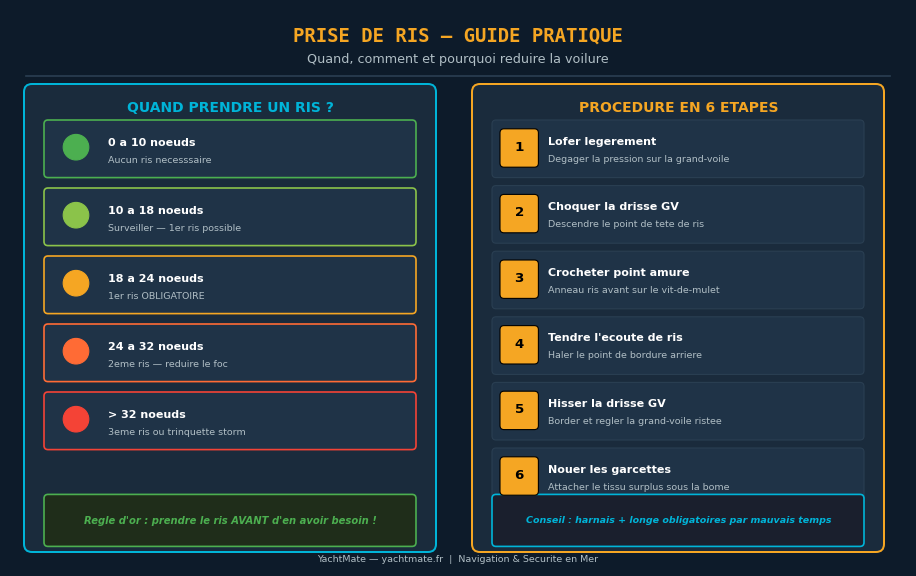
- 0 to 10 knots: no reef needed, full sail recommended.
- 10 to 18 knots: monitor heel — a first reef may be useful depending on the sail plan.
- 18 to 24 knots: first reef generally required for most cruising sailboats.
- 24 to 32 knots: second reef and jib reduction for safe sailing.
- Above 32 knots: third reef or storm jib, demanding offshore conditions.
These thresholds are guidelines: a light boat or inexperienced crew should reef earlier. A heavy, stable vessel may hold on a bit longer. But once heel exceeds 25–30°, the helm gets heavy, or spray regularly sweeps the deck, it's time to act.
Warning signs you should not ignore
Beyond wind strength, certain concrete signs indicate it's time to reef: the boat is weather-helm (constantly wanting to head up), the cockpit is repeatedly swept by waves, the sails are repeatedly flogging, or the crew is showing fatigue from wrestling the helm. Each of these is a message: reduce sail now.
How to reef: the 6-step procedure
The standard slab reefing procedure on a modern sailboat with lines led aft to the cockpit follows these steps. Depending on the age of the boat and its equipment, some moves may be done from the cockpit or require going on deck.
Step 1 — Head up slightly
Before any line work, head the boat closer to the wind to spill pressure from the mainsail. This makes all subsequent steps much easier and prevents you from having to muscle jammed hardware under full load. You don't need to come head-to-wind — a slight luff is enough.
Step 2 — Ease the main halyard
Lower the mainsail until the reef cringle is at the level of the boom's gooseneck fitting. This is often the move that determines reef quality: neither too little nor too much. Take time to position the sail precisely.
If reef lines are led back to the cockpit (as on most modern boats), the entire procedure can be done without leaving the safety of the cockpit. If you do need to go on deck, harness and tether are non-negotiable regardless of conditions.
Step 3 — Hook the tack cringle
The reef tack cringle is the grommet at the leading edge of the reef row. It must be hooked onto the gooseneck fitting or secured at the boom's front end. This is the anchor point of the reefed sail: it must be firmly set before hauling on any other lines.
Step 4 — Haul the clew earing
The clew earing (or reef pendant) tensions the aft reef cringle — the grommet at the trailing edge of the reef row. Hauling on it stretches the foot of the reefed sail and gives it its shape. The tension should be enough to prevent the sail cloth from flogging.
Step 5 — Re-hoist the main halyard
With tack and clew cringles properly set, re-hoist the main halyard until the sail is properly tensioned in its reefed section. Check that the luff is tight and the boom stays aligned.
Step 6 — Tie the reef points
Reef points (also called reef ties) are the short lines used to bundle the loose sail cloth below the boom. They prevent it from flogging and tearing. Use reef knots — never cleat-hitch around the boom, as this would prevent quickly shaking out the reef in an emergency.
Classic mistakes to avoid
- Waiting too long: acting too late makes the maneuver much harder, especially in a seaway.
- Forgetting to head up: trying to lower the halyard at full load is inefficient and risks sail damage.
- Poorly setting the tack cringle: an unsecured tack cringle results in a flogging or torn sail.
- Wrong tension on reef lines: the sail should be taut but not distorted.
- Knotting reef points around the boom: in an emergency, bad knots can jam the maneuver.
- Going on deck without a harness: even in moderate wind, conditions can deteriorate very quickly.
Practice reefing in calm weather, at the dock or in light conditions. When the wind really pipes up, you'll execute the maneuver automatically, without hesitation or stress. Skilled sailors drill their maneuvers until they become reflex.
Shaking out a reef
Shaking out a reef (removing it when the wind eases) is the reverse operation and is generally easier. The steps are: head up slightly, ease the clew earing, hoist the main halyard fully, release the tack cringle, then untie the reef points and stow everything neatly.
Again, wait until conditions are clearly and durably eased before shaking out a reef. Wind that drops can return quickly, and having to re-reef in a brief lull is poor practice.
Reefing assisted by the YachtMate app
The YachtMate app gives you valuable help in anticipating the need to reef. The integrated marine weather forecasts show you expected gusts hour by hour, letting you plan maneuvers in advance rather than reacting in a rush. The app can also alert you when apparent wind exceeds a threshold you define — ideal on long passages where constant monitoring is difficult.
"The sea does not forgive improvisation. A well-executed reef is the difference between a memorable passage and an incident gone wrong."
Sail safely with YachtMate
Get real-time weather alerts, plan your outings, and access practical navigation guides directly on your smartphone.
Download YachtMate for free