
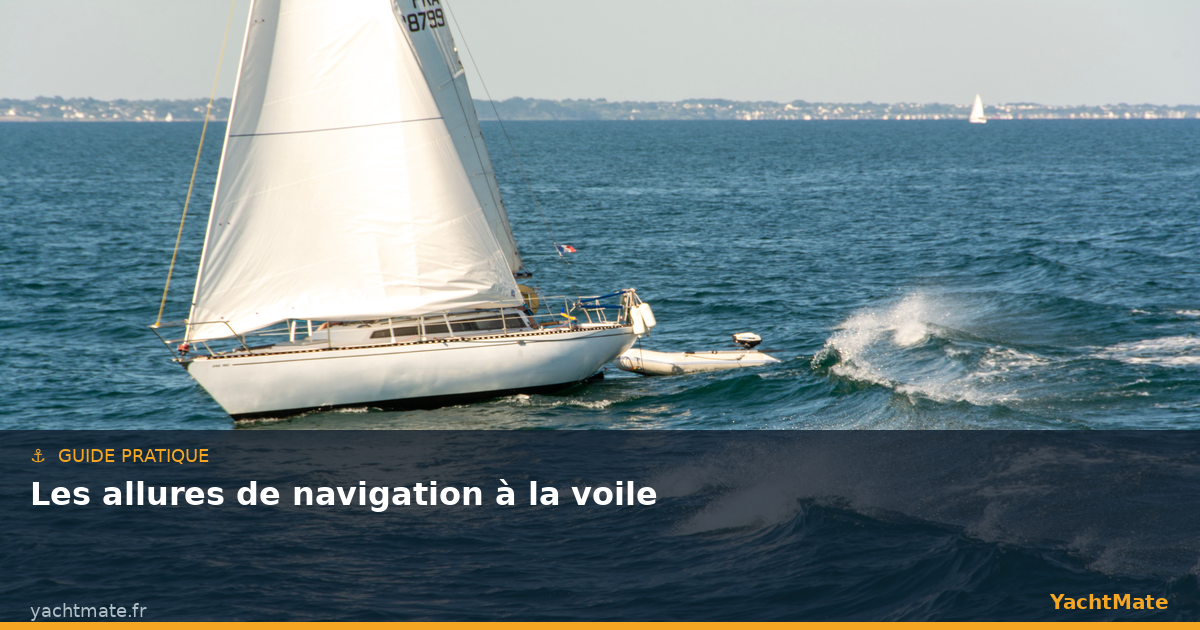
Understanding the points of sail means learning the grammar of sailing. A point of sail is simply the angle between your boat's course and the direction the wind is coming from. From that angle flow your sail trim, your boat speed, your comfort and even your safety. A sailboat is not steered like a motorboat: you have to work with the wind, sometimes go around it, and every point of sail has its own logic. In this guide we walk through every point of sail, from head to wind to running, with the matching trim and the technique for working upwind.
What is a point of sail?
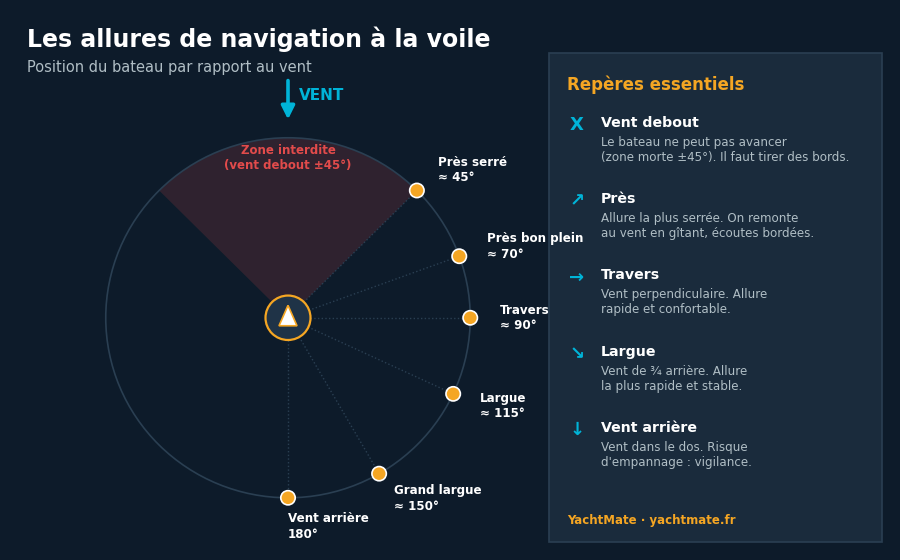
A point of sail is defined by the angle between the boat's heading and the source of the true wind. We measure it in degrees: 0° means you are pointing straight into the wind, 180° means the wind is exactly behind you. Between these two extremes lie all possible points of sail, grouped into broad families: close-hauled, the beam reach, the broad reach and running.
The fundamental rule is simple: a sailboat cannot sail directly into the wind. There is a sector, on either side of the wind's axis, where the sails refuse to fill and the boat stops: this is the no-go zone. The whole art of sailing is to make the most of the angles outside this zone, trimming your sails for each point of sail.
Don't confuse true wind and apparent wind. The true wind is what you feel at rest. The apparent wind combines the true wind with the wind created by the boat's own motion: it is what you trim your sails to. The faster you go, the more the apparent wind shifts forward toward the bow.
The no-go zone: head to wind
When the bow points toward the wind's source, within roughly 45° on each side, the sails begin to luff (they flap and flog) and the boat loses all drive. This is being head to wind, or "in irons". No conventional sailboat can make progress in this sector roughly 90° wide centred on the wind.
This zone is not a dead end: you go around it. To reach a point directly upwind, you sail a zigzag, alternating tacks. This is what we call beating or tacking upwind, a technique we detail below.
Close-hauled: working to windward
Close-hauled is the tightest point of sail a boat can hold, right at the edge of the no-go zone. You sail with the sails sheeted in hard, flat and tight, and the boat heels noticeably. It is a demanding but exhilarating point of sail, the one that lets you gain ground to windward.
Close-hauled, pinching (≈ 45°)
Sailing as close to the wind as possible, you aim for the tightest angle, generally around 40 to 45°. The sheets are fully trimmed, the boat heels and climbs to windward. It is the finest point of sail, but also the slowest and least comfortable: the sea comes head-on and the boat slams into the waves.
Close reach / full-and-by (≈ 70°)
Opening the angle a little (around 60 to 70°), you move to a close reach. You ease the sails slightly, the boat stands up, accelerates and becomes far more pleasant to steer. This is often the best compromise between ground made to windward and actual speed. For a beginner, the close reach is a reassuring and efficient point of sail.
When close-hauled, watch the telltales (the little strands of wool sewn onto the headsail). When they stream horizontally and parallel on both sides, your trim is optimal. If the leeward telltale flutters, you are too close: bear away slightly. If the windward one drops, you are too open: head up a touch.
The beam reach: the king of points of sail
On a beam reach, the wind comes perpendicular to the boat's axis, at about 90°. It is usually the most balanced and one of the fastest points of sail: the boat heels moderately, the helm is light, and the sails are sheeted halfway out. Many sailors consider the beam reach the most enjoyable for a relaxed cruise, because it combines speed, comfort and easy trim.
At this angle the apparent wind stays strong and the boat moves quickly without excessive effort. The manoeuvres are simple and the course easy to hold, which makes it an excellent point of sail to practise fine sail trim.
Broad reach and running deep: speed and pleasure
When the wind moves aft of the beam, you enter the downwind points of sail. On a broad reach (around 115 to 130°), the wind comes over the quarter. The sails are eased well out, the boat stands almost fully upright and accelerates: for most sailboats, this is the fastest and most stable point of sail. Heeling is slight, the sea comes from astern and rolling stays manageable.
Deeper still (around 150°), the wind comes clearly from behind but keeps a slight angle that preserves stability. It is a very comfortable point of sail for eating up the miles, often favoured on long passages with a settled breeze. You can fly a spinnaker or a gennaker here to gain even more power.
Running: caution and vigilance
Running (180°) means the wind blows from dead astern. The sails are fully eased and the boat is pushed along. This point of sail looks restful, but it is deceptive: the apparent wind drops, the sense of speed fades, and above all the risk of an accidental gybe is high.
An unintended gybe happens when the wind crosses to the other side of the mainsail without warning: the boom sweeps violently across the boat from one side to the other, risking injury to the crew or damage to the gear. On this point of sail, then, you steer with constant attention to your heading, and you can rig a preventer to make the manoeuvre safer.
Sailing dead downwind is rarely the most efficient option. It is often better to "tack downwind" by zigzagging slightly either side of dead astern: the sails stay well filled, the boat goes faster, and you remove the risk of an accidental gybe. On a downwind run, this technique often wins out in the end.
Sail trim by point of sail
The logic of trim is constant: the further you sail from the wind, the more you ease the sails. Close-hauled, the sheets are trimmed hard; as you bear away (move further from the wind), you let them out progressively. The ideal trim is to ease the sail until it just begins to luff along the leading edge, then trim in slightly until it fills again.
- Pinching close-hauled: sails sheeted hard, flat, boat heeled.
- Close reach: sails eased slightly, good course/speed compromise.
- Beam reach: sails half eased, balanced and fast.
- Broad reach: sails eased well out, fastest point of sail.
- Running: sails fully eased, watch for the gybe.
Beating: the art of working upwind
Since the no-go zone prevents you from reaching a point directly upwind, you proceed by successive tacks. In practice you sail close-hauled on one tack (say, starboard tack), then tack to set off close-hauled on the other tack (port tack), and so on, drawing a zigzag that overall carries the boat to windward.
This manoeuvre, the tack, swings the bow through the eye of the wind. The closer a boat points (the tighter its close-hauled angle), the fewer tacks it needs to reach its destination. This is one of the great strengths of a fast boat and crew: pointing high and "making ground" to windward efficiently.
"You cannot command the wind, but you can always trim your sails. Knowing your points of sail turns every breath of wind into ground gained."
Common mistakes to avoid
- Confusing the course you want with the angle you can sail: if your destination is in the no-go zone, you must beat, not force.
- Over-trimming downwind: on a broad reach and running, sails sheeted too hard slow the boat instead of driving it.
- Ignoring the telltales: they are the best visual indicator of good trim, especially close-hauled.
- Forgetting the gybe risk: running, a single second of inattention to your heading can trigger a violent gybe.
- Staying glued to dead downwind: often slower and more dangerous than tacking downwind on broad reaches.
Master your points of sail with the YachtMate app
The YachtMate app makes reading your points of sail in real time effortless. By displaying your heading, the wind direction and your track on the chart, you can instantly see which point of sail you are on and how many tacks will be needed to reach your next waypoint. The built-in marine weather forecasts help you anticipate wind shifts and pick the best moment to tack or gybe, so you sail faster and with complete peace of mind.
Sail smarter with YachtMate
Heading, wind, track and marine weather brought together in a single app built for boaters. Plan your trips and make the most of every point of sail.
Download YachtMate for free