
On a sailboat, everything revolves around the wind: its direction dictates your course and points of sail, its strength drives your trim and your reefing. Two instruments turn that invisible wind into usable numbers: the wind vane, which gives its direction, and the anemometer, which measures its speed. Read and calibrated properly, they win tenths of a knot upwind and hours on a passage. Set up wrong or misunderstood, they mislead you. Here is how to get the best from your wind instruments.
What do the wind vane and anemometer actually do?
The wind vane is a small blade mounted at the masthead that swings to line up with the wind. It measures the angle between the boat's axis and the wind: that angle tells you whether you are hard on the wind, reaching or running. The anemometer measures wind speed, usually with small spinning cups (or, on modern sensors, with ultrasound and no moving parts).
Together, these two sensors feed the boat's electronics. On a dial or multifunction display you read an angle and a speed which, combined with your log (speed through the water) and your compass, let the system compute a key figure: the true wind. That is where the subtlety lies, because what the vane feels is not the wind a stationary observer would feel.
Apparent wind and true wind: the difference that changes everything
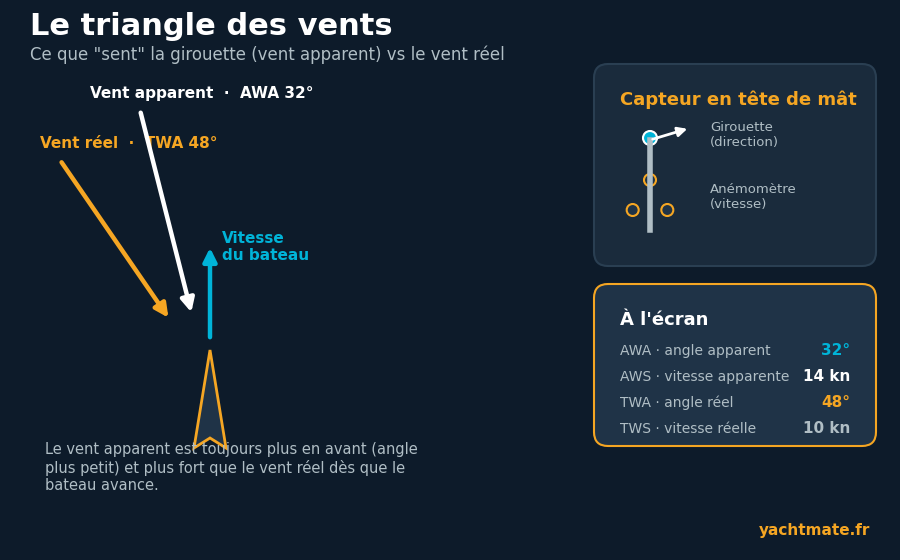
As soon as your boat moves, it creates its own airflow, like a hand held out of a moving car window. The wind the vane senses is therefore the sum of the true wind and this "wind of motion". We call it the apparent wind: it, and only it, is what your masthead instruments physically measure.
The apparent wind is always further forward (smaller angle) and stronger than the true wind while you make headway. That is why upwind it seems to "blow hard" while downwind, running away from the wind, the deck suddenly feels calm: you have subtracted your speed from the wind's. Grasping this distinction avoids many mistakes — chiefly, underestimating the true wind when running downwind, right up until the accidental gybe or the rough beat back.
The four figures to know
On your displays you will meet four now-universal English acronyms:
- AWA (Apparent Wind Angle): the apparent wind angle, measured directly by the vane;
- AWS (Apparent Wind Speed): the apparent wind speed, measured by the anemometer;
- TWA (True Wind Angle): the true wind angle, calculated by the electronics;
- TWS (True Wind Speed): the true wind speed, also calculated.
The first two are measurements, the last two are calculations. This has a practical consequence: if your true wind looks wrong, the cause is usually an upstream input — an incorrect boat speed, a misaligned vane or a poorly compensated compass.
Anatomy of a wind instrument system
The masthead sensor
The sensor combines the vane and the anemometer at the top of the mast, where the airflow is least disturbed by the sails and rigging. It is also the most exposed spot: bird strikes, frost, salt deposits and worn bearings all end up skewing the readings. A cup sensor can seize; a vane can develop play. The height makes servicing awkward, which is why it pays to check it on every mast climb rather than wait for a failure.
The processor and the display
The sensor's signals travel down to a processor (often built into the display or the boat's NMEA network). It shows raw AWA and AWS, then, by cross-referencing those values with boat speed and compass heading, computes TWA and TWS. On recent installations these data flow on a bus (NMEA 2000, SeaTalk…) and appear equally on a dedicated dial, the chartplotter, the autopilot or a mobile app.
Remember the simple rule: AWA and AWS are measured, TWA and TWS are calculated. When a true wind figure looks absurd, don't suspect the vane first: check your boat speed (fouled log?) and your compass, because they feed the calculation.
Reading the display day to day
Upwind, watch the AWA above all: it is your steering reference. Most cruising boats point around 30 to 40° of apparent angle; below that the sails luff and speed collapses. Keep an eye on how steady that angle is: an AWA that swings a lot betrays a lumpy sea, a helm watching the wake instead of the sails, or a tired vane.
Downwind, the TWA / TWS pair matters most, because it reveals the true wind that your run masks. A TWS of 25 knots downwind may show only 15 knots of apparent on deck: pleasant, but deceptive when it comes time to hoist or drop the spinnaker. Trusting feel alone leads straight to being over-canvassed.
Calibrating your wind instruments
An uncalibrated instrument lies politely. Three adjustments account for almost all of the accuracy.
Aligning the vane
The first is the angle offset: on installation, the vane is never perfectly aligned with the boat's axis. To correct it, sail close-hauled on port then on starboard in the same conditions and note the AWA on each tack: if it reads, say, 32° one side and 40° the other, your vane is 4° out. Adjust the offset in the display menu until you get symmetrical angles.
Calibrating wind speed
Compare speed against a reliable source: a local forecast in settled weather, a harbour station, or a handheld anemometer held to windward. An ageing cup sensor often underreads the breeze; you then apply a correction factor in the settings.
Don't neglect boat speed
Since true wind is calculated from boat speed, a perfect vane is not enough: if your log is fouled by weed or poorly calibrated, TWA and TWS will be wrong regardless. Calibrate the log over a known distance (ideally a round trip to cancel the current) before you trust the true wind.
Do your calibrations in flat water and moderate wind, never in a chop: stable data give reliable settings. And redo the alignment check after any dismasting, vane change or heavy weather — a single masthead knock is enough to throw it all off.
Using the wind to trim sails better
Accurate instruments are useless if you do nothing with them. Upwind, the AWA guides the helm to hold the best course/speed compromise; combined with the sail telltales, it helps sheet in or ease to the degree. TWS drives your reefing decisions: many crews set clear thresholds — first reef at such a true wind, second at another — so they no longer improvise under pressure.
Downwind, the TWA tells you whether it pays to bear away hard or, on the contrary, to luff up for VMG (velocity made good toward your destination). Advanced electronics even display the optimum angle for the true wind. Finally, a reliable anemometer is a safety asset: seeing the TWS climb before the sea builds lets you take a precautionary reef rather than a panic one.
Maintenance and common failures
The classic symptoms don't lie. A frozen or erratic speed almost always comes from seized cups or a dead bearing — to clean or replace on a mast climb. An inconsistent direction points to a bent vane, with play or a damaged reference magnet. Data that drops out intermittently suggests the wiring or a corroded connector at the mast foot, a notoriously fragile crossing point.
Prevent rather than cure: rinse the sensor with fresh water at season's end, check for tightness and play, and protect the vane during rigging work. A clean, well-secured sensor lasts for years.
And without electronics?
An instrument can fail at the worst moment; reading the wind the old-fashioned way remains essential. A simple wool telltale or a mechanical Windex at the masthead gives the apparent angle at a glance, with no battery. For strength, watching the sea and the Beaufort scale remain valuable references: whitecaps, breaking crests, spray torn from the water… all signs that, combined with the feel on the sails, let you sail safely even with the screen off. Electronics refine; they don't replace the sailor's eye.
Keep an eye on the wind with YachtMate
Marine weather, wind forecasts and detailed charts: YachtMate helps you anticipate every shift and pick the right point of sail.
Discover the app →