Breaking down at sea is one of the most stressful situations a recreational boater can face. Whether your engine fails at a port entrance, you're anchored in force 6 winds, or you're mid-crossing at night, knowing how to react and call for maritime assistance makes all the difference. This guide walks you through the step-by-step procedures for organising or accepting a tow safely and without any unpleasant financial surprises.
Assess the Situation First
Before triggering an alert, take a few minutes to assess how serious the situation really is. Not every breakdown requires immediate towing. A simple contaminated fuel issue, a broken belt or a jammed furler can sometimes be fixed on board with basic tools. Ask yourself: are you in immediate danger? Is the boat drifting towards shallow water or rocky coastline? Do you have favourable wind to sail your way out?
If the situation is not critical, take time to try and solve the problem yourself. An engine that won't start can often be diagnosed: check the fuel level, diesel filter, starter battery and cabling. If you have a sailing boat, the sails may get you out of trouble. However, if you are approaching a danger zone or night is falling, do not hesitate to call for help immediately.
Before every outing, note the contact details of your local coastguard station and set VHF channel 16 as your listening channel. Channel 16 is the international distress channel — always kept active on board.
Contacting the Coastguard: The Official Procedure
In French waters, the CROSS (Centre Régional Opérationnel de Surveillance et de Sauvetage) coordinates all maritime rescue operations. Similar authorities exist in all countries: the RNLI and HM Coastguard in the UK, the MRCC in Italy, and the MRSC in Spain. If sailing internationally, channel 16 and a DSC distress call will always connect you to the relevant rescue coordination centre.
How to Call for Help
The primary and most effective method is the VHF radio on channel 16. This channel is permanently monitored by all professional vessels and coastguard stations. In a life-threatening emergency (sinking vessel, man overboard, fire), broadcast a "MAYDAY". For a difficult situation with no immediate danger — such as an engine failure without risk of drifting into danger — use the signal "PAN-PAN" followed by your details.
A typical call: "PAN-PAN, PAN-PAN, PAN-PAN. This is [vessel name], MMSI [number]. Position: [lat/lon or description]. Nature of situation: engine failure. Persons on board: [X]. Requesting assistance and tow to [nearest port]. Over."
If you have no VHF, the coastguard can also be reached by mobile phone. In France, the emergency number at sea is 196 (free of charge). EPIRB and PLB distress beacons will also trigger a rescue response automatically when activated.
Is Coastguard Assistance Free?
Yes, coordination by the coastguard is entirely free. They may mobilise volunteer lifeboat crews (RNLI in the UK, SNSM in France), naval vessels, or helicopters. However, if a private commercial tug responds to your call or is dispatched at the coastguard's request, that service is paid and can be extremely expensive. Always clarify who is coming and at what cost before accepting any tow.
Accepting or Refusing a Commercial Tow
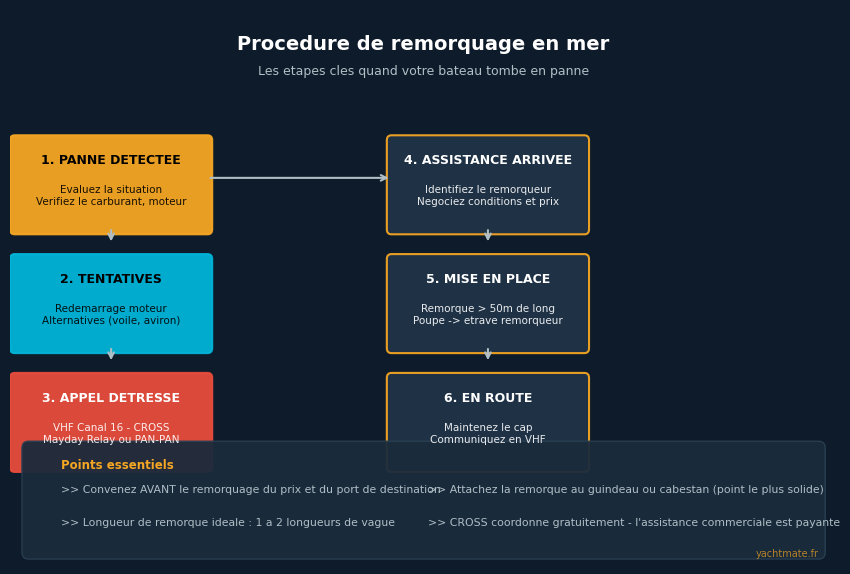
When a vessel offers assistance, you must negotiate the terms before accepting. In maritime law, an old concept called "salvage law" can award an unrequested rescuer a substantial share of the vessel's value, especially if the boat was in "imminent peril". To protect yourself:
- Ask clearly whether the intervention is commercial and what the price is (flat rate or hourly).
- Specify the destination port you want and have it confirmed by radio (all calls are recorded).
- If the boat is not in immediate danger, you have the right to refuse an overpriced offer and wait for another vessel.
- Always inform the coastguard of the agreement — this officially documents the terms of the operation.
A quality boat insurance policy often includes maritime assistance with vessel recovery up to a defined range. Check your policy before the season starts and keep your insurer's 24-hour helpline number near the VHF.
Setting Up the Tow Line: Technique and Safety
Once the agreement is reached, rigging the tow must be done methodically. Accidents during towing manoeuvres are common — collisions between hulls, crew falling overboard, snapping cables under tension. Follow these basic rules:
Choosing and Attaching the Tow Line
The ideal tow line is a long, elastic rope — polyester or nylon of at least 20 mm diameter. Avoid steel cables that have no stretch and can behave like whips if they snap. The ideal length is 1 to 2 wave lengths, allowing both vessels to move in sync with the swell and reducing violent jerks.
On the towed vessel, the attachment point must be as solid as possible: windlass, capstan or reinforced bow cleat. Never attach the tow line only to a cockpit cleat or a stanchion — these fittings are not designed for towing loads. If possible, pass the line around multiple anchor points to distribute the load.
During the Tow
The towed vessel must keep an active helm to stay in the tug's wake and prevent dangerous oscillations. If the engine is out of action, the ideal situation is to have someone at the helm. Communicate regularly by VHF or visual signals with the tug regarding speed (too fast = dangerous jerks) and arrival plans at the port.
A rough, high-speed tow can cause more damage to the vessel than the original breakdown. Always ask the tug to maintain a reasonable speed, especially in rough weather.
Volunteer Sea Rescue: Free and Efficient
Many countries operate volunteer sea rescue organisations that respond to distress calls at no cost to the sailor. In France, the SNSM operates around 220 stations along the coastline. In the UK, the RNLI is similarly staffed by volunteers. These organisations prioritise genuine emergencies — if your breakdown poses no real risk to life on board, they may ask you to wait or direct you to a commercial service.
This is why having comprehensive boat insurance with maritime assistance coverage is an excellent investment for any serious sailor heading offshore.