

Standing rigging is the permanent structural framework that supports your mast and sails—shrouds, stays, turnbuckles, chainplates, and the thousands of wire strands that bear the enormous forces of wind and motion. Unlike running rigging (sheets and halyards), standing rigging rarely receives direct attention until something breaks catastrophically. Yet improper maintenance of standing rigging is one of the most common causes of dismasting and structural failure at sea. A single cracked swage fitting or corroded turnbuckle, left undetected for months, can eventually fail under load, dropping your mast with cataclysmic consequences: loss of propulsion, potential damage to the deck and cabin structure, injury to crew, and a salvage situation that can cost tens of thousands of euros. This comprehensive guide examines the components of standing rigging, systematic inspection protocols, tension measurement techniques, replacement schedules, professional rigger consultation, and maintenance best practices that will keep your mast upright and your sailing safe for decades.
Professional sailors and riggers inspect standing rigging annually—often multiple times per season for boats actively racing or cruising offshore. Cruising sailors who never go aloft to inspect their rigging are taking unacceptable risks. Insurance underwriters increasingly demand annual rigging surveys for boats over 15 meters or those planning offshore passages. This guide is written for sailors who understand that taking 4-6 hours annually to inspect your rigging is one of the highest-ROI maintenance investments you can make.
Understanding Standing Rigging Components: Materials and Strengths
Modern standing rigging is typically 1x19 or 1x7 stainless steel wire rope, offering exceptional strength-to-weight ratio. A single 5mm diameter 1x19 wire has a breaking strength of approximately 1200 kilonewtons (27,000 pounds force). Yet this enormous strength is compromised by corrosion, metal fatigue from cyclic loading, and structural defects at swage fittings. Understanding the components is essential for effective inspection.
Wire rope specifications: 1x19 versus 1x7
1x19 wire (19 strands twisted into a single strand, themselves twisted into a rope) is more flexible and corrosion-resistant than older designs, but has smaller individual strands that are more vulnerable to fretting corrosion. 1x7 wire (7 strands twisted into rope) is stronger but less flexible and more susceptible to stress concentrations at fittings. Most modern sailing yachts use 1x19. Rod rigging (solid stainless steel rod instead of twisted wire) is stiffer, stronger, and corrosion-resistant, but is more expensive (3-4x the cost of 1x19 wire) and requires specialized fittings. For cruising boats, 1x19 offers an excellent balance of cost, performance, and maintainability.
Stainless steel grades: 304 versus 316 versus duplex
Grade 304 stainless steel is common but vulnerable to chloride pitting in marine environments. Grade 316 (with molybdenum added for corrosion resistance) is strongly preferred for rigging, offering superior durability in saltwater. "Duplex" stainless (higher yield strength) is increasingly used for demanding rigging applications, offering strength and corrosion resistance at lower cost than 316. Always specify 316 stainless for new rigging; confirm existing rigging grade during inspection (316 is typically labeled, 304 is often unlabeled).
Swage Fittings: The Failure Point
The most vulnerable component of standing rigging is the swage fitting—the compressed aluminum or stainless fitting that terminates the wire at the masthead, lower spreader junction, or deck chainplate. Swages are created by hydraulic compression of a metal sleeve onto the wire rope. When done correctly (proper diameter, pressure, and temperature control), swages have 95%+ the breaking strength of the wire itself. When done poorly, swages fail at 60-70% of wire strength. Even correct swages gradually weaken over years due to micro-corrosion within the fitting.
Swage inspection: visual signs of failure
- Cracks in the swage body — Any visible crack (even hairline) indicates imminent failure. Cracks propagate under load. Replace immediately.
- Discoloration or pitting — Dark spots, white corrosion products, or pitting surface indicate internal corrosion. May still be structurally sound, but warrants close inspection and possible replacement.
- Fretting marks — Fine circumferential grooves or "rust bloom" around the swage indicate the wire is moving microscopically within the fitting—a sign of internal stress and corrosion. This is a strong indicator of degradation.
- Extrusion or deformation — The swage should be perfectly cylindrical. Any bulging, tapering, or asymmetry indicates manufacturing defect or over-pressure. High risk of failure.
- Wire breakage at the swage — Broken wire strands at the fitting indicate the fitting has begun to fail. Replace immediately before complete failure occurs.
Swage replacement: in-spar versus terminal fittings
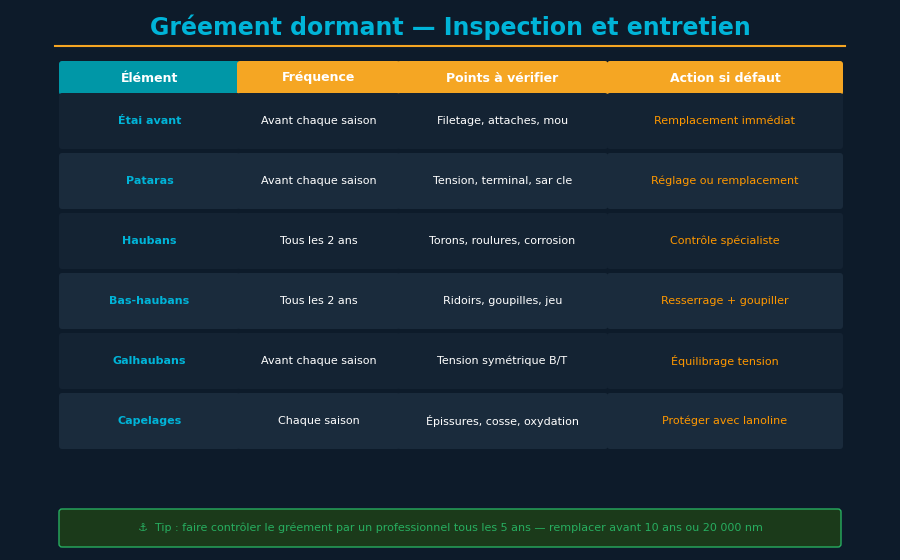
Lower shrouds and forestays typically have swages at both ends (at the chainplate and at the mast). Upper shrouds have swages at masthead and spreader junction. During replacement, only the damaged swage(s) are replaced, not the entire wire. A professional rigger can replace a single swage in 1-2 hours. Cost is typically 150-400 euros per swage (including labor and fitting), making swage replacement far cheaper than replacing entire wire runs.
Comprehensive Annual Inspection Protocol
An effective inspection requires going aloft with proper safety equipment. This means a bosun's chair (harness for safe seating while suspended), a safety line with double attachment, and ideally a second person on deck managing the halyard. Under no circumstances should you attempt rigging inspection while suspended only by a single halyard or without a safety harness.
Step 1: Visual examination of all wire runs
From the deck with binoculars, examine every wire run from base to termination. Look for discoloration, visible cracks, broken strands, or corrosion bloom. From aloft (approximately 15+ meters for a typical 12-15 meter sailboat), examine each wire in detail with your hands. Feel the surface for rough spots, pitting, or soft corroded areas. Run your fingers along the length: corrosion typically concentrates in lower sections where salt spray and bilge water accumulate.
Step 2: Detailed swage examination
At masthead, examine each swage closely: cracks, pitting, discoloration, deformation. Move swages side-to-side and rotate them: a swage with internal corrosion will move microscopically or feel rough. At lower spreader junction and at deck chainplates, repeat the examination. Spreader base connections are particularly vulnerable—salt spray and poor drainage accelerate corrosion there.
Step 3: Cotter pins and fasteners
All swages at deck level should be secured with cotter pins (split pins) through the swage eye. A missing or broken cotter pin is unacceptable—the swage can rotate and loosen. If cotter pins are rusted or difficult to remove, replace them with new stainless pins (cost: 5-10 euros each). Check all turnbuckles: the lock nuts should be tight, the cotter pin hole aligned and pinned. Loose turnbuckles can cause rigging tension to drift, causing mast bending and failure.
Step 4: Spreader condition and attachment
Spreaders are critical: they support upper and intermediate shrouds laterally, distributing force and preventing mast compression failure. Check the spreader tip fitting where upper shrouds attach: this is a stress concentration point. The fitting should be free from cracks or deformation. The spreader base should be solidly bolted to the mast: check all bolts are tight. A cracked spreader can cause sudden failure of upper shrouds.
Step 5: Lower spreader base (if present)
Intermediate or lower spreaders (present on larger or more heavily-rigged boats) attach intermediate shrouds. Examine the attachment fittings for cracks. Check that intermediate shrouds are properly tensioned—loose intermediate shrouds allow excessive mast bending and can cause fatigue failure of intermediate shroud swages.
Tension Measurement and Tuning: Tension Gauge Use
Proper tension is critical: under-tensioned rigging allows excessive mast bending, causing metal fatigue and eventual failure; over-tensioned rigging creates uneven loads and accelerates wear. Professional riggers use a tension gauge (a specialized instrument that measures wire sag) to quantify tension. For a typical 12-meter sailboat with 1x19 rigging, forestay tension should be approximately 1500-2000 kg (Newton's force): just loose enough that you can push the forestay 15-20mm sideways at mid-span by hand, but without excessive sag.
Tension gauge technique
A tension gauge clamps around a wire and measures the deflection when a known force is applied. The gauge then reads the tension directly. Tension gauges cost 1000-3000 euros and require training to use correctly. Most cruising sailors do not own tension gauges; instead, they rely on visual assessment and the "hand push" test. Professional riggers use gauges routinely. If you have significant rigging concerns, hiring a professional rigger (cost: 800-1500 euros for a full rigging survey) is well worth the investment.
The 10-Year Replacement Rule for Offshore Boats
Many insurance underwriters and sailing authorities recommend complete standing rigging replacement every 10 years for offshore boats. This is a conservative rule based on metal fatigue research: even with perfect maintenance, wire rope undergoes cumulative micro-damage from millions of load cycles. A boat that sails 100+ days per year will accumulate more fatigue damage than a boat that sails 20 days per year. The 10-year rule acknowledges that even if visible inspection shows no problems, invisible fatigue may be present.
Justification for the 10-year rule
A complete standing rigging replacement for a 12-meter boat costs 5000-12,000 euros (depending on complexity and location). This cost is spread over 10 years: roughly 500-1200 euros per year. Most boat owners budget for haul-out, paint, and antifouling every 2-3 years anyway. Replacing rigging during a scheduled haul-out adds perhaps 20-30% to the total cost but ensures that you're not carrying invisible fatigue damage into the next decade. For boats planning significant offshore passages, this is excellent insurance.
Boats used less frequently: alternative strategy
For boats used occasionally (20-30 days per year), the 10-year rule may be overly conservative. An alternative is to perform detailed inspection at 8 years, then make a judgment call: if visual and mechanical inspection shows no significant defects, extend service to 12-15 years. Document all inspections. Many cruising boats use the same rigging for 15+ years successfully. The key is meticulous annual inspection and honest assessment of condition.
Dismasting Causes and Prevention
Dismasting typically occurs when standing rigging fails catastrophically. The primary causes are:
- Swage failure — Corroded or cracked swage fitting fails under load, allowing wire to separate. Can happen in sudden high wind or in heavy sea state.
- Wire rope corrosion — Severe corrosion reduces wire strength. Combined with rigging tension and dynamic loads, corrosion-weakened wire fails suddenly.
- Spreader failure — Cracked spreader allows upper shrouds to collapse. Without lateral support, mast buckles and falls.
- Rigging tension imbalance — Loose shrouds on one side allow mast to bend asymmetrically. Under load, this causes accelerated fatigue and eventual failure.
- Mast compression — Under certain conditions (especially in heavy wind with loose lower shrouds), the mast itself can compress and buckle. This is rare but catastrophic.
Preventive maintenance checklist
- Annual inspection aloft — Non-negotiable. Check every wire, swage, and spreader annually.
- Maintenance of tension — Verify shroud tension is balanced and adequate. If one shroud is noticeably softer than the opposite side, adjust turnbuckles to equalize.
- Corrosion prevention — Rinse rigging with fresh water monthly during the sailing season. Salt deposits trap moisture and accelerate corrosion.
- Protective coating — Some sailors apply light machine oil or Tef-Gel to standing rigging to reduce corrosion. This must be done carefully to avoid staining sails or deck.
- 10-year replacement (or thorough inspection) — Plan for complete replacement at 10 years, or perform detailed inspection at 10 years and make an informed decision.
Upgrading to Rod Rigging: Benefits and Trade-offs
Rod rigging (solid stainless steel rod instead of twisted wire) offers several advantages: it's stiffer (reducing mast bending), it's stronger (allowing thinner diameter and less weight aloft), and it's theoretically more durable (no internal corrosion). However, rod rigging costs 3-4 times more than wire rigging, requires specialized fittings and spar modifications, and makes replacement more complicated. Rod rigging is common on racing boats and newer high-performance cruisers but less common on older cruising boats due to cost.
When rod rigging makes sense
For boats under 12 meters, wire rigging is almost always the better choice. For boats 15+ meters, especially those planning extended offshore passages, rod rigging may be worth consideration. The decision should factor in: boat age and lifespan, budget, sailing intensity, and planned service interval. Upgrading an existing boat from wire to rod rigging requires spar modifications (new attachment points) costing 8000-15,000 euros, plus new rigging (5000-10,000 euros). This is economical only if you intend to keep the boat for many years.
Hiring a Professional Rigger: When and How
A professional rigger brings expertise that catches problems invisible to amateur inspection. For boats 15+ meters, boats planning offshore passages, boats with unusual or complex rigging, or boats over 10 years old, professional inspection is strongly recommended.
What a rigger survey includes
- Visual and tactile inspection — Rigger examines every swage, wire run, spreader, and attachment.
- Tension measurement — Uses tension gauge to verify all shrouds are correctly tensioned.
- Written report — Documents findings, photographs defects, recommends repairs or replacement.
- Cost estimate — Provides detailed estimate for any repairs identified.
- Recommendations — Suggests maintenance schedule and replacement timeline.
Cost of professional survey
A professional rigging survey for a 12-15 meter boat costs 800-1500 euros. This includes inspection aloft, tension measurement, and written report. If repairs are identified, these are additional: swage replacement costs 150-300 euros each, wire replacement costs 100-150 euros per meter of wire plus fittings and labor. A full rigging replacement (all standing rigging) for a 12-meter boat costs 8000-12,000 euros installed.
Freshwater Rinsing and Lubrication: Routine Maintenance
After sailing in salt water, rinse the mast and rigging with fresh water (ideally distilled water) to remove salt deposits. This should be done monthly during the sailing season. Salt deposits trap moisture and accelerate corrosion beneath the surface. Use a deck rinse/washdown system or manually spray the mast with a freshwater hose.
Turnbuckle lubrication
Turnbuckles should be lightly lubricated annually with lanolin (a natural, non-sticky lubricant derived from sheep's wool). Lanolin resists salt water, doesn't stain sails or deck, and lubricates without attracting dirt. Apply a thin coat with a brush or cloth to each turnbuckle and spreader base. This reduces corrosion and makes future adjustments easier. Avoid synthetic oils or greases, which accumulate dirt.
Seasonal Checks: Pre-Season and Post-Season
In addition to annual aloft inspection, perform quick visual checks before and after the sailing season.
Pre-season rigging check (spring)
- Check all deck-level swages and cotter pins for corrosion or looseness.
- Verify all turnbuckles are tight and properly pinned.
- Check shroud tension with hand-push test: all shrouds should have similar resistance to pushing.
- Check forestay sag: should be minimal, approximately 15-20mm deflection at mid-span with hand pressure.
- Check boom vang and running backstays (if present) for proper attachment and tension.
- Examine chainplates for corrosion or cracking. Chainplate failure is less common than swage failure but equally catastrophic.
Post-season rigging check (autumn)
- After the sailing season, do a quick visual inspection of all accessible rigging.
- Pay special attention to areas that showed any signs of wear during the season.
- If you identified any questionable swages or wires, plan professional evaluation before next season.
- Clean and lightly lubricate turnbuckles and spreader bases with lanolin.
- Document any concerns in a maintenance log for reference during annual aloft inspection.
The mast depends entirely on standing rigging. You would never board a commercial aircraft without assurance that the wings are properly maintained. Apply the same discipline to your mast. Devote one afternoon annually to aloft inspection—it's the single most important maintenance task you can perform.
Cost Estimation and Budgeting
A typical 12-15 meter sailboat with modern 1x19 standing rigging will require: professional survey at 10 years (800-1500 euros), potential swage replacements (150-300 euros each, possibly 2-4 swages), and complete standing rigging replacement at 10-15 years (8000-12,000 euros for a complete system). Spread over the 10-year interval, this is approximately 1000-1500 euros annually—reasonable for long-term peace of mind. For boats used intensively, budget annual professional inspection (1000-1200 euros) every 5 years as a compromise between thorough oversight and cost control.

Create a rigging inspection log and photograph every swage and spreader attachment during your annual inspection. Date and annotate photographs (draw arrows to problem areas). This visual history allows you to track corrosion progression and catch emerging problems early. If you eventually sell the boat, a detailed rigging inspection log increases buyer confidence and resale value significantly.
Conclusion
Standing rigging is the structural foundation of your sailing vessel. Meticulous annual inspection aloft, careful tension monitoring, timely swage and wire replacement, and systematic maintenance prevent catastrophic failures that can cost your life, injure crew, or result in total loss. The 10-year replacement rule is conservative but justified for offshore cruising boats: it acknowledges that metal fatigue is invisible and allows you to sail with confidence. A single afternoon annually spent aloft, combined with professional rigger consultation every 5-10 years, is the best insurance you can purchase. With proper care, a standing rigging system will serve reliably for 15-20 years, supporting thousands of miles of safe, confident sailing.
Navigate Smarter with YachtMate
Discover how YachtMate enhances your coastal and offshore sailing with planning tools, performance tracking, and maintenance management.
Discover YachtMate →