
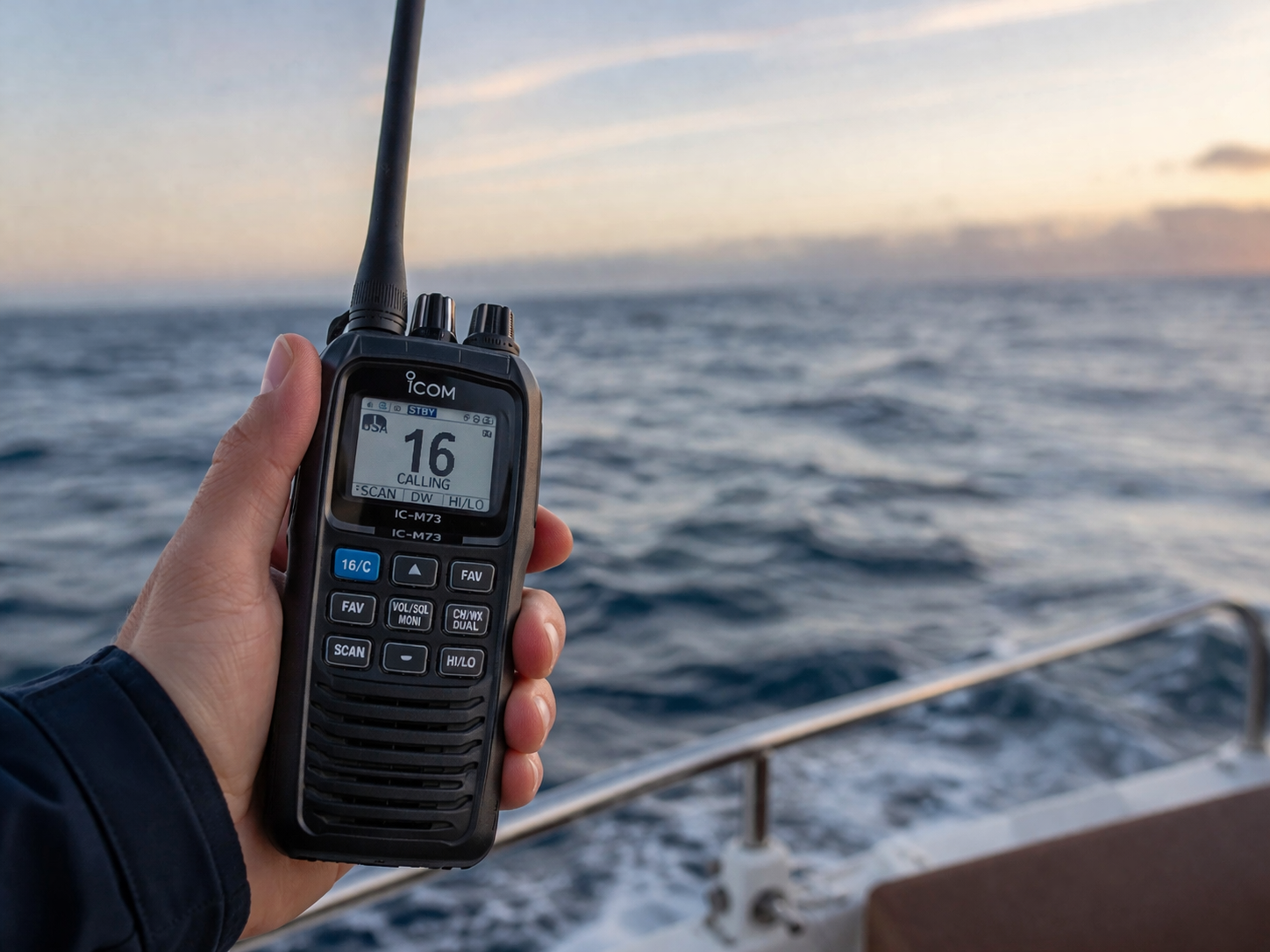
The VHF (Very High Frequency) radio is the essential communication device on any recreational vessel. More reliable than a mobile phone at sea, it connects you to other vessels, coastguard stations, marinas, and — in an emergency — maritime rescue coordination centres. Yet many sailors underuse their VHF, or don't know exactly how to operate it. This complete guide covers everything: how it works, which channels to use, calling procedures, and best practices.
Why is VHF essential and often mandatory?
In many European countries, any vessel navigating beyond a certain distance offshore must carry a fixed or handheld VHF radio. But beyond regulation, the VHF is a genuine active safety tool. Unlike a mobile phone — whose network coverage is often non-existent offshore — the VHF operates continuously on dedicated maritime frequencies.
The range of a fixed 25 W VHF installed on board is typically 20 to 40 nautical miles, depending on antenna height and atmospheric conditions. A handheld VHF (5–6 W) offers 5 to 10 miles. In a distress situation, that range can be lifesaving.
Fixed or handheld VHF?
A fixed VHF is recommended as your primary onboard radio: higher power, antenna mounted aloft, connected to the chart table. A handheld serves as a backup, or for communicating from the cockpit, dinghy, or ashore. Ideally, carry both.
YachtMate displays your real-time GPS coordinates at all times. In an emergency, find your exact latitude and longitude instantly in the app and read it out over your VHF — a crucial time-saver when every second counts.
VHF Channels: which ones to use and why
The marine VHF band has 57 channels, but only a handful are used regularly in recreational sailing. Knowing the right channels avoids mistakes and keeps you compliant with maritime law.
Channel 16: the international calling and distress frequency
Channel 16 (156.8 MHz) is the reference channel at sea. Every vessel equipped with a VHF is legally required to maintain a continuous watch on it while underway. All MAYDAY distress calls, PAN PAN urgency calls, SECURITÉ safety broadcasts, and coastguard announcements are made on channel 16. It is NOT for routine conversations — use it only to establish contact, then switch to a working channel.
Channel 9: inter-vessel calls
Channel 9 is commonly used as the recreational boater inter-ship channel in many countries. After making contact on channel 16, sailors typically switch to channel 9 for their routine communications: marina information requests, coordination between boats, etc.
Port and marina channels
Each port or marina has its own VHF channel, usually between channels 9 and 12. Before entering a port, call the harbour master on their published channel (indicated on charts and cruising guides) to request a berth. Most harbour masters also monitor channel 16.
Channel 70: Digital Selective Calling (DSC)
Channel 70 is reserved exclusively for DSC (Digital Selective Calling). You won't hear any voice traffic on it — messages are transmitted digitally. It is used to trigger an automatic distress alert containing your MMSI and GPS coordinates.
Weather channels
National meteorological services broadcast marine weather forecasts on dedicated VHF channels (which vary by region and country). These bulletins are broadcast at fixed times and should be noted carefully before and during passages.
YachtMate's weather feature gives you 7-day marine forecasts directly on your smartphone, complementing VHF weather bulletins. Before casting off, use both: the app for the general forecast trend, the VHF for the official broadcast from your regional coastguard.
Understanding and using DSC (Digital Selective Calling)
DSC is a digital technology built into all modern VHF radios that transforms onboard safety. To use it, your VHF must be programmed with your MMSI (Maritime Mobile Service Identity) and ideally connected to a GPS.
What is the MMSI?
The MMSI is a unique 9-digit identification number for each vessel. It is issued by your national maritime authority — in the UK by Ofcom, in the USA by the FCC, and so on. This number must be programmed into your VHF before use. Once your VHF is connected to a GPS, your position is automatically included in any DSC distress alert.
Triggering a DSC distress alert
In a life-threatening emergency (sinking, fire, person overboard), the red DSC distress button (usually under a protective cover) instantly transmits a digital signal on channel 70 containing:
- Your MMSI (vessel identity)
- Your GPS position (if VHF is connected to GPS)
- The nature of the distress (if you had time to select it)
- The UTC time of the call
This signal is received by all DSC-equipped vessels within range and by the coastguard. It triggers an audible and visual alarm on their sets. After sending the DSC alert, switch immediately to channel 16 and transmit your vocal MAYDAY call.
Radio calling procedures: what to say and what not to say
Maritime radio uses standardised language and procedures. Using them correctly is both a legal obligation and a guarantee of efficiency, especially under stress.
Routine call on channel 16
To contact another vessel or a marina:
- Check that channel 16 is clear
- Call: "[Name of vessel called], [Name of vessel called], this is [Your boat name], channel 16, over."
- Wait for the reply, then suggest switching: "Shall we move to channel 9?"
- Confirm: "Channel 9, over."
The MAYDAY distress call
MAYDAY is used when there is grave and imminent danger to the vessel or persons on board. Procedure on channel 16:
"MAYDAY MAYDAY MAYDAY — This is [Vessel name] [Vessel name] [Vessel name] — MAYDAY [Vessel name] — Position: [Latitude / Longitude or landmark] — [Nature of distress] — [Number of people on board] — [Any other useful information] — Over."
Repeat until you receive a reply. Keep channel 16 on watch.
PAN PAN and SECURITÉ
PAN PAN is used for a less serious urgency (injured person but the vessel is not in immediate danger). The call structure is identical to MAYDAY, preceded by "PAN PAN PAN PAN PAN PAN".
SECURITÉ is used to broadcast an important navigation warning to other vessels (reported wreck, drifting net, vessel with lights out). It is a safety message, not a distress call.
Licence requirements
To legally operate a marine VHF, the skipper must hold a radio operator's licence. In Europe, this is typically the Short Range Certificate (SRC), obtained after passing a short exam. In the USA, no licence is required for domestic voyages, but an FCC ship station licence and operator licence are required for international travel.
The SRC exam covers radio procedures, distress protocols, and basic DSC operation. It is available through most sailing schools and clubs.
Choosing your marine VHF
The market offers VHF radios of widely varying quality. Here are the key criteria:
Fixed VHF: essential features
- Power: 25 W is the standard. Some models offer a 1 W low-power mode for short-range use.
- Built-in DSC: mandatory on any modern fixed VHF.
- GPS connectivity: NMEA 0183 or NMEA 2000 to link the VHF to your onboard GPS.
- Waterproofing: IPX7 minimum (1 m submersion / 30 min).
- Colour screen: makes reading channels and DSC information easier.
- Remote handset: a cockpit-mounted remote unit is very practical.
Reliable brands include: Standard Horizon, Icom, Garmin, Uniden.
Handheld VHF: your backup lifeline
Choose a floating model rated at least 5 W. The battery should last at least 8 hours in normal use. Some models include a built-in GPS DSC function — a major plus in a man-overboard scenario.
Before every passage, confirm that your VHF is on channel 16, volume is adequate, and the battery is fully charged. Use YachtMate's departure checklist to make this verification automatic — it's part of the recommended pre-departure safety checks built into the app.
Best practices and common mistakes to avoid
What you should do
- Maintain a continuous watch on channel 16 while underway
- Speak slowly and clearly — radio distorts the voice
- Listen before transmitting: check the channel is clear
- Use the word OVER to indicate you have finished transmitting
- Program your MMSI before going to sea
- Connect your VHF to the onboard GPS for DSC
- Test your VHF regularly (with coastguard permission)
What you should not do
- Use channel 16 for routine conversations
- Transmit false distress calls (a serious criminal offence)
- Block the squelch too tightly — you will miss safety broadcasts
- Forget to charge the handheld VHF battery
- Operate without a valid radio licence on international voyages
VHF maintenance
Your VHF is exposed to a harsh environment: salt, humidity, vibration. Regular maintenance extends its service life and ensures availability when it matters most.
- Rinse the handset with fresh water after every offshore passage
- Inspect the coaxial cable and antenna connectors each season
- Check that the front-panel waterproof gasket is undamaged
- Test output power with a wattmeter if you have any doubts
- Replace handheld VHF batteries every 2–3 years
Stay connected and safe at sea with YachtMate
YachtMate guides you through every step of your voyage: real-time GPS position, 7-day marine forecasts, logbook, departure checklist and offline charts. The perfect companion to your VHF radio for the modern sailor.
Discover YachtMate