
How many times has dropping the mainsail turned a great day out into a chore? The sail spilling off both sides of the boom, sliding across the coachroof, escaping into the cockpit, while you wrestle it back with both arms as the boat rolls head to wind… The lazy jack and lazy bag combination was designed precisely to eliminate that struggle. Together, they let you drop, contain and stow the mainsail almost without leaving the cockpit — a level of comfort and safety that has made this system one of the most popular upgrades on modern cruising sailboats.
Lazy jacks, lazy bag: what are we talking about?
The two terms are often confused, but they describe two distinct and complementary parts.
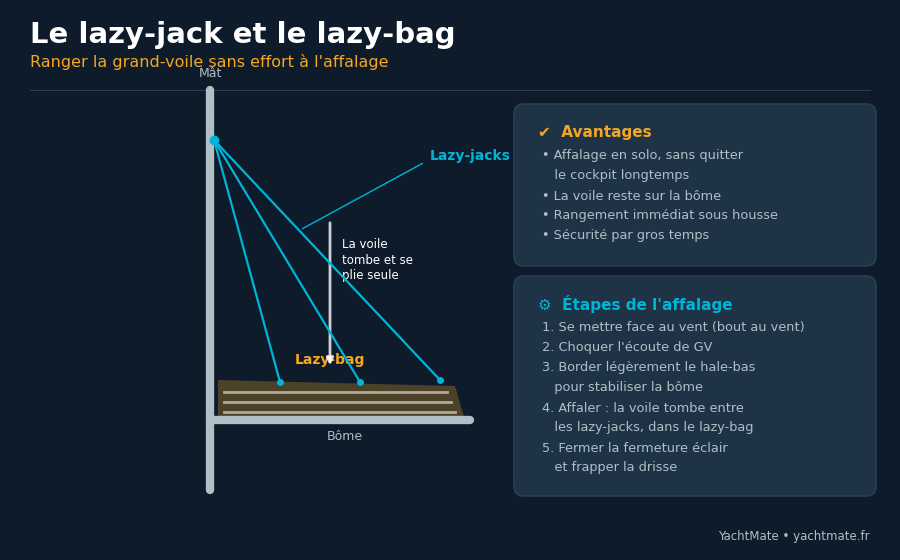
Lazy jacks are a network of thin lines rigged on each side of the sail, running from a point high on the mast down to several points spread along the boom. These lines form a V-shaped "cradle" that guides and holds the mainsail as it comes down. Instead of falling wherever it likes, the sail is funnelled and stacked on top of the boom, without spilling over the sides.
The lazy bag (also called a sail pack, boom bag or stack pack) is a fabric cover permanently fixed to the boom and opened along the top with a zip. When the sail is dropped, it falls straight inside; all that's left is to zip it up to enclose and protect the cloth. The lazy bag almost always incorporates the lazy jack lines, so the two work in tandem: the lazy jacks guide, and the lazy bag receives and protects.
On a new or used boat, check whether the mainsail is already "lazy-bag ready". A sail designed for the system has a suitable foot and often full-length battens that help it fold neatly. An older sail works too, but will stow less tidily.
Why fit this system on board?
The main advantage is obvious from the very first drop: you no longer need to go forward onto the deck to control the sail. Head to wind, you simply ease the halyard and the sail stows itself between the lines. For a short-handed crew — and especially for single-handed sailing — it's a major safety gain: fewer trips across a moving deck, less risk of a fall, and a rushed, sloppy furl is no longer inevitable.
The second benefit is sail protection. Once the zip is closed, the mainsail is shielded from UV — the cloth's main enemy — and from spray at anchor. No more sail cover to rig and remove at every stop: the bag is always in place. Finally, quick stowing encourages you to reef or drop early when the weather turns, rather than putting the job off out of laziness.
How to drop the sail cleanly with lazy jacks
The manoeuvre is simple, but a few habits guarantee a tidy stow every time.
1. Point head to wind
This is the single most important point. The mainsail must luff freely, not be pinned on one side by the wind. Bring the bow head to wind (under engine or by luffing up) and hold that heading throughout the drop. If the sail stays sheeted to one side, it will escape the lazy jacks and fall beside the bag.
2. Ease the sheet and steady the boom
Release the mainsheet to free the cloth, then take up a little on the boom vang (or the sheet) to stop the boom rising and sweeping across the cockpit. A boom that lifts distorts the lazy-jack cradle and makes the sail harder to bring down.
3. Drop decisively
Open the halyard clutch and let the sail come down in one steady motion. Guided by the lines, the cloth stacks itself into the lazy bag. On larger sails, pull the foot downward to help the last few metres.
4. Zip up and secure
Close the lazy bag zip, secure the halyard (cleated off or lightly tensioned so it doesn't slap), and you're done. In under a minute your mainsail is stowed and protected.
Plan your drop point with the YachtMate app: spot a clear patch of water and a head-to-wind heading before you enter the harbour or approach the anchorage. Reefing or dropping at the right moment, in open water, is far less stressful than doing it at the last second in a narrow channel.
The flip side: what to watch out for
Lazy jacks aren't all upside, and knowing their limits avoids nasty surprises.
The snagging risk when hoisting
The main drawback comes when raising the sail. If you're not perfectly head to wind, a batten or the headboard can catch in a lazy-jack line and jam the halyard — or even tear the sail if you force it. The golden rule: always hoist strictly head to wind, and drop back down a touch if it snags rather than forcing it.
Chafe and windage
The lines rub against the sail when reaching and can wear it over time; the lazy bag also adds a little weight and windage at the boom. On some boats, cleats are fitted to lead the lazy jacks forward against the mast when not in use, to reduce chafe while sailing.
"A well-tuned lazy jack means a mainsail that stows itself. Badly tuned, it's a halyard that jams on every hoist. It all comes down to being head to wind."
Getting the tension right
Lines that are too tight distort the leech and increase the risk of snagging; too loose, and they no longer guide anything. Set the tension so the cradle is just open enough to catch the cloth, without pressing on the hoisted sail. Most systems adjust via a downhaul line at the mast base.
Installation and maintenance
You'll find lazy-jack kits on their own (from around a hundred euros) or complete made-to-measure lazy-bag sets, built by a sailmaker to the dimensions of your boom and mainsail. Fitting a simple kit is within reach of a handy sailor: attach a high point on the mast (roughly two-thirds up the sail) and spread two or three lead points along the boom on each side.
For upkeep, rinse the lazy bag with fresh water to remove salt, check the lines regularly (they age under UV) and lubricate the zip, often the first thing to fail. Inspect the attachment points on mast and boom: a shackle that opens or an eyelet that tears out lets the whole cradle collapse.
Combine lazy jacks with a boom reefing system (single-line or classic slab reefing): you can then reef and drop the sail while keeping a tidy stow, without ever climbing onto the coachroof. It's the ideal setup for couples and single-handed cruising.
In summary
The lazy jack / lazy bag combination turns dropping the mainsail from an acrobatic manoeuvre into a routine gesture done from the cockpit. It delivers safety, speed and sail protection, at the cost of a little care when hoisting and minimal maintenance. For most cruising sailboats — and especially those sailed short-handed or solo — it's a modest investment that dramatically improves life on board. The one rule never to forget: hoist and drop strictly head to wind.
Sail with more peace of mind using YachtMate
Plan your harbour and anchoring manoeuvres, track the wind and weather, and hold your course with YachtMate — the navigation app built for recreational boaters. Nautical charts, AIS and weather, available on iOS and Android.
Discover YachtMate →