
Two numbers sum up your boat's vertical footprint in the water: the draft, below the waterline, and the air draft, above it. One protects you from running aground, the other from bridges and power lines. Ignoring them exposes you to the two most common and most avoidable incidents in boating: touching bottom at a harbour entrance, or clipping an overhead obstacle. This guide explains what these measurements mean, how to know them precisely and how to factor them into every navigation decision.
1. Two dimensions, two opposite dangers
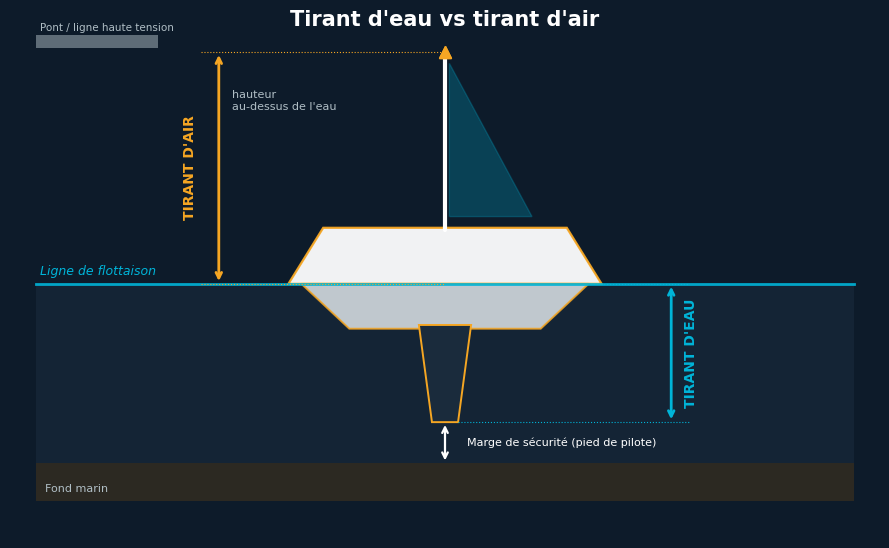
The draft is the vertical distance from the waterline to the lowest point of the hull, usually the bottom of the keel (or the bottom of a rudder, skeg or propeller on some boats). It is the minimum water depth you need to float without touching bottom. A 10-metre cruising yacht commonly draws 1.5 to 2 metres; a full-length centreboarder or lifting keel can drop below 60 cm with the keel raised.
The air draft is the height from the waterline to the highest point of the boat: the masthead on a sailboat (VHF antenna included!), the top of the bimini or antenna on a motorboat. It determines your ability to pass under a bridge, a high-voltage line or into a covered lock. A 10-metre mast often reaches 15 or 16 metres above the water.
The same boat is therefore judged "from below" and "from above": both figures are fixed, but the water level moves constantly with the tide.
2. Knowing your boat's measurements
Your first source is the builder's documentation: spec sheet, owner's manual or drawings. Draft is nearly always listed, often for the "light" (unloaded) boat. Air draft is given less often and is worth verifying yourself.
Measuring it yourself
For draft, the most reliable method is to measure at the yard during a haul-out, from the bottom of the keel to the waterline. For air draft, a simple method is to hoist a tape measure to the masthead on a halyard, then add the freeboard height. Never forget the parts that stick up: antenna, wind vane, masthead light, solar panel on an arch.
Write down both real figures (including the 30 to 50 cm safety margin) on a label stuck near the chart table. During a manoeuvre you have no time to search: the number must be immediately available.
3. Draft: avoiding grounding
Touching bottom is the most frequent incident in coastal sailing. To avoid it, you never rely on the bare draft: you add a safety margin, sometimes called under-keel clearance. This margin (often 20% of the draft, or at least 30 to 50 cm) offsets sounder errors, swell that drives the keel down into the troughs, and chart imprecision.
The basic calculation is simple: available depth = charted sounding + height of tide at the time. You can pass safely if this figure exceeds your draft plus the safety margin. Chart soundings are given relative to chart datum, a very low level rarely reached: most of the time you have more water than the chart shows, but that is no reason to skip the calculation.
Watch the depth sounder
The sounder is your best ally on approach. Set its offset so it shows either total depth or, more usefully, depth under the keel. In shallow water, slow down: touching sand at 2 knots is harmless, the same on rock at 6 knots can be catastrophic.
4. Air draft: bridges, cables and locks
Air draft poses the opposite problem: here it is high tide that threatens you, because it reduces the clearance under a fixed bridge. The height marked on structures is usually given relative to the highest astronomical tide or to a datum stated on the chart: read the legend carefully before committing.
High-voltage lines are especially treacherous. Regulations impose a safety distance (an arc can jump without direct contact): never aim to pass "just under". On rivers and inland waterways, it is often cables, not bridges, that set the limit.
Before passing under a structure, compare your air draft to the clearance at high water, never to the present moment. A bridge offering 16 m at mid-tide may offer only 14 m at spring high water.
5. The effect of tides and loading
Water level is not the only variable. The boat's loading changes the draft: full water and fuel tanks, provisions, crew and gear can sink a boat several centimetres. Conversely, a sailboat's heel when beating increases draft on one side and reduces it on the other — a detail that matters in a narrow channel.
Finally, water density plays a role: a boat floats slightly higher at sea (salt water) than in fresh water. Moving from an estuary up a river can therefore reduce your under-keel clearance by a few centimetres, without anything changing on board.
6. Mistakes to avoid
- Forgetting the antenna and wind vane in the air draft: these easily add 30 to 60 cm above the masthead.
- Trusting the "light" draft when the boat is loaded for cruising.
- Neglecting the safety margin in swell or over poorly charted ground.
- Reasoning about the present moment rather than the critical one: lowest water for draft, highest water for air draft.
- Confusing bridge height references (highest astronomical tide, mean level): always read the chart legend.
Mastering these two measurements turns two sources of anxiety into simple calculation parameters. With a draft and air draft known to the centimetre, good tide reading and a well-set sounder, most areas reputed to be "tricky" become perfectly accessible.
Anticipate your water depths with YachtMate
YachtMate shows depth, tides and your safety margins in real time to guide you on approach. Free.
Discover YachtMate