
Of all the instruments on board, the depth sounder may be the most understated — yet one of the most essential. It tells you the depth of water under the hull, keeps you off the bottom, secures an anchorage and determines whether you can enter a harbour at low tide. A sailboat that touches bottom, a propeller that scrapes the seabed: most of these incidents could have been avoided by reading the echo sounder carefully. This guide explains how the device works, how to choose a transducer, and above all how to set it up and read it correctly to navigate with confidence.
How does an echo sounder work?
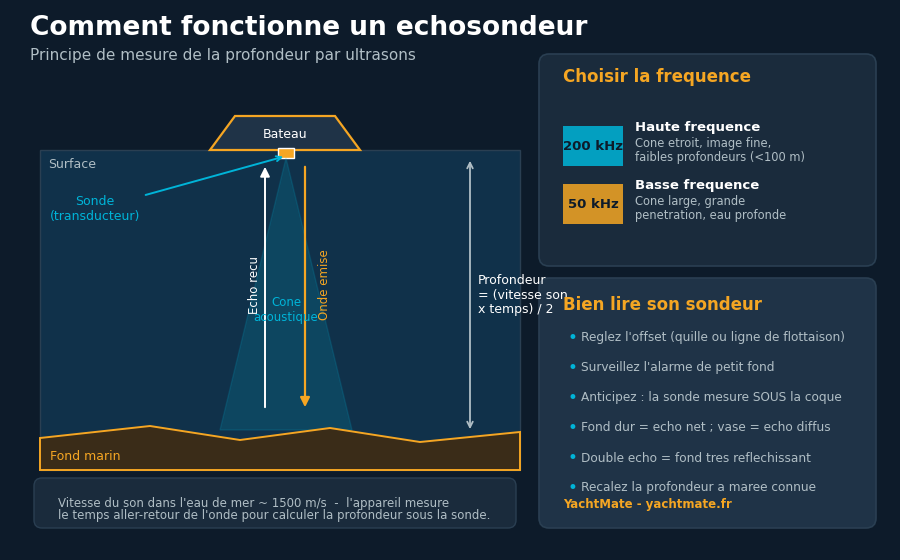
The principle is surprisingly simple and based on acoustics. A transducer fixed under the hull emits an ultrasonic pulse aimed at the bottom. The wave travels through the water, bounces off the seabed, then returns to the transducer, which picks it up. The device measures the round-trip time of this echo and, knowing the speed of sound in seawater (around 1500 m/s), calculates the distance: that is the depth shown on the screen.
The term "echo sounder" comes precisely from this: an echo is measured to deduce a sounding, that is, a depth of water. The pulse rate is high — several pulses per second — giving an almost instantaneous reading and allowing you to follow bottom changes in real time while underway.
A measurement under the hull, not under the keel
A crucial and often misunderstood point: the transducer measures the distance between itself and the bottom, not between your lowest point (keel, propeller, rudder) and the bottom. Depending on the setting chosen, the screen can display the depth under the transducer, under the keel, or below the waterline. Understanding this reference is the foundation of safe reading — we return to it below with the offset setting.
The different types of transducers
The heart of a sounder's performance is its transducer. The choice depends on the hull material, the type of boat and the cruising area.
The through-hull transducer
Mounted in a hole drilled through the hull, the through-hull transducer is in direct contact with the water and offers the best accuracy, particularly at high speed and in rough seas. It is the standard on sailboats and cruising boats. It comes in bronze (polyester or wood hulls) or stainless/plastic. Drawback: installation requires drilling below the waterline and a watertight skin fitting, so the boat must be hauled out.
The transom-mount transducer
Fixed to the transom, just below the surface, it installs easily without drilling the hull. Ideal for motorboats, RIBs and small craft, it can suffer from turbulence and bubbles at high speed or in the propeller wash. An economical and portable solution, perfect for getting started.
The in-hull transducer
Bonded inside the hull, it transmits through the polyester without drilling. Practical and tamper-proof from outside, it loses a little range and works only on solid polyester hulls (not on cored sandwich hulls with foam or balsa, nor on steel or aluminium). Water temperature measurement is not possible with it.
Many modern transducers combine depth, surface speed and water temperature in a single housing. With the YachtMate app, you can view this data on the chart and cross-check the measured depth against the charted sounding — an excellent way to verify that your instrument is correctly calibrated.
Choosing the right frequency: 50 or 200 kHz
Sounders generally work on two frequencies, sometimes both at once. The choice directly affects the quality and range of the measurement.
- 200 kHz (high frequency): the beam is narrow (typically 10 to 20°), the image is precise and detailed. Ideal for shallow water (anchoring, harbour approaches, coastal navigation) down to about 100 metres. It is the most widely used frequency in recreational boating.
- 50 kHz (low frequency): the beam is wide (40° and more) and penetrates much deeper, down to several hundred metres. Less precise on detail, it is useful for offshore navigation or deep-water fishing.
For typical coastal use, 200 kHz is more than enough. If you regularly sail offshore or want to detect fish schools at depth, a dual-frequency transducer offers the best of both worlds.
Setting the offset: the step never to skip
The offset is the most important setting on a sounder, yet the most often ignored. It tells the device where the transducer sits relative to the reference you want to display. Three conventions exist:
- Depth below the transducer: offset at zero, the screen shows the raw measured distance. It is the true value, but it does not account for draught.
- Depth below the keel: you enter a negative offset equal to the distance between the transducer and the lowest point of the boat. The screen then shows the actual clearance under the keel — the safest option.
- True depth (below the waterline): you enter a positive offset equal to the transducer's draught. The reading then matches the actual water depth, comparable to the sounding charted on the map.
"Before the first sail of the season, always check your offset. A poorly calibrated sounder showing 2 metres when there are only 50 cm left under the keel means a guaranteed grounding."
The choice depends on your habit, but the most prudent remains depth below the keel: the screen directly indicates the margin you have before touching. Note your setting somewhere — it is easy to forget from one season to the next.
To check your offset, anchor in an area of known depth at a determined tide: compare the sounder reading with the actual depth (charted sounding corrected for tidal height). If the difference is constant, adjust the offset accordingly. YachtMate gives you the current tidal height to make this calculation easily.
Reading your sounder while underway
A sounder does more than display a number: the nature of the echo also tells you about the type of bottom, valuable information for anchoring.
- Hard bottom (rock, pebbles): the echo is sharp, thin and strongly reflective. You sometimes see a double echo (the wave makes two round trips), a sign of a very reverberant bottom and good holding… but also sometimes of smooth rock that holds poorly.
- Soft bottom (mud, fine sand): the echo is more diffuse and spread out. Mud absorbs part of the wave, so the reading can be less clear.
- Sand: good reflection, clear echo, an ideal bottom for anchoring.
- Seagrass (Posidonia): on graphic sounders you can make out a layer above the hard bottom. Avoid for anchoring — and protected in the Mediterranean.
Setting the shallow-water alarm
The most useful safety function: the minimum depth alarm. Set it to a value that leaves you a comfortable margin (for example your draught + 1 metre). As soon as the water depth falls below this threshold, an audible signal alerts you — essential at night, in fog, or when you are busy with a manoeuvre. Some units also offer a rising-bottom (rapid change) alarm, very useful when approaching the coast.
Limits and pitfalls to know
The sounder is reliable, but not infallible. A few situations can distort the measurement: air bubbles under the hull (wake, propeller cavitation, rough seas) scramble the signal and cause dropouts; a layer of weed or shellfish on the transducer (fouling) reduces its sensitivity; a dense fish school or a marked thermocline can return a false echo. Finally, at very high speed, some transducers lose the bottom.
The golden rule: the sounder is an aid, not an absolute truth. Always cross-check its reading with the chart, the tidal height and your own observation. On a delicate approach, slow down: a sounder reads the bottom better at reduced speed, and you will have time to react if it suddenly drops out.
Transducer maintenance
A fouled transducer loses performance. During the annual haul-out, clean it gently (without abrasive or metal scraper that would scratch the membrane) and apply a compatible specific antifouling if needed. Check through-hull transducers for cracks and the condition of the skin fitting. For in-hull transducers, make sure the coupling fluid (if present) has not dried out.
Navigate with greater peace of mind using YachtMate
Depths, tides, nautical charts and route planning in a single app designed for recreational boaters. Available on iOS and Android.
Discover YachtMate →