

On board, damp is a quiet but stubborn enemy. It fogs the portholes at dawn, leaves bulkheads clammy, soaks mattresses and eventually stains wood and upholstery with mould. Whether at the dock or under way, the mechanism is the same: warm, moisture-laden air meets cold surfaces and condenses. The good news is that this process is very easy to control once you understand it. This guide explains where the moisture comes from, where it hides and how to drive it out for good, without turning your saloon into a sauna or a fridge.
1. Why air condenses on board
Warm air can hold far more water vapour than cold air. When that moist air cools against a surface, it reaches a threshold — the dew point — beyond which it can no longer hold all its water: the excess settles as fine droplets. It is exactly what happens on an iced glass on a summer day, and it is what runs down your portholes at first light.
On a boat, the hull sits in water that is often far colder than the air inside. The walls, especially below the waterline and behind lockers, play the part of the iced glass. So condensation needs just two ingredients: vapour produced inside and cold surfaces to receive it. Tackling damp means acting on one or the other — ideally both.
A cheap thermo-hygrometer changes everything: it shows the relative humidity (RH) of the saloon. Aim for 45 to 60%. Above 65%, condensation and mould become almost inevitable; that is the signal to ventilate, heat or dehumidify.
2. Where the moisture comes from
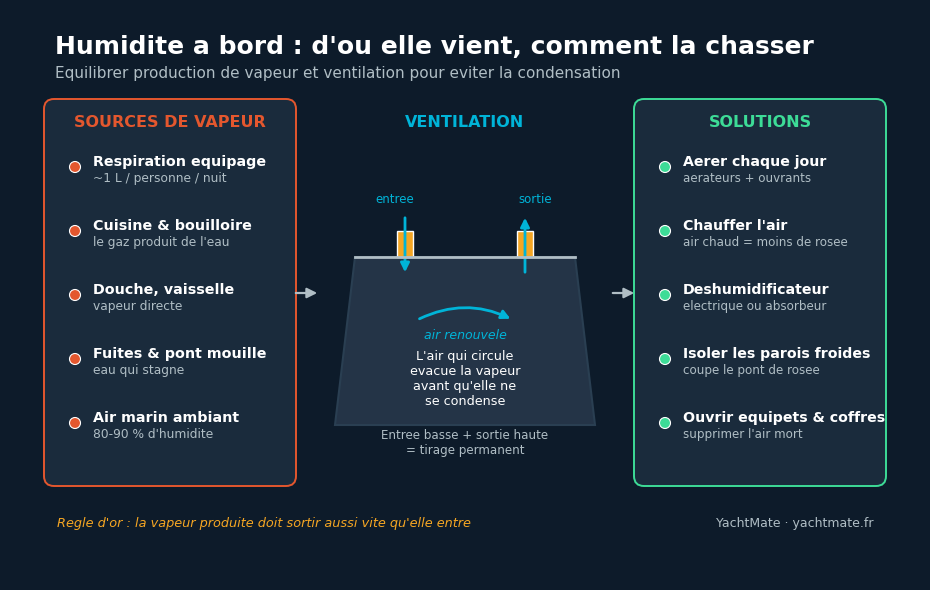
Many sailors go hunting for a leak when most of the water actually comes from… themselves and daily life aboard. The main sources are:
- Breathing and perspiration: one crew member releases nearly a litre of water per night. Four people in a closed saloon add up to a lot of vapour before dawn.
- Cooking: boiling water, cooking and above all burning gas — burning a bottle of butane releases almost its own weight in water vapour.
- Showering and washing up: hot water and direct steam in a closed volume.
- Laundry drying inside, including oilskins and towels.
- Leaks: portholes, through-hulls and deck fittings poorly sealed, water sitting in the bilge.
- Sea air itself, whose relative humidity often exceeds 80%.
Identifying your dominant sources points to the solution: a boat lived in over winter suffers mainly from breathing and cooking, while a boat closed up at the dock suffers mainly from ambient air and small leaks.
3. The high-risk areas
Condensation does not spread at random: it picks the cold spots and corners with no airflow. Watch first:
- Portholes and the coachroof, especially uninsulated aluminium frames that form a thermal bridge.
- Under the mattresses: the sleeper's warm air meets the cold hull beneath the berth, and the plywood stays damp.
- The bottom of lockers and cupboards, where the air never moves.
- The bilge and the back of furniture pressed against the hull.
- Closed stowage boxes: rolled oilskins, sleeping bags, food stores.
4. Ventilation: the best weapon
Ventilation is by far the most effective action, because it removes vapour before it condenses. The goal is a constant airflow through the boat: a low intake (near the waterline, forward for example) and a high outlet (a vent, a cracked-open deck hatch). Cold air comes in, warms, picks up moisture and leaves.
Permanent ventilation
Dorade-box vents are designed to let air through while blocking green water: they work even with the boat closed and in bad weather. Multiply the intake and outlet points, and never fully block the vents just because it is cool out.
Active ventilation
Whenever the weather allows, open up wide: hatches, portholes, companionway. Ten minutes of a brisk through-draught in the morning refresh the air on board far better than timid ventilation all day. After a shower or cooking, ventilate at once to clear the burst of steam.
Move the air where it stagnates: lift mattresses off the hull with slatted bases or a mesh underlay, leave locker doors ajar, and stand cushions on edge when the boat is closed. Air that moves almost never condenses.
5. Heating and dehumidifying
The second weapon is to move the air away from its dew point. Slightly warmed air can hold more vapour without condensing: that is why gentle heating (diesel forced-air, an electric heater at the dock, a stove) dries the atmosphere as well as making it pleasant. Beware, though, of unflued combustion heaters, which release vapour and carbon monoxide themselves: they have no place in a closed space.
The dehumidifier
For a boat plugged in at the pontoon, especially over winter, a small electric dehumidifier is the most effective solution. It draws several litres of water a day and holds humidity below 60% unattended. Choose a model matched to the volume, with automatic shut-off or continuous drainage to the sink.
Power-free absorbers
Without power, salt absorbers (calcium chloride) passively capture moisture in cupboards, the chart table or stowage boxes. Cheap and handy for small volumes, they saturate quickly: remember to replace them and empty the tray of brackish water, which is corrosive to metal.
6. Treating and preventing mould
When damp settles in, mould appears as black or green patches on seals, upholstery and wood. Beyond the musty smell, it damages materials and harms air quality. To treat it:
- Clean affected surfaces with a mild solution (diluted white vinegar or a marine anti-mould product), wearing gloves and ventilating.
- Dry thoroughly, then treat the cause: ventilation and humidity, or the patches will come back.
- Take cushions, mattresses and sleeping bags out to dry in the sun whenever you can.
- Over winter, remove from the boat whatever you can (upholstery, linen, food) and leave the lockers open.
Fighting damp is a balance, not a one-off battle: cut the vapour you produce (cook with the lid on, ventilate after a shower), ventilate continuously and heat gently. Hold those three levers and your boat will stay healthy, winter and summer alike.
Sail with peace of mind using YachtMate
Marine weather, charts and humidity and dew forecasts at your fingertips: YachtMate helps you pick your airing windows and prepare every stopover. Free.
Discover YachtMate