Why Boat Insurance Matters More Than You Think
Boat insurance protects far more than just equipment—it provides essential peace of mind for serene sailing without financial fear. A collision, serious engine breakdown or coastal disaster costs quickly €5,000 to €100,000 depending on severity. Without adequate insurance, these costs fall entirely on your personal liability, potentially compromising entire personal wealth. For any motorboat or valuable sailboat owner, insurance is legally absolute necessity.
Boat insurance offerings have diversified substantially over past decade. Premiums are now more competitive, coverages more customizable, deductibles better adapted to actual sailor budgets. Quality boat insurance balances reasonable cost, complete coverage and effective 24/7 assistance.
Legal Aspects and Formal Obligations
In France, boat insurance isn't legally mandatory for all pleasure boats, unlike cars. However, owning uninsured registered boats exposes you to lawsuits if your boat damages others. Sailing clubs, ports, and homeowner insurance typically require specific boat insurance as contractual condition. For motorboats or serious cruisers, insurance is practically contractually essential.
Essential Coverage Types
Liability: Minimum Base
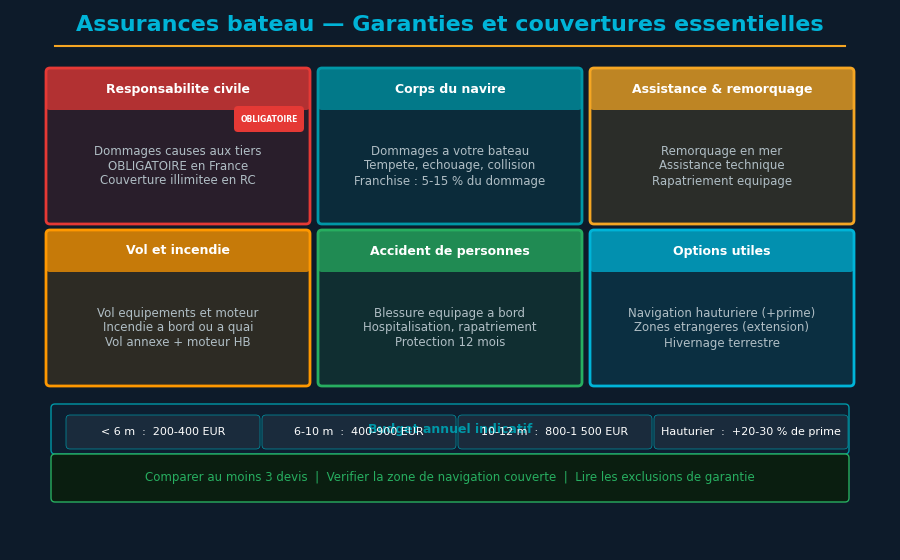
Liability covers damage your boat causes to others: collision with third party, damage to coastal structures, person injuries. This is minimum required coverage for accessing French and European ports. Standard guaranteed amount: €1 million, sometimes expandable to €10 million for offshore cruisers. Cost for this coverage alone: moderate €150-300 annually for small coastal boat.
Never sail uninsured, even for single day. Accidental bay collision quickly exceeds €50,000 in damages; your personal liability becomes permanently legally engaged.
All-Risk and Theft: Boat Protection
"All-risk" or comprehensive insurance protects your boat itself against various incidents: accidental grounding, fire, storms, floating debris collisions, vandalism. Boat and major equipment theft included. Essential if boat has significant value (€10,000+). Cost varies by value, age, skipper experience, accepted deductibles per contract.
Deductible (your cost-share per incident) proves crucial negotiation point. Lower deductible (€200) costs higher monthly premiums; higher deductible (€2000) reduces premium but increases personal exposure. For standard cruising boats, €500-1000 deductible offers good economic balance.
Record your boat's estimated value and major equipment in YachtMate. This justifies insurance coverage and documents property value for incidents.
Additional Coverage Worth Considering
Assistance and Marine Breakdown
24/7 assistance covers sea towing costs, engine breakdown support, qualified mechanic dispatch. For offshore or distant-water sailors, invaluable protection: open-ocean engine failure requires expensive rescue. Assistance includes emergency medical evacuation if injured at sea. Cost: €300-600 annually additional depending on geographic range.
Expanded Liability (Commercial Activities)
If occasionally renting boat, operating paid sailing activities, or commercial instruction, standard insurance proves insufficient legally. "Commercial operation" liability covers paid passengers or students responsibility. Non-disclosure voids coverage for incidents involving paid third parties. Additional cost: €200-500 depending on activity intensity.
Legal Protection and Defense
Legal defense covers attorney fees in disputes (collisions, general average, port litigation). Rarely included standard; request specifically. Valuable if navigating international waters or frequent high-collision-risk zones.
Factors Affecting Insurance Cost
Boat Value and Engine Power
€40,000 sailboat pays less than €80,000 motorboat monthly premium. Powerful engines (100+ hp) trigger higher premiums (statistically higher risk). Older boats (20+ years) face increased or refused insurance if condition poor documented. Reputed-solid builders get better insurer rates.
Skipper Experience and Qualifications
Age, boating experience, certifications (coastal license, offshore credentials) requested at enrollment. Senior skipper (60+) without license pays more than young skipper with offshore credentials and safety training. Regular training (safety, rescue) reduces premiums 5-15% per underwriter. Many insurers reward training completion (-10% safety course example).
Navigation Zone and Season
Mediterranean coastal cruising: low premium. Rough Atlantic: elevated premium. Transatlantic offshore: very high premium with mandatory high deductibles. Boat winterized ashore 8 months: reduced premium. Year-round navigation including winter: standard or increased premium.
Insurance choice should balance complete protection against reasonable cost. Comparing annual quotes remains essential for serene sailing.
Comparing Major French Boat Insurers
Generalist Insurers (Axa, Allianz, Maaf)
Large multirisks insurers offer boat insurance complementing home coverage. Advantage: combined package often discounted (homeowner + boat -10% cumulative). Disadvantage: less specialized coverages, default high deductibles, limited breakdown assistance. Suitable for moderate coastal boats navigated casually.
Specialized Marine Insurers (April Marine, Zurich Marine, GAN Bateau)
Nautical-dedicated insurers provide customized coverage. Advantage: negotiable deductibles, enhanced 24/7 assistance, nautical expertise understanding. Disadvantage: typically higher premiums, sometimes slow claim processing. Excellent for regular cruisers or offshore sailors demanding professionalism.
Online Insurers and Broker Networks
Platforms (Kabooki, Avocado Insurance) or independent brokers compare offers and negotiate. Advantage: competitive pricing, simple administration, email responsiveness. Disadvantage: less personal relationship, variable post-incident support quality. Good for small boats or tight budgets seeking best price-coverage ratio.
Document all incidents, repairs and damage history in YachtMate. This creates valuable history for annual renegotiation and justifies deductibles for future incidents.
Reducing Your Insurance Premium
Higher Deductibles Equal Lower Premiums
Accepting €1000-1500 deductible instead €300 can reduce premiums 20-30% annually. If you sail cautiously and confidently, this remains valid strategy: you absorb minor incidents, insurance covers catastrophic losses.
Training and Certifications
Boat licensing (coastal/offshore), rescue courses or safety training reduce premiums 5-15%. Initial investment quickly pays back across multiple insurance years.
Boat Safety Improvements
Anti-theft alarms, GPS beacons, approved current extinguishers, current lifeboats: many discounts possible (cumulative up -30% total). These improvements statistically reduce serious incidents.
Winter Storage and Secure Moorage
Properly winterized ashore: 30-50% premium reduction. Winter mooring: standard premium. Supervised port berth: reduced premium versus unattended moorage. More physically secured boat means lower statistical incident risk.
Filing Claims: Process and Timelines
Quick Post-Incident Procedure
Incident occurs: declare immediately (24-48h maximum) to insurer or broker. Provide: exact date/time/location, clear circumstances, digital damage photos, involved third-party coordinates, eyewitness statements. Retain useful items (damaged components, repair quotes) accelerating claim processing.
Expert Assessment and Compensation
Significant incidents (€5000+): insurer mandates independent marine expert inspecting damage, estimating actual costs, rendering technical opinion. Assessment takes 2-4 calendar weeks. Once accepted, compensation comes within 30 legal days maximum. Contractual deductibles are deducted from final payment.
Conclusion: Boat Insurance as Navigation Partner
Quality boat insurance costs just hundreds annually but protects you from potentially catastrophic financial risk. Choosing well means: verifying essential coverages, comparing real offers, assessing acceptable deductibles, accurately documenting boat value. Reputable insurance with effective assistance becomes invaluable navigation partner, letting you enjoy seagoing with genuine peace of mind.
Practical Experience and Continuous Learning
Experience accumulated over time becomes your best teacher in this specific domain. Every voyage, every challenge encountered contributes to your personal expertise. Systematically document your observations, solutions discovered, and results to create valuable knowledge base for future sailing adventures.
Sharing Experience with Community
The sailing community is generally welcoming and generous with sharing experiences and knowledge. Joining specialized forums, online discussion groups, or attending sailor gatherings enables exchanging with other enthusiasts and learning from their respective experiences. This mutual exchange significantly enriches your understanding and practical skills.
Continuous Training and Educational Resources
Maritime field constantly evolves with regular technology innovations, regulatory modifications, and discovery of better practices. Investing in continuing education—through formal courses, specialized readings, or technical webinars—keeps you updated and significantly improves your safety and overall navigation competence.
Integration with Other Onboard Systems
Modern boat systems function not in isolation but as part of integrated ecosystem where each component interacts with others. Understanding these interconnections proves crucial for optimizing overall performance and troubleshooting effectively when problems arise.
Compatibility and Interactions
Before adding new equipment or system, carefully verify compatibility with existing installations. Conflicts between systems cause unexpected malfunctions, energy efficiency loss, or even material damage. Meticulous planning during design phase prevents many costly future complications.
Long-Term Budget Planning
Managing boat budget requires long-term vision and strategic planning. Beyond immediate operational costs, anticipate future equipment replacements, technology updates, and major maintenance predictable as boat ages. Proper planning prevents emergency funding crises and reduces financial stress significantly.
Expense Optimization
Seek opportunities reducing costs without compromising quality or safety. This includes group purchasing with fellow sailors, negotiating with regular suppliers, rigorous preventive maintenance avoiding costly repairs, or researching equivalent alternatives at better market prices.
Advanced Technical Deep Dives
Understanding advanced technical aspects helps you maximize system performance and identify issues before they become serious problems. Technical knowledge empowers you to make informed decisions about upgrades, modifications, and troubleshooting procedures that could save thousands in unnecessary repairs.
Pressure and Performance Metrics
Monitoring key performance indicators—pressure gauges, flow rates, temperature variations, and efficiency percentages—provides insight into system health. Regular baseline measurements allow detecting gradual degradation before complete failure occurs. Most experienced sailors maintain detailed logbooks tracking these metrics monthly, creating historical trends useful for predictive maintenance planning.
Common Failure Patterns and Prevention
Certain components fail in predictable patterns based on usage frequency, environmental conditions, and maintenance quality. Learning these patterns helps you replace components preventively before failure, avoiding emergency situations far from qualified help. Vibration, temperature changes, and water quality variations all contribute to accelerated wear of specific components.
Environmental and Sustainability Considerations
Modern sailing increasingly emphasizes environmental responsibility and sustainability. Understanding ecological impact of your practices and equipment choices aligns sailing with contemporary values and often proves economically beneficial through reduced waste and efficient resource usage.
Waste Minimization Strategies
Implement practices reducing material waste aboard and marine environment impact. Proper disposal of used oil, batteries, and other hazardous materials protects fragile marine ecosystems. Many cruising destinations now have marinas and waste collection facilities specifically supporting environmentally conscious sailors, making sustainable practices increasingly practical and supported.
Future Technology and Innovations
Marine technology evolves rapidly with increasingly sophisticated systems becoming standard. Stay informed about emerging technologies—lithium batteries, advanced sail materials, automated systems, renewable energy solutions—to understand future possibilities for enhancing comfort, safety, and efficiency of your sailing adventures. Early adoption of promising technologies can provide competitive advantages and improved experiences.
Document Boat Insurance with YachtMate
Record incidents, repairs, boat value and insurance history securely in cloud.
Discover YachtMate →