
The bilge pump is one of those pieces of equipment you completely forget about… until the day you desperately need it. Yet it is one of the most important safety items on board: it keeps the bottom of the boat dry, evacuates water from a dripping stuffing box, a wave taken aboard or, in the worst case, an actual hull breach. An undersized pump, a seized float switch or a strainer clogged with hair and a tissue, and your entire dewatering system becomes useless at the critical moment. This complete guide explains how to choose the right pump, understand real-world flow rates, wire a reliable installation and maintain it so it answers the call when it matters.
What is a bilge pump really for?
The primary role of a bilge pump is to evacuate water that collects at the lowest point of the hull. This water has many constant sources: condensation, rainwater coming through ports or the companionway, spray, stuffing box leaks on the propeller shaft, seepage from seacocks or through-hulls, an overflowing sink or ice box. On most boats a small volume of water reaches the bilge continuously, and the automatic pump deals with it without any intervention.
But one thing must be clear: a bilge pump is not designed to save a sinking boat. Faced with a real hull breach — a ripped-out through-hull, a collision, a broken seacock — even a high-capacity pump only buys you time to plug the leak and call for help. The pump handles everyday water and minor failures; the real answer to a major breach is plugging the hole and having a tapered wooden bung within reach of every through-hull.
Keep a clean, dry bilge at all times: it is your best alarm system. A normally dry bilge that suddenly holds water immediately signals a new problem (stuffing box, seacock, rain). A permanently wet bilge hides real leaks.
Understanding a pump's real flow rate
This is the classic trap. The box proudly states "3000 GPH" (gallons per hour), about 11,000 litres/hour. In reality, you will never get that figure. The advertised rate is measured at the pump outlet, at zero discharge head and with a perfect 13.6 V supply. On board, your pump has to lift the water a metre or more up to the overboard outlet, the hose has bends, the battery voltage hovers around 12 V, and the strainer is partly fouled.
The result: count in practice on 50 to 60 % of the advertised flow, sometimes less. A "2000 GPH" pump lifting water 1.2 m through a 28 mm hose will deliver more like 1000 to 1200 real L/h. That is why you must never undersize, and always think in terms of useful flow, discharge head included.
Several factors reduce real flow: the height between the pump and the overboard outlet (each metre costs dearly), hose diameter (move up to 28 or 38 mm rather than 19 mm whenever possible), the number of bends, the length of the run, the supply voltage and the state of the strainer. A smooth, large-diameter hose that is short and has few bends matters as much as the power of the pump itself.
Automatic, manual, high-capacity: the 3-level rule
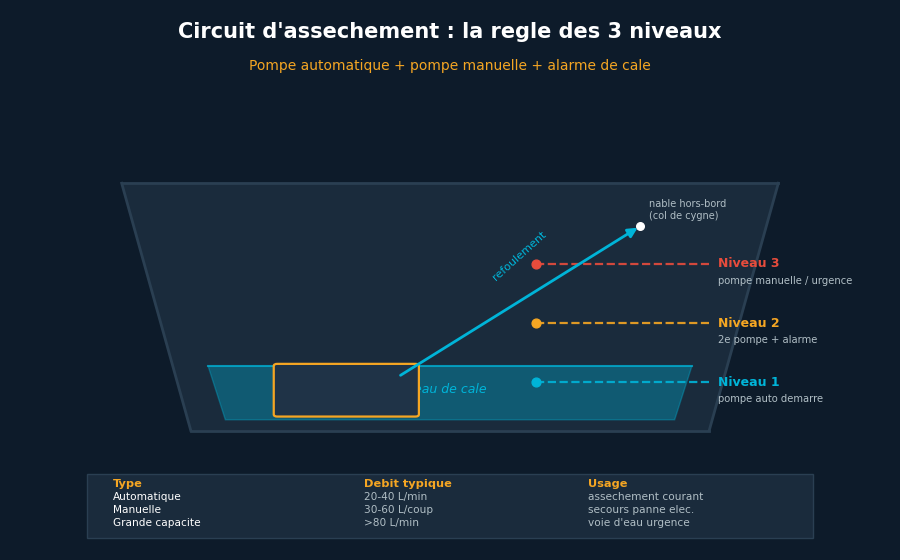
A well-designed dewatering system never relies on a single pump. Best practice is to stack three independent lines of defence, triggered at rising water levels.
Level 1 — The automatic pump
This is the everyday workhorse. Of modest flow (typically 20 to 40 L/min, i.e. 1200 to 2400 L/h), it triggers as soon as the water reaches a few centimetres in the bilge, thanks to a float switch or an electronic sensor. It runs for a few seconds, empties the bilge and stops. It works even with the boat closed up, alongside or at anchor, which is essential.
Level 2 — The second pump and alarm
Mounted slightly higher than the first, a second, higher-capacity electric pump takes over if the water keeps rising despite the main pump. Its trigger must be coupled with an audible and visual bilge alarm at the helm. If this pump starts, something abnormal is happening: you need to be warned immediately.
Level 3 — The manual pump and emergency
Essential and completely independent of electricity, the hand pump (diaphragm type) is your last resort in case of a battery failure or a flooded pump. Operable from the cockpit, it delivers 30 to 60 litres per arm stroke depending on the model. For extreme situations, some add a high-capacity pump (over 80 L/min) or divert the engine cooling pump to the bilge via a dedicated valve.
The float switch: the weak point to watch
In 90 % of cases, when an automatic pump fails to start, the culprit is not the pump: it is its switch. The classic mechanical float is moving, so prone to seizing, sticking in the high position (the pump then runs continuously and drains the battery) or in the low position (the pump never starts). Hair, plastic film, diesel and bilge debris easily jam the mechanism.
Electronic switches (capacitive or field sensors, with no moving parts) are far more reliable and increasingly common. Many modern pumps now integrate electronic detection directly into the pump body, with an automatic test cycle every few minutes. Whatever the technology, always fit a three-position switch at the panel: forced ON / OFF / AUTO, so you can trigger the pump manually at any time.
Test the automatic trigger once a month: pour a bucket of water into the bilge and check that the pump starts on its own, discharges properly at the outlet and stops when the bilge is empty. Thirty seconds that can save you a nasty surprise.
Wiring and installation: the golden rules
A bilge pump is useless if its power supply fails at the wrong moment. A few non-negotiable principles apply.
- Direct, protected supply: the automatic pump must stay powered permanently, even with the battery switch OFF, via a dedicated fuse mounted as close as possible to the battery. This is the only way it protects the boat in your absence.
- Watertight connections up high: all splices are made as high as possible above the maximum water level, with adhesive-lined heat-shrink terminals. Never use connector blocks or bare connections in the bilge bottom.
- Adequate wire gauge: undersizing the cable drops the voltage and therefore the flow. Follow the gauge tables according to run length and pump current.
- Anti-siphon loop: run the discharge hose up in a loop (gooseneck) above the waterline before the overboard outlet, to stop the sea flowing back into the bilge through heel or waves.
- Accessible strainer: the suction head must have a strainer that is easy to remove and clean, set at the lowest point but away from the largest debris.
The bilge alarm: see the problem before it grows
A pump can do its job for hours without you knowing — until the battery is flat or the leak exceeds its capacity. The bilge alarm fills this gap: a simple buzzer and LED at the panel, triggered by a second float placed above the normal operating level. If the alarm sounds, you know the water is rising faster than the pump can evacuate it, and you can act immediately: find the leak, bring the second or manual pump into action, head for shelter.
The most complete systems count pump cycles and flag an abnormal frequency, or relay the information to a mobile app. This is exactly the kind of monitoring that turns a developing failure into a simple, contained incident.
Maintenance: a simple but vital routine
A bilge pump lives in the harshest environment on the boat: stagnant water, diesel, salt, debris. Without maintenance, it degrades silently. Adopt this routine.
- Every outing: a glance at the bilge, checking the main pump is on AUTO and the bilge is dry.
- Every month: test the automatic trigger with a bucket of water, clean the strainer, check the discharge flows well at the outlet.
- Every season: remove and fully clean the pump and float, inspect terminals and fuses, check the state of the hose and any anti-return valve, test the manual pump and the alarm.
- At lay-up: make sure the bilge is perfectly empty to avoid freezing, which cracks pump bodies and deforms diaphragms.
Keep a spare pump on board, or at least a compatible motor cartridge: it is one of the easiest failures to fix at sea… provided you have the part. A few clamps, a length of hose and some terminals in the toolbox usefully complete the kit.
A good dewatering installation is not the most powerful pump in the catalogue: it is three independent pumps, an alarm to warn you, careful wiring and regular maintenance.
Conclusion: peace of mind at the bottom of the bilge
The bilge pump perfectly embodies the philosophy of safety at sea: a modest, inexpensive item, but one whose reliability rests entirely on anticipation and maintenance. By applying the three-level rule, favouring protected and permanent wiring, making the trigger reliable and adding an alarm, you turn a classic weak point on board into a genuine safety net. Above all, you keep your mind at ease — at anchor as under way — knowing the bottom of your boat will stay dry.
Keep an eye on your boat with YachtMate
Track the maintenance of your pumps and safety equipment, get your seasonal reminders and keep all your checks at hand, straight from your phone.
Discover YachtMate →