
Crossing paths with a 300-metre container ship in fog, or navigating a busy harbour entrance — these are everyday situations for recreational sailors. The AIS (Automatic Identification System) is one of the most powerful tools available for safe navigation and anticipating the movements of other vessels. Yet many leisure boaters still don't fully understand how this system works, or which equipment to choose. This complete guide answers all your questions.
What is AIS?
AIS is an automatic radio communication system that allows vessels to exchange information in real time using dedicated VHF frequencies (channels 87B and 88B, at 161.975 MHz and 162.025 MHz). Originally developed to prevent collisions between large commercial vessels, it has gradually become more accessible to recreational boaters.
In practice, an onboard AIS transponder regularly broadcasts a signal containing detailed information about your vessel, while simultaneously receiving data from all other AIS-equipped boats within a range of 20 to 40 nautical miles depending on propagation conditions. This data is then displayed on your chart plotter or navigation app as icons representing each vessel, along with their detailed information.
What information does AIS broadcast?
A standard AIS message contains a series of data essential for vessel identification and collision risk assessment, including the MMSI (9-digit unique vessel identifier), vessel name and flag, vessel type (sailing yacht, cargo, fishing vessel, etc.), precise GPS position, true heading and speed over ground, course over ground (COG) and gyrocompass heading (HDG), draught, length and beam, destination port and estimated arrival time, and navigation status (at anchor, underway, moored…).
This information, cross-referenced with your own route, allows your navigation software to calculate the CPA (Closest Point of Approach) and TCPA (Time to Closest Point of Approach) — two critical values for anticipating collision risks well before they become dangerous.
YachtMate natively integrates AIS data reception and display on your navigation chart. Connect a compatible AIS receiver to your smartphone via Wi-Fi or Bluetooth, and see all vessels around you in real time with their route vectors — no additional subscription required.
The different classes of AIS equipment
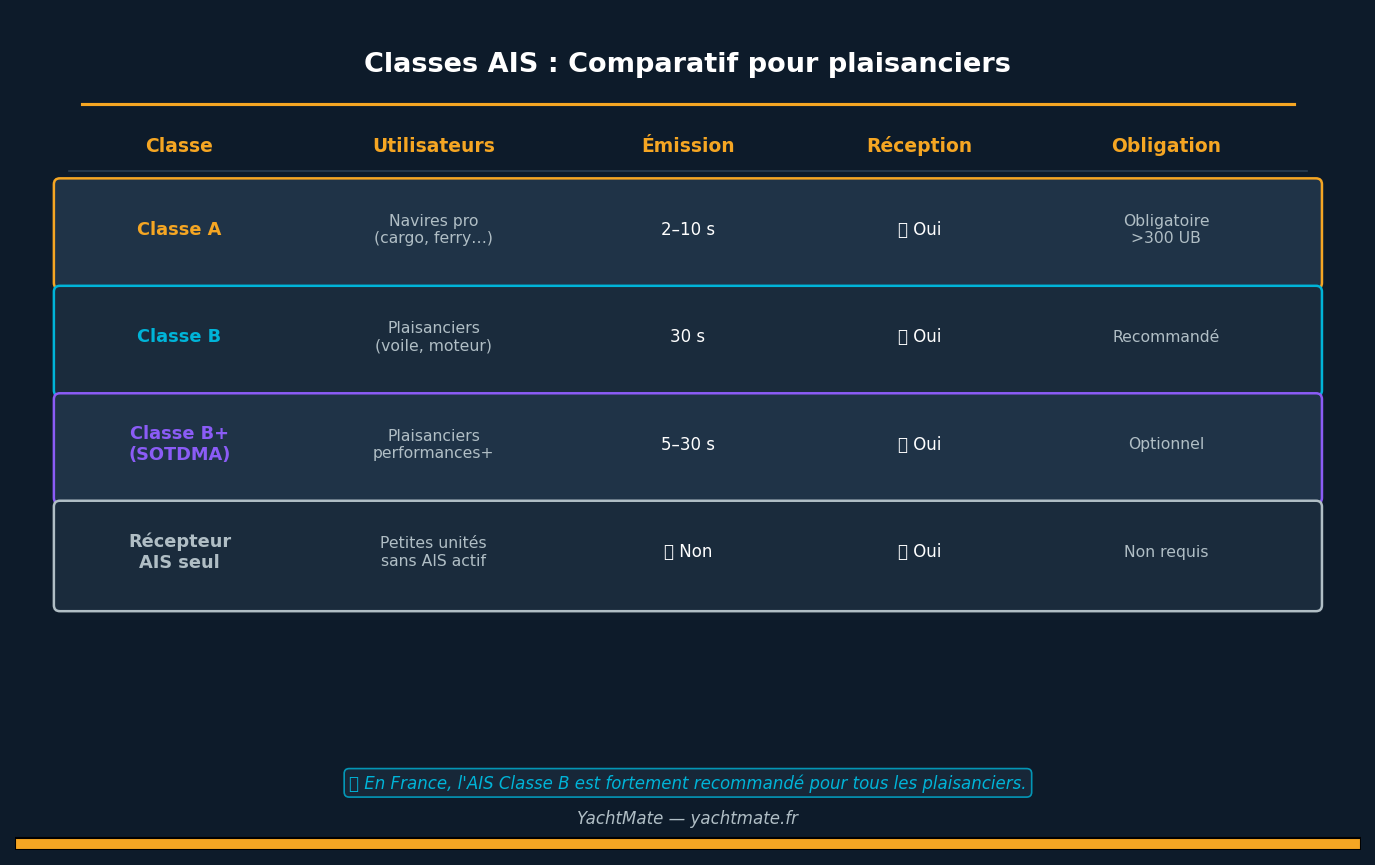
There are several categories of AIS equipment, each suited to different uses and budgets. Understanding these distinctions will help you choose the right equipment for your needs.
Class A: reserved for professional vessels
Class A is the standard required for commercial vessels over 300 GT navigating in international waters, as well as ferries and passenger ships. These transponders transmit every 2 seconds underway and every 10 seconds at anchor. They include a dedicated display and keyboard for entering destination information. Their cost — often several thousand euros — makes them unsuitable for leisure boating.
Class B: the ideal choice for recreational sailors
Class B is the standard designed specifically for leisure boating. It transmits every 30 seconds (every 3 minutes when stationary) and receives both Class A and Class B signals. Priced between €150 and €500 depending on the model, it is accessible to the vast majority of recreational boaters. Transmission power is 2 watts (versus 12.5 watts for Class A), but remains more than sufficient to be detected at 10–20 nautical miles in normal conditions.
Class B+ (SOTDMA): more power and reliability
Class B+ or SOTDMA (Self-Organized Time Division Multiple Access) is an enhanced version of Class B, transmitting at 5 watts with a transmission frequency that can drop to every 5 seconds in high-traffic areas. It also uses the SOTDMA protocol rather than CSTDMA, guaranteeing radio channel access even in very congested areas (ports, straits…). This type of device typically costs between €400 and €800.
AIS receiver only: listen without transmitting
For small craft or sailors who simply want to see other vessels without being seen, receiver-only AIS devices (sometimes called "passive AIS") are available. They receive all surrounding signals and transmit them to your navigation software via USB, Bluetooth or Wi-Fi. Their cost is very low (€30 to €150), but they have an important limitation: you remain invisible to other vessels. This can pose a risk in reduced visibility or heavy commercial traffic.
An AIS receiver lets you see others, but not be seen. In areas with heavy commercial traffic, a bidirectional transponder (Class B) is far safer.
How AIS works technically
AIS uses TDMA (Time Division Multiple Access) technology, which divides time into small windows (slots) and dynamically assigns a transmission window to each vessel. This avoids radio signal collisions on the dedicated channels. The system is designed to handle thousands of vessels simultaneously in the same area, which explains its reliability even in high-traffic zones like the English Channel or the Strait of Gibraltar.
AIS data is transmitted alternately on two VHF channels (87B and 88B) to avoid saturating a single channel. Each vessel automatically selects its transmission slot according to an algorithm that accounts for local traffic density.
AIS range: what you need to know
AIS operates on VHF frequencies with near-optical propagation. Its range therefore depends mainly on antenna height. Between two sailing yachts at sea, expect a range of 15 to 25 nautical miles. Between a cargo vessel (very high antenna) and a sailing yacht, this range can reach 40 nautical miles. In coastal areas, shore-based AIS stations relay signals, making them available on platforms like Marine Traffic — useful for route planning from port.
Before leaving port, check real-time AIS data directly in YachtMate to visualise maritime traffic on your planned route. Identify high-density zones, fast vessels and routing constraints to plan your navigation more effectively — especially useful before transiting a strait or entering a high-traffic channel.
Choosing and installing your Class B AIS transponder
Selection criteria
When choosing a Class B AIS transponder, several criteria deserve attention. Connectivity is key: look for a device that communicates with your chart plotter via NMEA 0183 or NMEA 2000, and ideally via Wi-Fi or Bluetooth for mobile app integration. An integrated antenna splitter will save you from installing a dedicated VHF antenna: the transponder will share your fixed VHF antenna. Also check that the device is MED (Marine Equipment Directive) certified in Europe.
Well-known brands include Vesper Marine, Garmin (AIS 800 and 900 series), Icom, Simrad, Raymarine and Comar. A complete Class B unit (with antenna splitter) typically costs between €300 and €600.
Installation: straightforward but precise
Installing a Class B AIS transponder is generally within reach of a DIY-minded sailor. Typical connections include the 12V power supply, the VHF antenna via the splitter, an NMEA cable to the chart plotter or navigation computer, and optionally a Wi-Fi/Bluetooth connection for mobile integration. Place the unit in a ventilated location (transponders generate heat) and ensure the antenna cable is of good quality and properly waterproofed.
Once installed, you will need to configure your MMSI (Maritime Mobile Service Identity), your 9-digit identification number. In most countries this number is issued by the national communications authority when registering your vessel's radio licence. Note: once programmed, the MMSI generally cannot be changed without manufacturer intervention.
AIS regulations for recreational sailors
In France and Europe, AIS is not mandatory for pleasure craft under 300 GT navigating national waters. However, several points are worth noting. The SOLAS Convention requires Class A AIS on all commercial vessels over 300 GT on international voyages, and on all cargo vessels over 500 GT. Passenger vessels of all sizes are also covered. For leisure boating, AIS is strongly recommended by maritime authorities, particularly in high-traffic commercial zones.
DSC and AIS: two complementary systems
It is important not to confuse AIS with DSC (Digital Selective Calling). DSC is a feature of your fixed VHF radio that allows you to send digital distress calls (the red MAYDAY button) or to contact a specific vessel by its MMSI. AIS, on the other hand, continuously broadcasts navigation data without human intervention. Both systems use the same MMSI and are complementary: AIS identifies vessels around you, while DSC lets you communicate with them directly.
With YachtMate, tap any AIS icon on the chart to instantly access the vessel's complete information: name, MMSI, heading, speed, destination and real-time CPA calculation. An audible and visual alert can be configured when a vessel presents a collision risk (CPA below your customisable threshold) — ideal for night watches.
Using AIS intelligently: practical tips
Having an AIS transponder is not enough — you also need to use it effectively to get the full safety benefits. Start by configuring your CPA and TCPA alerts on your chart plotter or app. A CPA under 0.5 nautical miles and TCPA under 15 minutes are generally reasonable alert thresholds for offshore sailing. In coastal areas or channels, you can tighten these thresholds.
Remember that not all vessels are AIS-equipped: sailing yachts without transponders, small fishing boats, kayaks, paddle boards… AIS never replaces visual and radar watch. It complements your safety toolkit without replacing it. Finally, regularly verify that your own signal is being received by checking your presence on Marine Traffic from your smartphone — a simple and reassuring check before any crossing.
Navigate more safely with YachtMate
YachtMate displays real-time AIS data on your chart, calculates collision risks and alerts you before it's too late. Compatible with all Wi-Fi/Bluetooth AIS receivers on the market.
Discover YachtMate for free