Why an Onboard Watermaker is Essential for Offshore Navigation
Freshwater autonomy represents one of the major challenges in long-distance sailing. A watermaker transforms seawater into potable water of superior quality, completely eliminating dependence on coastal resupply stops. For a cruising sailboat consuming 50 liters daily, a good watermaker produces 10-20 liters per hour—a genuine revolution for extended autonomy at sea.
Beyond comfort, it's a critical safety matter. During storms or prolonged isolation in open ocean, reliable freshwater access can make the difference between manageable situation and genuine emergency. Modern systems are compact enough for 10-15 meter sailboats, and energy consumption has decreased significantly over the past decade, making technology accessible to cruisers at all experience levels.
Concrete Benefits for Cruising Sailors
A watermaker offers far more than simply water supply. It reduces boat weight (less water storage needed), extends cruising range for weeks, and maintains complete hygiene without artificial limitations. For crews with children or elderly family members, it's invaluable for comfort and security that directly impacts daily quality of life aboard.
YachtMate automatically records your daily water consumption and alerts you if usage exceeds estimated reserves. This helps you plan watermaker installation and required output correctly.
Watermaker Technologies: Reverse Osmosis vs Distillation
Two primary technologies dominate onboard desalination: reverse osmosis (RO) and distillation. Each presents specific advantages and disadvantages for marine sailing environments.
Reverse Osmosis (RO)
Reverse osmosis dominates modern recreational boats since the 1990s. It forces seawater through a semi-permeable membrane under extreme pressure (800-900 bars). The membrane passes only water molecules, rejecting salts, minerals and impurities. Advantages: very high efficiency (40-50% output), relatively low power consumption (300-600W), and excellent stable water quality throughout.
However, RO requires constant, steady operating pressure for effective function. Membranes are sensitive to sudden salinity changes and organic or mineral particle presence. Rigorous multi-stage pre-filtration is absolutely essential for correct membrane lifespan (2-5 years depending on intensive use patterns).
Solar and Electric Distillation
Distillation uses heat to evaporate seawater, then condenses vapor into freshwater. Technically simpler (no membrane replacement), but presents very low output (5-10 liters daily for small systems) and consumes enormous energy for minimal results. Primarily used for small coastal boats or emergency backup systems.
Selection Criteria for Appropriate Watermaker
Production Capacity by Crew Size
First question: how much freshwater do you realistically consume daily? Two-person crew cruising moderately uses 30-50 liters. Four-to-six person crew with normal hygiene needs 60-100 liters daily. Good RO systems produce 10-50 liters hourly depending on size and power, meaning 2-3 hour sessions cover daily needs completely.
- Small sailboats (<12m) — Compact 500-1000W units, 8-15 L/h output
- Standard cruising (12-18m) — 1500-2500W systems, 15-30 L/h output
- Large sailboats (>18m) — High-capacity 3000W+, 30-50 L/h output
Power Consumption and Electrical Supply
Critical often-underestimated point: RO consumes 400-800 watts hourly continuously. On small boat with 400Ah battery (12V), this drains reserves rapidly within hours. Most cruisers use generators, additional solar panels, or operate systems when engine runs for alternator charging benefit.
Some recent systems function on 12V/24V low voltage, enabling solar power use in ideal conditions. However, for guaranteed efficiency and consistent output, most performance systems require 220V or robust 24V high-capacity inverter.
Record your complete daily energy consumption (solar panels, engine, battery status) in YachtMate to calculate precisely how long you can operate watermaker safely without complete battery discharge risk.
Space and Installation
Space remains precious aboard boats. Modern compact systems occupy approximately 60x40x20cm and weigh 15-25kg—acceptable dimensions for most vessels. Installation requires seawater access, dedicated electrical supply with breaker, and proper filter staging before RO membrane. Qualified technician completes standard installation in 4-6 hours.
A quality watermaker isn't luxury—it's investment in safety, boat independence, and cruising quality of life.
Recommended Brands and Models for Cruising Sailboats
Premium Systems for Extended Offshore
Leading brands—Spectra Watermakers, Katadyn, Cruise RO—offer worldwide recognized reliability with excellent spare parts availability in major ports. Spectra systems earn reputation for German-build quality and remarkable ease of maintenance, with membranes available globally and active user communities. Katadyn offers complete range serving all boat sizes from small cruisers to 30+ meter vessels.
- Spectra Ventura 200 — Compact and versatile, 200 gallons/day (760 L/day), ideal for 8-12m boats
- Katadyn PowerSurvivor — Manual or electric, ultra-reliable and low-tech, popular with offshore cruisers
- Cruise RO series — Complete 10-50 L/h range, excellent finish and responsive support
Budget-Conscious and Robust Options
For tight budgets accepting moderate output, Asian brands like Phase RO and Aqua Pro offer good value, though spare parts availability varies by region and direct technical support differs.
Maintenance and Membrane Lifespan
Thorough Preventive Maintenance
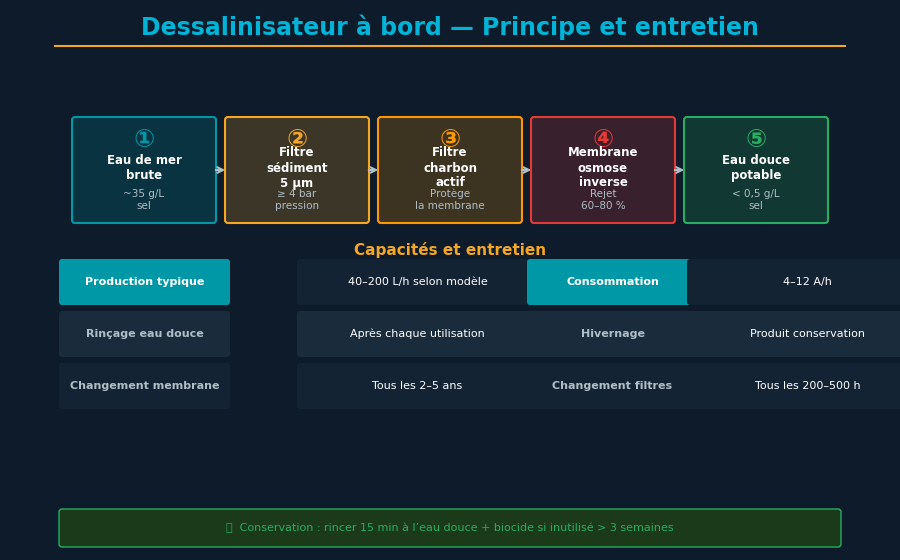
Secret to long watermaker life: rigorous preventive maintenance. RO membranes require constant, filtered water flow. Sand, plankton, organic matter, biofilm drastically reduce lifespan. Three-stage pre-filtration (20, 5, 1 micron) is absolutely essential in coastal, tropical or biologically active zones.
Monthly freshwater flushing after extended navigation sessions recommended by manufacturers. This operates system with stored freshwater to eliminate salt residues and minerals naturally accumulating in plumbing. Some modern systems feature automated rinsing, reducing manual tasks.
Lifespan and Replacement Costs
Well-maintained membranes last 3-5 years depending on intensity. Replacement costs €200-600 per membrane depending on type and brand. Predictable expense integrated into annual boat budget. Pre-filtration filters change every 6-12 months per local water quality and usage intensity.
Create detailed maintenance log in YachtMate tracking every filter replacement with dates and costs. This helps anticipate expenses and keep system in permanent optimal condition.
Electrical Installation and Integration
Typical Installation Schematic
Proper sequence: seawater → 20µm filter → 5µm carbon → 1µm filter → high-pressure pump → RO membrane → tank. Check valve after membrane. Pressure gauge monitoring (800-900 bars normal operation).
Electrically: dedicated breaker 20A minimum, robust wiring (gauge per max current), ideally pure sine wave inverter 220V capability for 24V battery systems. Progressive pump startup preferred to avoid battery and alternator stress from current spikes.
Safety and Seawater Leak Prevention
Properly functioning systems never leak seawater onboard. Check fittings regularly. Optional alarm system alerts pressure anomalies. Winterization: drain completely and leave dry.
Complete Budget: Equipment, Installation and Annual Maintenance
Quality RO system: €3500-8000 complete turnkey. Professional installation: €500-1500 depending on boat complexity. Annual maintenance: €300-600 (filters, rinse fluids, checks). Over 10 years regular use, justified investment for 12m+ cruiser.
Small coastal sailboat: Katadyn manual (€1500-2500) suffices, offering independence with moderate physical effort.
Conclusion: Choosing the Right Watermaker for Your Sailing
Watermaker selection is personal decision depending on sailing style, boat size, energy budget and future ambitions. Offshore or extended tropics: essential. Regional coastal cruising: small system may suffice. Regardless, build quality and maintainability trump initial purchase price.
Practical Experience and Continuous Learning
Experience accumulated over time becomes your best teacher in this specific domain. Every voyage, every challenge encountered contributes to your personal expertise. Systematically document your observations, solutions discovered, and results to create valuable knowledge base for future sailing adventures.
Sharing Experience with Community
The sailing community is generally welcoming and generous with sharing experiences and knowledge. Joining specialized forums, online discussion groups, or attending sailor gatherings enables exchanging with other enthusiasts and learning from their respective experiences. This mutual exchange significantly enriches your understanding and practical skills.
Continuous Training and Educational Resources
Maritime field constantly evolves with regular technology innovations, regulatory modifications, and discovery of better practices. Investing in continuing education—through formal courses, specialized readings, or technical webinars—keeps you updated and significantly improves your safety and overall navigation competence.
Integration with Other Onboard Systems
Modern boat systems function not in isolation but as part of integrated ecosystem where each component interacts with others. Understanding these interconnections proves crucial for optimizing overall performance and troubleshooting effectively when problems arise.
Compatibility and Interactions
Before adding new equipment or system, carefully verify compatibility with existing installations. Conflicts between systems cause unexpected malfunctions, energy efficiency loss, or even material damage. Meticulous planning during design phase prevents many costly future complications.
Long-Term Budget Planning
Managing boat budget requires long-term vision and strategic planning. Beyond immediate operational costs, anticipate future equipment replacements, technology updates, and major maintenance predictable as boat ages. Proper planning prevents emergency funding crises and reduces financial stress significantly.
Expense Optimization
Seek opportunities reducing costs without compromising quality or safety. This includes group purchasing with fellow sailors, negotiating with regular suppliers, rigorous preventive maintenance avoiding costly repairs, or researching equivalent alternatives at better market prices.
Advanced Technical Deep Dives
Understanding advanced technical aspects helps you maximize system performance and identify issues before they become serious problems. Technical knowledge empowers you to make informed decisions about upgrades, modifications, and troubleshooting procedures that could save thousands in unnecessary repairs.
Pressure and Performance Metrics
Monitoring key performance indicators—pressure gauges, flow rates, temperature variations, and efficiency percentages—provides insight into system health. Regular baseline measurements allow detecting gradual degradation before complete failure occurs. Most experienced sailors maintain detailed logbooks tracking these metrics monthly, creating historical trends useful for predictive maintenance planning.
Common Failure Patterns and Prevention
Certain components fail in predictable patterns based on usage frequency, environmental conditions, and maintenance quality. Learning these patterns helps you replace components preventively before failure, avoiding emergency situations far from qualified help. Vibration, temperature changes, and water quality variations all contribute to accelerated wear of specific components.
Environmental and Sustainability Considerations
Modern sailing increasingly emphasizes environmental responsibility and sustainability. Understanding ecological impact of your practices and equipment choices aligns sailing with contemporary values and often proves economically beneficial through reduced waste and efficient resource usage.
Waste Minimization Strategies
Implement practices reducing material waste aboard and marine environment impact. Proper disposal of used oil, batteries, and other hazardous materials protects fragile marine ecosystems. Many cruising destinations now have marinas and waste collection facilities specifically supporting environmentally conscious sailors, making sustainable practices increasingly practical and supported.
Future Technology and Innovations
Marine technology evolves rapidly with increasingly sophisticated systems becoming standard. Stay informed about emerging technologies—lithium batteries, advanced sail materials, automated systems, renewable energy solutions—to understand future possibilities for enhancing comfort, safety, and efficiency of your sailing adventures. Early adoption of promising technologies can provide competitive advantages and improved experiences.
Navigate More Independently with YachtMate
YachtMate helps document water consumption, watermaker maintenance and energy autonomy.
Discover YachtMate →