
You have surely noticed it in summer: the morning is calm, the sea like glass, then around midday a light wind picks up from offshore, builds through the afternoon and dies away at sunset. This is no meteorological coincidence — it is the thermal breeze, a local wind driven by the temperature difference between land and sea. Understood properly, it becomes the boater's best ally: a steady, predictable wind, perfect for going sailing. Misjudged, it ruins an anchorage or turns the run back to port into an ordeal. Here is how it works and how to make the most of it.
What is a thermal breeze?
A thermal breeze is a coastal wind born solely from the difference in heating between land and water. Land warms up and cools down far faster than the sea: that is the whole engine of the phenomenon. When two neighbouring surfaces are at different temperatures, the air above them has different densities, and that pressure difference sets the air in motion.
The result is a wind that reverses twice a day: it blows from sea to land during the day (the sea breeze) and from land to sea at night (the land breeze). It is a local wind, rarely exceeding 15 to 20 knots, extending only a few miles either side of the coastline. It is superimposed on the general wind (the "synoptic" or gradient wind): sometimes it reinforces it, sometimes it cancels it out.
The sea breeze: the engine of summer afternoons
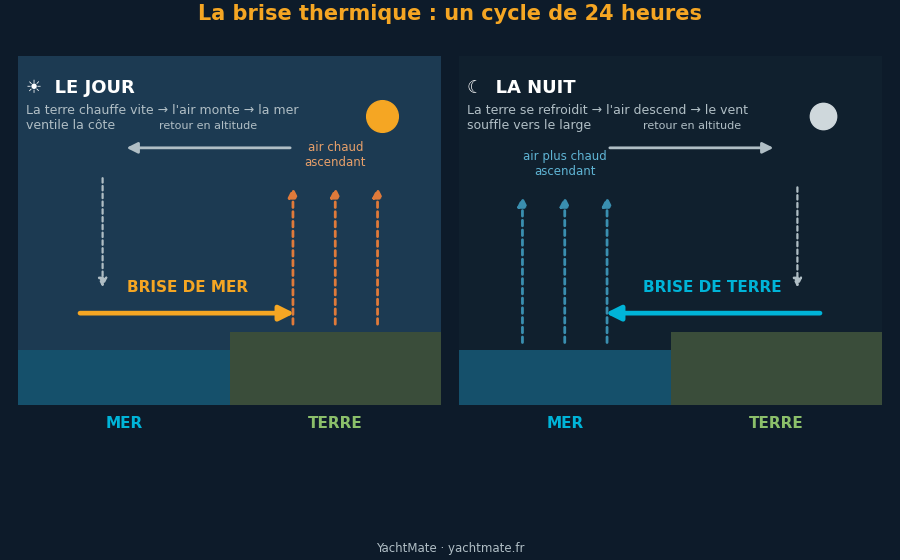
This is the best known and most useful. In the morning, the sun heats the land far faster than the sea. By the middle of the day, the warm, light air above the ground rises. As it climbs, it leaves a zone of lower pressure near the surface. Nature abhorring a vacuum, the cooler, denser air sitting over the sea begins to slide towards the coast to fill the deficit: this is the sea breeze.
Higher up, a return circulation carries air back out to sea, closing the cell. In practice, the sea breeze usually picks up in late morning, reaches its peak in early afternoon (often 10 to 15 knots, sometimes more in fine weather) and fades by the end of the day. It also brings cooler, more humid air — the very wind that makes summer afternoons on the water so pleasant.
The sea breeze is stronger the clearer the sky and the more stable the air mass. A fine anticyclonic spell in summer is the ideal setup: plan your sailing for early afternoon, when the breeze is best established.
The land breeze: the quiet wind of the night
At night the mechanism reverses. The land, with no sun to warm it, cools rapidly by radiation, while the sea retains the heat accumulated during the day. The water becomes "warmer" than the land. The air above the sea rises gently, and the cool air that has settled over the land slides out to sea to replace it: this is the land breeze.
It is almost always weaker than the sea breeze (often 3 to 8 knots), because the temperature gap between land and sea is less pronounced at night. It sets in during the second half of the night and lasts until early morning, before the sun restarts the cycle. For anyone sleeping at anchor near the coast, it is what swings the boat round and freshens the cabin at daybreak.
A typical daily cycle
On a fine anticyclonic summer day, with no marked general wind, the thermal breeze follows a very regular rhythm. Here are indicative times for our latitudes (they vary with season, region and the nature of the shoreline):
| Time | Phenomenon | Typical wind |
|---|---|---|
| Dawn – 9 am | Calm, land breeze fading away | 0–5 knots |
| 10 am – noon | Sea breeze establishing | 5–10 knots |
| 1 pm – 5 pm | Sea breeze at its peak | 10–18 knots |
| 6 pm – 9 pm | Weakening, return to calm | 5–0 knots |
| Night – early morning | Land breeze | 3–8 knots |
One further subtlety: the sea breeze does not always blow exactly perpendicular to the coast. Through the afternoon its direction gradually veers (clockwise in the Northern Hemisphere) under the Coriolis effect. A detail that matters when adjusting your course and trim.
Recognising and anticipating the breeze
A few signs let you predict a good thermal breeze without complex calculations:
- A clear morning sky over the land: a sign the ground will heat up well.
- A calm anticyclonic setup, with no strong synoptic wind to mask the breeze.
- The appearance of small cumulus clouds over the land at midday: they mark the rising warm air and often herald a well-established breeze.
- A strong temperature contrast between coastal air and the sea: the bigger the gap, the more sustained the breeze.
Be wary of "average" wind forecasts that smooth out the local phenomenon. A bulletin announcing 5 knots may well hide a 15-knot sea breeze in the afternoon. Always cross-check the general forecast with your reading of the sky and local experience.
Using the breeze under sail
For a sailing boat the thermal breeze is a gift: a clean, steady wind that picks up at just the right moment. A few principles to make the most of it:
- Head out with the building breeze: leave around midday as it sets in rather than early in the morning calm.
- Anticipate the veer: since the direction shifts through the afternoon, plan your return route accordingly so you don't end up beating hard against the breeze.
- Get back before it drops: the breeze dies at the end of the day. Avoid planning a long return leg at 8 pm or you'll finish under engine.
- Under power or fishing, enjoy the morning calm and flat water before the breeze raises a chop.
For harbour and anchoring manoeuvres, remember the boat will lie to the sea breeze in the afternoon, then to the land breeze at night: you and your neighbour will swing together, but always check your swinging room remains safe through the nighttime reversal.
Pitfalls to know
The thermal breeze remains a local and fickle phenomenon. Three classic pitfalls:
1. Reinforcement against the general wind. When the sea breeze adds to a synoptic wind from the same direction, you can reach 25 knots and a heavy chop within a few hours, even though the morning was peaceful. A great classic of the Mediterranean gulfs.
2. Cancellation. Conversely, a general wind blowing from land to sea can prevent the breeze from establishing: the day then stays soft despite the fine weather.
3. The abrupt evening shift. The change from sea breeze to calm, then to land breeze, can catch a tired crew off guard: sails flogging, the boat lying beam-on at anchor. Anticipate it.
The thermal breeze is summer's gift to those who can read it: a reliable, clean wind. But it remains local: two headlands a few miles apart can experience very different breezes on the same day.
In short, the thermal breeze rewards observation. Learn the rhythm of your stretch of water, note the times of the shifts and the strength reached on different days: over time you will anticipate the wind better than any national bulletin.
Anticipate local weather with YachtMate
YachtMate combines the marine forecast, your favourite anchorages and your logbook to plan every outing as close as possible to real conditions. Free.
Discover YachtMate