

Seasickness — or marine motion sickness — is undoubtedly one of the most feared issues among beginner sailors, and it can even affect experienced mariners. It can ruin an idyllic outing in minutes, transforming an enthusiastic crew into prostrate passengers, and puts many people off sailing altogether. Yet effective solutions exist: preventive medications, natural remedies, on-board positioning strategies, and mental preparation. With the right knowledge, it is entirely possible to overcome — or at least manage — seasickness.
Understanding seasickness: why does it happen?
Seasickness is a form of motion sickness, just like car sickness or airsickness. It is caused by a sensory conflict between what your eyes see and what your inner ear (the vestibular system) feels. When you are below deck on a sailing boat, your eyes see a stable environment, but your inner ear detects the boat's movements — rolling, pitching, yawing. This disagreement triggers a cascade of neurological responses: nausea, dizziness, pallor, cold sweats, and vomiting.
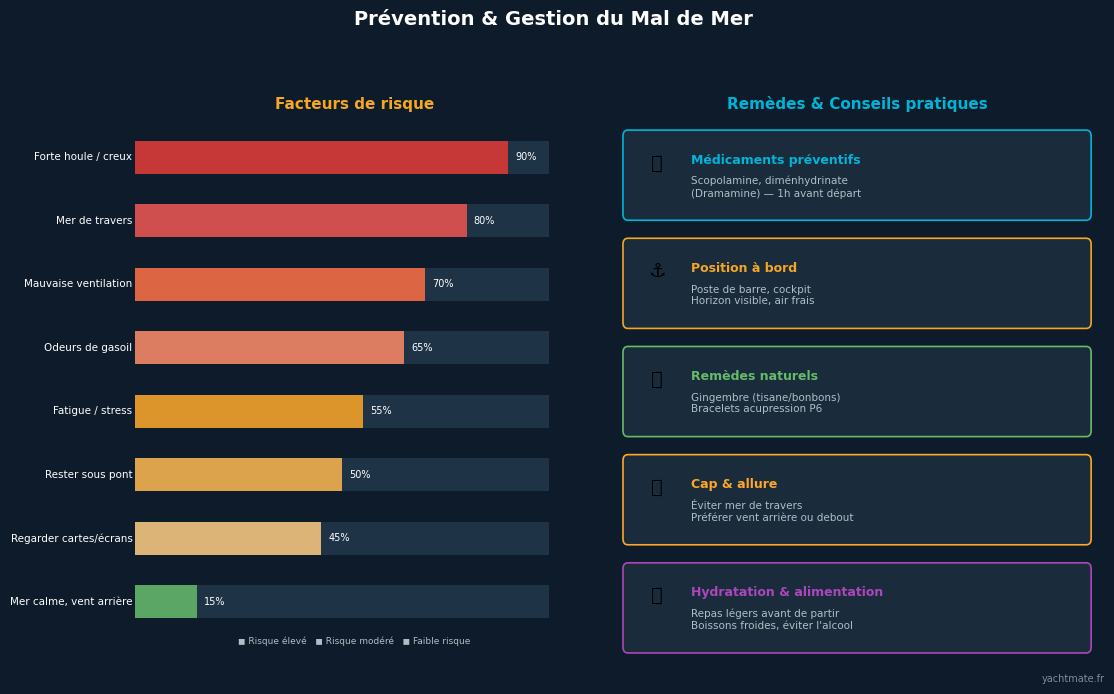
Some people are naturally more susceptible, depending on their neurological wiring. Women are statistically more affected, as are children between ages 2 and 12. But healthy adults can also suffer from seasickness, especially in challenging conditions — heavy swell, confused sea, beam seas.
The main aggravating factors
- Beam seas (swell hitting the boat from the side) are the most physically draining
- Staying below deck or in the cabin, away from the horizon
- Reading or looking at charts, phones or tablets while underway
- Strong smells: diesel, greasy cooking, paint, tobacco
- Fatigue, stress and anxiety before boarding
- An empty or overly full stomach
- Dehydration or excess alcohol the night before
Before leaving port, check the weather forecast in the YachtMate app. A sea with swells of 1.5 m or more warrants preventive medication, especially for inexperienced crew members.
Antimotion medications: when and which ones?
Pharmacology offers several proven solutions against seasickness. The key point is to take them before symptoms appear, because once nausea has set in, oral medications are far less effective — and nearly impossible to swallow.
Dimenhydrinate (Dramamine, Gravol)
This is the most widely used antihistamine for motion sickness. Take it approximately 30 minutes to 1 hour before departure. It causes drowsiness in many people — which can be an advantage for night passages but a disadvantage for racing or for the helmsman. The usual dose is 50 mg every 6 to 8 hours. A children's version is available for those aged 2 and over.
Scopolamine patch (Transderm Scop)
The transdermal scopolamine patch is considered one of the most effective solutions for longer passages. Apply it behind the ear at least 4 hours before departure; it works for up to 72 hours. Possible side effects include dry mouth, mild drowsiness and slight blurred vision. It is contraindicated in people with glaucoma and requires a prescription in many countries.
Prochlorperazine (Stemetil) and promethazine (Phenergan)
These prescription medications are particularly useful when nausea has already started. Promethazine suppositories are very practical when seasickness is already established and swallowing tablets is difficult. They are a staple of offshore race first-aid kits.
Natural remedies: effective or placebo?
For those who prefer to avoid medications, or wish to combine approaches, several natural solutions have proven helpful among sailors.
Ginger
A well-known medicinal plant, ginger has the strongest scientific evidence of any natural remedy for motion sickness. Take it as a herbal tea before departure, in capsules (500 mg, 30 min before), as sweets or candies, or freshly grated in hot water. Its effect is less powerful than synthetic drugs, but it may be sufficient in moderate sea conditions.
Acupressure wristbands
Sea-Band wristbands apply pressure on the P6 acupuncture point (Nei Kuan), located about three finger-widths from the wrist. Several studies have shown their effectiveness in reducing mild to moderate nausea. They are contraindication-free, drug-free and can be worn alongside other remedies.
Gradually acclimatise to the sea
The best long-term strategy is progressive exposure. Start with short outings (2–3 hours) in calm weather. Gradually increase duration and conditions. The brain learns — over repeated passages — to reconcile the conflicting signals from the visual and vestibular systems. Most sailors who thought they could never handle the sea have overcome motion sickness through regular, progressive outings.
Dehydration makes seasickness worse. Always bring fresh mineral water, isotonic drinks and plain crackers on board. Avoid very rich or spicy meals the evening before and the morning of departure.
Position and behaviour on board: the first medicine
Before any treatment, certain habits on board can significantly reduce the risk of seasickness.
Stay in the cockpit, facing the horizon
The golden rule: stay in the fresh air, on deck, looking at the horizon. The cockpit is the best place on the boat for a motion-sensitive passenger. A fixed horizon gives the brain the visual reference it needs to reconcile vestibular signals. Below deck, this reference disappears and the sensory conflict intensifies rapidly.
Choose the right point of sail
If you can influence it, avoid beam seas. A following wind or a head-on sea is generally less uncomfortable for sensitive crew. On a sailing boat, a broad reach with a regular swell on the stern is often well-tolerated. A hard beat in steep head seas can be difficult even for seasoned sailors.
Stay active
Helming, managing sails, keeping watch — these activities occupy the brain and reduce focus on nausea. Inactive passengers lying below deck are the first victims. Involve your crew in sailing tasks as much as possible.
Seasickness is never a fatality. The vast majority of sailors who thought they could never navigate have succeeded in overcoming motion sickness with the right preparation and progressively longer passages.
What to do when seasickness has already set in?
- Get on deck immediately and settle in the cockpit, facing the horizon
- Administer a fast-dissolving medication (oral lyophilisate, suppository) or apply a patch if not already worn
- Give cold water in small sips and plain crackers
- Have them take the helm if their condition allows — this often improves things quickly
- Eliminate strong smells: move away from the engine, close hatches if cooking
- For repeated vomiting: hydrate regularly and watch for signs of severe dehydration
- If no improvement after 2–3 hours: consider changing course or heading to the nearest port
🧭 Plan your passages with YachtMate
Check real-time marine weather forecasts, plan your routes and anticipate sea conditions — directly from your smartphone. Fewer surprises at sea, more fun on board.
Download YachtMate for free